
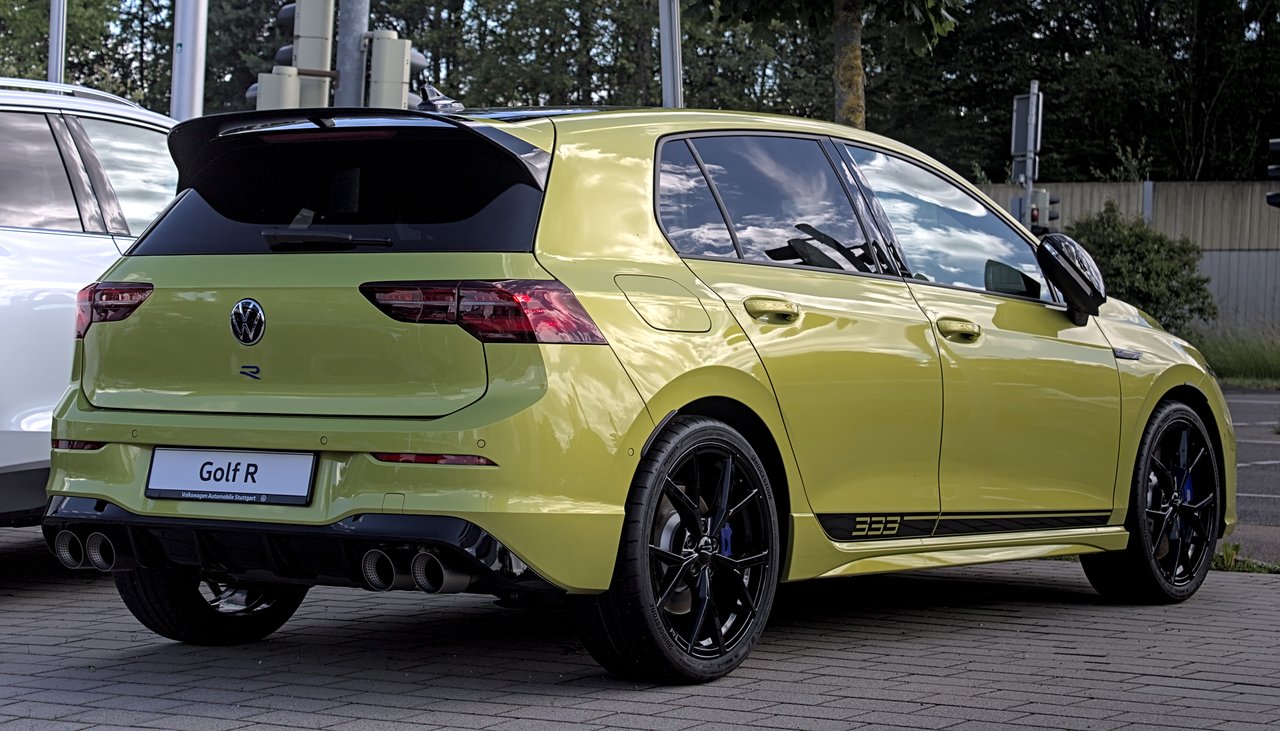
Photo via Wikimedia Commons under CC BY-SA 4.0 license.
The Benchmark Refined: Engineering the 2025 Volkswagen Golf R Mk8.5
When Volkswagen launched the Mk8 Golf R in 2021, its mechanical capability was never in question. Armed with an innovative torque-vectoring rear axle, it transformed Wolfsburg’s flagship from an understeer-prone autobahn missile into a genuine, corner-carving scalpel. Yet, the car was hobbled by an interior execution that felt like an unforced error: unlit climate sliders, sluggish software, and haptic steering wheel buttons that misfired during spirited heel-and-toe or mid-corner adjustments.
The Mk8.5 facelift represents Volkswagen in full listening mode. It is not merely a styling nip-and-tuck; it is a calculated mechanical and ergonomic redemption. By elevating the EA888 engine output to match celebrated European specials like the Golf R 333, rectifying the human-machine interface, and refining dynamic software logic, Volkswagen has built the definitive everyday performance car for the internal-combustion twilight.
Powertrain Architecture: Extracting 333 PS from the EA888 evo4
At the mechanical core of the Mk8.5 Golf R sits the fourth-generation EA888 (evo4) 2.0-liter direct-injection turbocharged four-cylinder. For this mid-cycle revision, Volkswagen engineers recalibrated the engine management software, raised boost parameters, and altered thermal control logic to deliver 333 PS (328 hp / 245 kW) from 5,600 to 6,500 rpm. Peak torque swells to 420 Nm (310 lb-ft), sustaining a massive plateau from 2,100 all the way to 5,500 rpm.
The evo4 architecture incorporates a cylinder head with an integrated, water-cooled exhaust manifold running straight into the turbocharger housing. This layout shortens the gas flow path to spin the turbine wheel with minimal energy loss while keeping exhaust gas temperatures controlled under sustained wide-open throttle loads. Fuel delivery combines both high-pressure direct injection (operating up to 350 bar) and multi-port injection to balance emissions under partial load with outright cylinder charge cooling at maximum boost.
Crucially, the Mk8.5 adopts an anti-lag pre-loading function for the turbocharger first seen on the anniversary editions. During constant-speed driving or overrun in the more aggressive drive modes, the electronic throttle valve stays open while the ignition timing is retarded, cycling air through the combustion chambers to keep the turbine spinning. Step back on the throttle, and boost threshold latency is effectively erased, yielding immediate throttle response out of apexes.
Power routes exclusively through a seven-speed dual-clutch transmission (DSG, code DQ381). The six-speed manual gearbox has been permanently retired globally due to emissions compliance constraints and packaging limitations with the latest electronic driver-assist architectures. The DSG’s shift mapping has been tightened; upshifts in Race and Special modes execute with a deliberate clutch-overlap snap, reducing shift interruption to negligible milliseconds.
Exhaust scavenging and acoustic presence can be augmented via an optional factory Akrapovič titanium cat-back exhaust system. Weighing roughly seven kilograms less than the standard stainless-steel assembly, this setup integrates active exhaust valves controlled by vehicle dynamics software, shifting from quiet highway cruising to an unbaffled, authentic five-figure-rpm gravelly bark without artificial cabin synthesizers.
Chassis Kinematics and R-Performance Torque Vectoring
Straight-line velocity has always been easy to achieve; corner exit agility is where the Mk8.5 distinguishes itself. The foundation remains Volkswagen's MQB Evo platform, utilizing a MacPherson strut front axle pinned to a rigid aluminum subframe and a four-link independent rear suspension. Negative camber on the front axle sits at a purposeful 1.3 degrees, engineered via bespoke steering knuckles to maximize the tire contact patch when loaded laterally.
The centerpiece of the drivetrain remains the R-Performance Torque Vectoring rear differential. Rather than relying on a traditional rear differential with a single Haldex-style central multi-plate clutch, the Golf R employs a rear drive unit equipped with two independent, electronically controlled multi-plate clutch packs—one for each rear half-shaft.
This layout allows the Golf R to vary torque distribution not just between the front and rear axles (up to 50 percent directed rearward), but laterally across the rear axle itself. In hard cornering, the system routes up to 100 percent of the rear axle's torque to the outside rear wheel. This creates a mechanical yaw moment around the vertical axis, actively tucking the nose into the apex and eliminating entry and mid-corner understeer before standard stability control intervention is required.
All chassis hardware communicates through a central brain: the Vehicle Dynamics Manager (VDM). The VDM networks the rear differential clutches, the XDS electronic differential lock (brake-based torque vectoring on the front axle), and the Dynamic Chassis Control (DCC) twin-valve adaptive dampers. Reading steering angle, wheel speed, and lateral acceleration 200 times per second, the DCC dampers adjust individual compression and rebound rates within milliseconds across 15 selectable firmness settings.
Braking hardware matches the car's dynamic ceiling. The front axle utilizes 357 mm x 34 mm ventilated, cross-drilled steel discs pinned to cast aluminum hubs. These pin-disc rotors expand symmetrically under high thermal loads without warping, shedding unsprung mass while clamped by rigid two-piston aluminum calipers.
Track-Tested: Special and Drift Dynamic Modes
Selecting the R-Performance package unlocks two specialized drive modes engineered for distinct scenarios: "Special" and "Drift."
Special mode was honed specifically on the undulating, camber-shifting tarmac of the Nürburgring Nordschleife. Modern hot hatches often fail at the Green Hell by relying on track-stiff suspension setups that cause tires to skip over curbs and compressions. Special mode pairs the engine’s sharpest throttle maps, lightning DSG shifts, and full rear-biased torque-vectoring logic with a softer, compliant damper profile. This compliance allows the chassis to breathe with the road, keeping the Michelin Pilot Sport Cup 2 or Goodyear Eagle F1 SuperSport tires keyed into uneven pavement without snapping sideways over crests.
Drift mode alters the VDM's governance entirely. By setting the electronic stability control to ESC Sport or ESC Off, the rear differential clutches pre-load the outside rear wheel with maximum torque upon corner entry. Combined with deliberate steering input and throttle aggression, the car breaks rear traction smoothly, holding a progressive, easily metered drift angle that defies standard front-biased AWD conventions.
Cockpit Overhaul: Eradicating the Mk8's Flaws
Inside, the Mk8.5 addresses virtually every operational complaint leveled at its predecessor. Dominating the dash is a new 12.9-inch freestanding touchscreen powered by Volkswagen's fourth-generation modular infotainment matrix (MIB4). The operating system has been overhauled from the silicon up, featuring a permanent top bar for quick system toggles and an anchored lower climate control strip.
Crucially, the capacitive touch sliders beneath the central screen for cabin temperature and volume are now backlit, making nighttime adjustments intuitive rather than infuriating. Behind the thick-rimmed, flat-bottom steering wheel lies the definitive upgrade: the fiddly, hyper-sensitive capacitive touch spokes of the Mk8 have been discarded in favor of tactile physical buttons. Drivers can now grip the wheel during high-G maneuvers without accidentally triggering the heated steering wheel or cycling instrument displays.
Volkswagen Golf R Mk8.5 Specifications
| Specification Parameter | Technical Data |
|---|---|
| Engine Type | 2.0-liter (1,984 cc) EA888 evo4 Turbocharged Inline-4 |
| Bore x Stroke | 82.5 mm x 92.8 mm |
| Compression Ratio | 9.3:1 |
| Peak Power Output | 333 PS (328 hp / 245 kW) @ 5,600–6,500 rpm |
| Peak Torque | 420 Nm (310 lb-ft) @ 2,100–5,500 rpm |
| Transmission | 7-speed transverse wet dual-clutch (DSG DQ381) |
| Drivetrain Layout | 4MOTION AWD with R-Performance Torque Vectoring |
| Acceleration (0–100 km/h) | 4.6 seconds (4.4 seconds with Launch Control tested) |
| Top Speed | 250 km/h (electronically limited) / 270 km/h (Performance Pack) |
| Curb Weight (DIN) | 1,545 kg (3,406 lbs) |
| Brakes (Front / Rear) | 357 mm cross-drilled pin-discs / 310 mm solid discs |
| Dimensions (L x W x H) | 4,290 mm x 1,789 mm x 1,458 mm |
| Wheelbase | 2,631 mm |
| Base Price (Germany / Est. US) | €53,795 / ~$47,500 USD |
Market Positioning and Key Competitors
The Golf R Mk8.5 arrives in both standard hatchback form and as the long-roof Golf R Variant estate (retained for the European market). A menacing "Black Edition" variant also debuts, integrating blackened badges, brake calipers, 19-inch Estoril forged alloy wheels, and standard fitment of the Performance Pack.
In the contemporary performance hierarchy, the Golf R occupies a unique niche:
- Honda Civic Type R (FL5): The purist’s benchmark. The Honda offers superior manual shift action, lighter curb weight, and telepathic steering feedback, but sacrifices all-weather traction and daily refinement compared to the Golf.
- Audi S3: Shares the exact same 333 PS EA888 powertrain and rear torque splitter, but packages it in a traditional sedan form factor with a slightly more muted chassis balance and higher MSRP.
- BMW M135 xDrive / Mercedes-AMG A35: German rivals that rely on simpler, front-biased all-wheel-drive systems using conventional single-clutch rear differentials. They lack the rear-axle adjustability and track agility unlocked by the Golf R's twin-clutch layout.
Frequently Asked Questions (FAQ)
Can you buy the Mk8.5 Golf R with a manual transmission?
No. Volkswagen discontinued the manual gearbox for the Golf R globally after the 2024 model year. Every Mk8.5 leaves the factory paired exclusively with the seven-speed DQ381 dual-clutch transmission, which enables faster acceleration times, better fuel economy parameters, and integration with the latest driver assistance and emissions suites.
How does the torque-vectoring rear axle differ from standard 4MOTION?
Standard 4MOTION (found on the Tiguan or previous Golf models) utilizes an electronically controlled central Haldex clutch on the rear differential input shaft, which can send power front-to-back but relies on braking individual slipping wheels laterally. The Golf R's R-Performance system uses two wet multi-plate clutches directly on the rear axle shafts. This allows continuous, mechanical torque allocation side-to-side, overdriving the outside rear wheel to actively yaw the chassis through corners.
Is the optional Akrapovič exhaust worth the added investment?
For track day regulars and sound enthusiasts, yes. Beyond shedding seven kilograms of mass behind the rear axle, its titanium construction changes the exhaust note frequency, delivering a deeper, more mechanical tone under throttle and pronounced, natural overrun crackles without the artificial sound-aktor buzzing inside the cabin.
The Verdict: Engineering Realized
The Mk8.5 Volkswagen Golf R represents the complete realization of a performance concept that fell just short of perfection three years ago. By retaining its exceptional torque-vectoring all-wheel-drive system and mating it to 333 PS of refined, lag-free turbo propulsion, Volkswagen has preserved its point-to-point cross-country pace. More importantly, by restoring mechanical buttons to the cockpit and fixing the software stack, Wolfsburg has cleared away the interface frustrations, crowning the Golf R Mk8.5 as the undisputed king of everyday, all-weather performance hatchbacks.
Sources and editorial note
Specifications, performance numbers, pricing, and technical measurements in this feature are based on official manufacturer documentation, engineering releases, and certified automotive benchmarks. Real-world parameters may vary based on market specifications and testing conditions.
The featured lead image is sourced from Wikimedia Commons under Creative Commons licensing with proper attribution. Editorial reporting complies with international copyright and fair-use standards.