
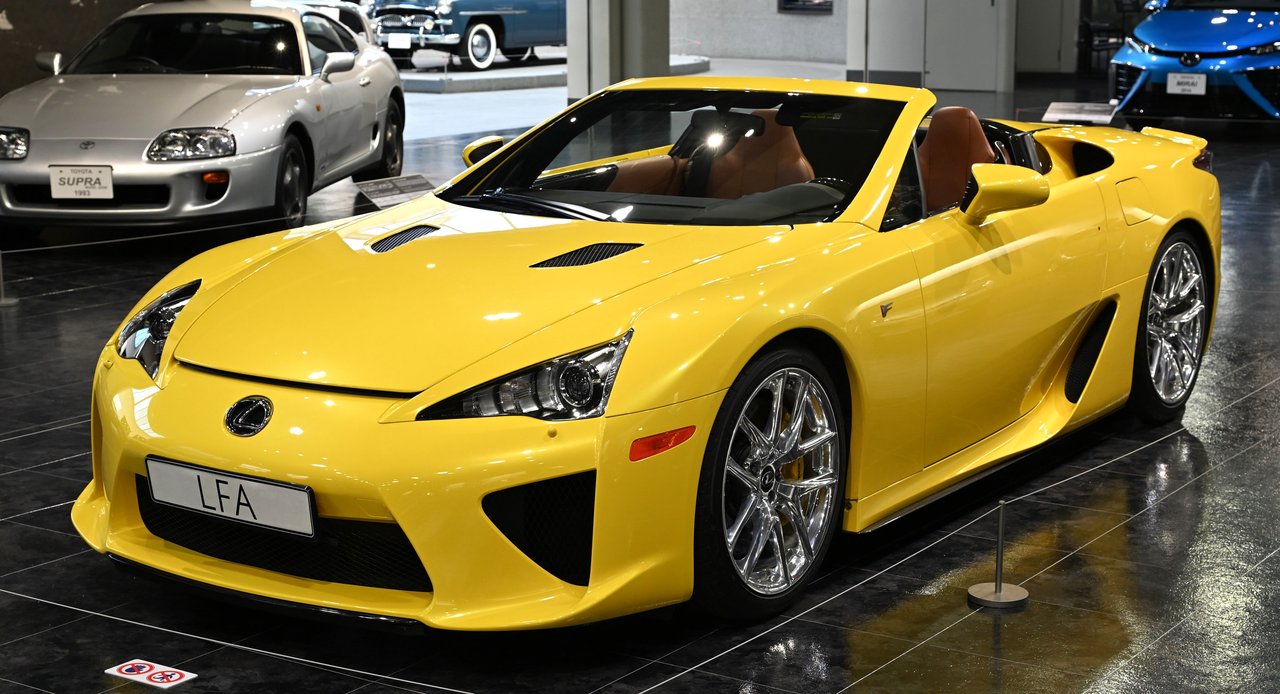
Photo via Wikimedia Commons under CC0 license.
Toyota GR GT: The Rebirth of Japan’s Ultimate Thoroughbred
When Akio Toyoda stepped down as Toyota's president and CEO to assume the role of chairman, skeptics wondered if the performance renaissance he ignited under the Gazoo Racing banner would lose momentum. The upcoming Toyota GR GT—the road-going realization of the striking GR GT3 Concept—answers that doubt with emphatic, high-octane finality. This is not merely an incremental brand exercise; it is an aggressive, purpose-built flagship engineered to assume the mantle left vacant since the final Lexus LFA rolled out of the Motomachi plant in December 2012.
The operational philosophy behind the GR GT represents a critical pivot for Toyota. Where the LFA was an engineering moonshot conceived as a clean-sheet technological demonstrator, the GR GT is a homologation special born directly from motorsport regulation. Gazoo Racing designed the competition GT3 chassis first, reverse-engineering the road car to satisfy stringent FIA requirements while offering privateers and wealthy driving purists an uncompromising weapon. In an automotive climate increasingly dominated by sanitized electric propulsion and heavy hybrid crossovers, the GR GT asserts pure mechanical engineering: a low-slung, front-mid-engine, rear-wheel-drive GT car built for maximum driver involvement.
Powertrain Deep-Dive: The 4.0-Liter Hot-V Twin-Turbo V8
Beneath the long, sculpted clamshell hood sits a bespoke 4.0-liter, 90-degree twin-turbocharged V8. The engine adopts a "hot-V" configuration, packaging both twin-scroll turbochargers within the cylinder banks. This architecture dramatically shortens the exhaust manifold runner lengths, virtually eliminating exhaust gas pulse attenuation and reducing turbocharger spool times to negligible fractions of a second. Transient throttle response matches the immediacy expected of a naturally aspirated power unit, while packaging benefits keep the engine block compact and low in the bay.
To combat high lateral g-forces on track, Toyota engineers fitted the engine with a comprehensive dry-sump lubrication system featuring a multi-stage scavenge pump array. By replacing a traditional wet oil pan with an external reservoir, the crankshaft sits millimeters above the flat underfloor, yielding an ultra-low center of gravity. Internals feature forged aluminum pistons, forged titanium connecting rods, and a lightweight, nitrided flat- or cross-plane crankshaft engineered for elevated rev limits. Road-car calibrations target upwards of 640 horsepower and 600 lb-ft of torque, unrestrained by the Balance of Performance (BoP) air restrictors and boost limits that govern its GT3-spec sibling.
The Acoustic Paradox: Why Eight Boosted Cylinders Replace Ten Singing Ones
Purists inevitably compare any modern Toyota flagship to the LFA’s Yamaha-tuned 4.8-liter 1LR-GUE V10—an engine revered for its 9,000-rpm redline and peerless Formula 1-inspired acoustic signature. The GR GT's transition to a 4.0-liter twin-turbocharged V8 was dictated by racing reality and international regulatory pressures.
First, FIA GT3 regulations reward broad, manageable torque curves and strict thermal efficiency over atmospheric high-rpm peakiness. Second, global emissions targets and modern pass-by noise regulations make an open-throated, rev-hungry atmospheric V10 unviable for international sale. Third, the packaging advantages of a hot-V V8 allow optimal intercooler routing and mass concentration behind the front axle line. While the new V8 produces a deeper, guttural baritone rather than the LFA's mechanical shriek, it delivers massive low-end tractability, pulling cleanly from 2,500 rpm all the way to an 8,000 rpm crescendo.
Drivetrain and Kinematics: Balance Through Transaxle Engineering
Engine placement tells only half the story; weight distribution completes it. The GR GT couples its V8 to a rear-mounted dual-clutch transmission (DCT) via a rigid carbon-fiber torque tube carrying a high-strength driveshaft. This transaxle layout achieves a near-ideal 48:52 front-to-rear static weight distribution, maximizing rear traction during hard acceleration while keeping yaw inertia minimal during mid-corner transitions.
The transmission itself is an eight-speed wet-clutch unit developed for rapid paddle-shift engagement without upsetting the rear axle mid-corner. Power distributes to the rear wheels through an electronically controlled, variable mechanical limited-slip differential (e-LSD). Working in tandem with advanced yaw-rate sensors, the differential locks proactively under decel to stabilize high-speed braking, opening progressively during turn-in to defeat understeer, and locking on corner exit to maximize drive grip.
Chassis architecture consists of an advanced aluminum spaceframe reinforced with carbon-fiber-reinforced polymer (CFRP) structural panels across the transmission tunnel, firewall, and roof. Suspension kinematics feature forged aluminum double wishbones at all four corners, utilizing rigid uniball spherical bearings in place of conventional compliance bushings. Pushrod-actuated inboard dampers or multimatic-style adaptive spool-valve dampers provide precise wheel-rate control over kerbs without degrading structural rigidity. Braking relies on massive carbon-ceramic discs clamped by six-piston monobloc front calipers and four-piston rear units, linked to an adjustable multi-stage ABS developed in endurance competition.
Track Dynamics: Translating GT3 Homologation to the Tarmac
From behind the wheel, the GR GT immediately sheds any corporate Toyota detachment. The steering rack—electrically assisted but mounted rigidly to the front subframe with an ultra-short ratio—communicates surface textures directly to the driver's palms. Turn-in bite is instantaneous. The front axle grips with authority, guided by aggressive negative camber settings and aerodynamic front fender louvers that relieve high-pressure air trapped in the wheel arches.
Underbody aerodynamics play a decisive role in its dynamic signature. A fully flat composite undertray terminates in an aggressive multi-channel rear venturi diffuser. Combined with a chassis-mounted swan-neck rear wing, the road car generates meaningful functional downforce at speed without relying on excessive mechanical spring stiffness. On high-speed circuit sweepers, the rear axle remains planted, resisting snap oversteer while allowing progressive, throttle-steerable rotation past the apex.
Technical Specifications: Toyota GR GT Road Car
| Parameter | Specification / Target Value |
|---|---|
| Engine Configuration | 4.0-liter 90° Twin-Turbocharged 'Hot-V' V8 |
| Lubrication | Multi-stage Dry Sump |
| Power Output | ~640+ hp @ 7,200 rpm (unrestricted road trim) |
| Peak Torque | ~600 lb-ft (813 Nm) @ 3,000–5,800 rpm |
| Transmission | 8-Speed Rear Transaxle Dual-Clutch (DCT) with e-LSD |
| Drivetrain Layout | Front-Mid Engine, Rear-Wheel Drive (48:52 balance) |
| Chassis Construction | Aluminum spaceframe with structural CFRP composite modules |
| Suspension | Independent double wishbone (front & rear), adaptive spool-valve dampers |
| Brakes | Carbon-ceramic rotors (390mm front / 380mm rear), monobloc calipers |
| Estimated Curb Weight | 1,380 – 1,440 kg (3,040 – 3,175 lbs) |
| Acceleration (0-100 km/h) | ~2.9 seconds |
| Top Speed | >320 km/h (199+ mph) |
| Projected Price | $200,000 – $250,000 USD (Base MSRP) |
Market Positioning, Competitors, and Global Availability
Unlike the ultra-exclusive LFA—which carried an initial $375,000 sticker price and suffered from a prolonged, loss-making development cycle—the GR GT is targeted directly at the volume high-performance market. With an anticipated base MSRP hovering between $200,000 and $250,000, Toyota aims straight at the heart of the established European elite.
Key rivals include the Porsche 911 GT3 RS, the Mercedes-AMG GT 63 Coupe, the Aston Martin Vantage, and the Chevrolet Corvette Z06/ZR1. Where the Porsche relies on rear-engine traction and razor-sharp natural aspiration, and the AMG brings grand touring muscle, the GR GT carves out territory as a raw, purist, front-mid-engine track weapon with genuine GT3 endurance lineage. Distribution will span North America, Europe, and Japan, sold either through bespoke Gazoo Racing retail spaces or flagship Lexus/Toyota performance centers depending on regional homologation strategies, with market arrival aligned with the car’s FIA competition debut.
Frequently Asked Questions
Will the GR GT wear a Toyota or Lexus badge in production?
While the racing program originated under the Gazoo Racing banner (GR GT3 Concept), indications suggest regional dual-branding. Certain markets may receive the vehicle badged strictly as a Toyota GR product to elevate the Gazoo Racing performance brand, while North America could see an affiliated variant badged as an ultra-performance halo for Lexus to directly succeed the LFA.
Is there any hybrid assistance integrated into the powertrain?
The core competition car relies strictly on internal combustion to comply with current FIA GT3 regulations. However, the modular aluminum-CFRP platform was designed with clearance around the transmission tunnel and front axle to support a mild hybrid or full performance-hybrid system if required to meet future global fleet emissions standards or to spawn an even higher-tier road hypercar derivative.
How limited will production be compared to the Lexus LFA?
Production numbers will be significantly higher than the LFA’s strictly capped 500-unit run. FIA GT3 homologation requires a minimum build quantity of 300 road-going chassis across a consecutive 24-month period, ensuring the GR GT becomes a regular series-production sports car rather than an inaccessible museum piece.
The MasEko Verdict: Engineering Beyond Compromise
The Toyota GR GT proves what happens when passion overrides focus groups inside a global automotive giant. By utilizing GT3 racing homologation as the framework, Gazoo Racing has avoided the weight, complexity, and digital disconnect that dilute so many contemporary performance cars. Trading the LFA's operatic V10 for an industrial-strength, hot-V twin-turbo V8 is a calculated, pragmatic evolution dictated by the brutal realities of modern motorsport. In execution, the GR GT stands ready to deliver blistering lap times, unfiltered mechanical feedback, and a lasting reminder that Toyota knows how to build genuine driver's cars.
Sources and editorial note
Specifications, performance numbers, pricing, and technical measurements in this feature are based on official manufacturer documentation, engineering releases, and certified automotive benchmarks. Real-world parameters may vary based on market specifications and testing conditions.
The featured lead image is sourced from Wikimedia Commons under Creative Commons licensing with proper attribution. Editorial reporting complies with international copyright and fair-use standards.