
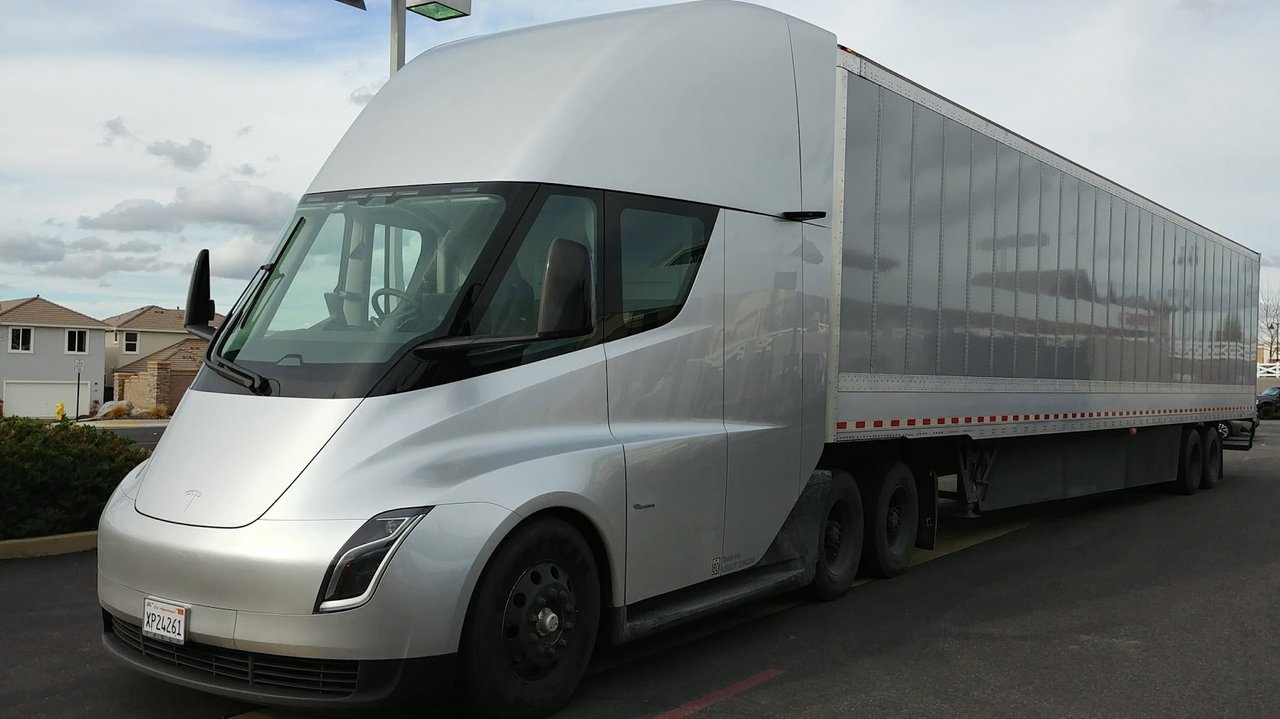
Photo via Wikimedia Commons under Public domain license.
By MasEko
Heavy Metal, Zero Tailpipe: The Tesla Semi Enters Volume Production
The Class 8 over-the-road trucking segment is an unyielding, brutally pragmatic corner of the global economy. Fleet operators do not buy sentiment; they buy total cost of ownership, payload capacity, and uptime. For decades, the Class 8 diesel tractor stood as the undisputed heavyweight champion of this space—loud, soot-belching, but undeniably effective at hauling 82,000 pounds of gross combined weight across transcontinental asphalt. Yet, as smokestacks face mounting regulatory pressure and fuel price volatility continues to squeeze logistics balance sheets, the electric semi-truck has evolved from a Silicon Valley fever dream into an industrial reality.
Following years of pilot fleets operating with heavy-hitting early adopters like PepsiCo, the turning point has finally arrived. In its Q3 2026 corporate update, Tesla confirmed that volume production of the Class 8 Semi is officially underway at its dedicated Nevada facility, boasting an installed annual capacity of 25,000 units. This is no longer a low-volume validation exercise. The electric heavy hauler is stepping into the ring as a mass-produced industrial tool, ready to challenge the diesel hegemony head-on. But beneath the aerodynamic, bullet-train styling lies a radical engineering architecture designed to rewrite the rules of heavy-duty freight hauling.
Powertrain Deep-Dive: Tri-Motor Torque and Megawatt Juice
To move 82,000 pounds of truck, trailer, and cargo up a six-percent mountain grade without dropping below highway speeds, conventional internal combustion requires monstrous displacement, compound turbocharging, and a 12-to-18-speed automated manual transmission that constantly hunts for the optimal power band. Tesla’s approach discards the traditional transmission entirely in favor of an independent, multi-motor layout derived from its passenger car division's high-performance architecture.
Mounted beneath the fifth wheel are three independent rear electric motors delivering a combined nominal output of 800 kilowatts (roughly 1,073 horsepower). Rather than relying on a complex driveshaft and differential setup that bleeds mechanical efficiency, the Semi utilizes a dual-motor rear axle assembly for cruising efficiency and traction management, paired with a third motor that acts as a primary torque source. This configuration allows for torque vectoring across the dual drive axles, vastly improving traction on slick winter overpasses and eliminating the wheel-spin drama typical of single-axle rear-wheel-drive diesel rigs.
Energy storage is handled by an ultra-high-voltage architecture operating well above the standard 400-volt threshold, designed specifically to feed power into the system without melting standard copper wiring harness thickness. The truck is offered in two distinct battery configurations: a Standard Range variant rated for 325 miles at a full 82,000 lbs GCW, and a Long Range variant capable of pushing 500 miles on a single charge. Official operational metrics peg the truck's overall efficiency at an astonishing 1.7 kWh per mile—a figure that defies the sheer aerodynamic drag profile of a frontal area measuring over 100 square feet.
Refueling—or rather, recharging—a battery pack of this magnitude requires infrastructure capable of industrial-scale energy delivery. Enter the Tesla Megacharger network. Operating at peak charging rates of up to 1.2 megawatts, the system uses liquid-cooled charging cables thick as a firefighter's hose to force electrons into the pack. On a high-output Megacharger, the Long Range Semi can replenish its massive battery from empty to 60 percent state-of-charge in approximately 30 minutes, allowing drivers to comply with mandated rest breaks while simultaneously prepping the truck for the next statutory driving block.
Chassis Dynamics and Packaging Architecture
Climbing up into the cab of the Tesla Semi reveals an interior layout that completely breaks with conventional commercial vehicle design. The driver sits dead-center in the cockpit, a layout inspired by motorsport rather than logistics. This centralized command position provides commanding visibility through massive wraparound laminated glass, eliminating the blind spots historically created by traditional A-pillars and wide door mirrors—though camera-based digital mirror systems assist with lane changes.
Despite housing a massive battery pack beneath the floorpan, the Long Range Semi keeps its unladen curb weight down to 23,000 pounds. This is a critical metric for fleet operators; every pound of battery weight directly subtracts from allowable payload capacity under federal bridge formula gross weight limits. By optimizing the structural battery pack casing as an integral load-bearing member of the chassis frame rails, Tesla’s engineers managed to offset the weight penalty traditionally associated with heavy-duty energy storage.
Suspension duties are managed by an electronically controlled air suspension system at all axle points. The front axle utilizes independent unequal-length control arms paired with air springs, replacing the stiff, leaf-sprung beam axles found on legacy trucks. This dramatically subdues cab vibration, protecting sensitive electronics and reducing driver fatigue over long-haul routes. Out back, the drive axles feature dual-stage air leveling to automatically compensate for shifting trailer loads, maintaining precise ride height and optimized aerodynamic rake regardless of whether the trailer is packed with heavy canned goods or light paper products.
Braking is primarily handled by heavy-duty regenerative braking through the tri-motor powertrain. Because the electric motors can harvest kinetic energy and feed it back into the battery pack during deceleration, friction brake wear is drastically reduced. Traditional air brakes are fitted for emergency stops and holding the rig stationary on steep grades, but day-to-day speed scrubbing is managed almost entirely through accelerator pedal modulation—a technique known in the industry as single-pedal driving, translated here to an 41-ton vehicle.
Tesla Semi Specification Sheet
| Metric | Standard Range Trim | Long Range Trim |
|---|---|---|
| Range (at 82,000 lbs GCW) | 325 miles | 500 miles |
| Powertrain | 3 Independent Rear Motors | 3 Independent Rear Motors |
| Peak Power Output | 800 kW (approx. 1,073 hp) | 800 kW (approx. 1,073 hp) |
| Energy Efficiency | 1.7 kWh / mile | 1.7 kWh / mile |
| Curb Weight | ~21,500 lbs (estimated) | 23,000 lbs |
| Max Gross Combination Weight | 82,000 lbs | 82,000 lbs |
| Max Charging Speed | Up to 1.2 MW (Megacharger) | Up to 1.2 MW (Megacharger) |
| Charging Time (0-60%) | ~30 minutes | ~30 minutes |
| Annual Production Capacity | 25,000 units (Nevada Plant) | |
Handling, On-Road Performance, and Fleet Realities
Out on a stretch of interstate or navigating a tight distribution center yard, the dynamic personality of the Tesla Semi is astonishing. Traditional diesel semi-tractors are lumbering beasts that require deliberate, early planning for every maneuver. The Semi, by contrast, responds to steering inputs with sports-car-like immediacy, aided by a low center of gravity born from the flat battery pack bolted directly to the chassis frame.
Acceleration is the most jarring departure from conventional trucking. While a standard diesel rig hauling 80,000 pounds takes a leisurely 45 to 60 seconds to crawl up to highway speeds, the tri-motor Tesla Semi accomplishes the 0-60 mph sprint in roughly 20 seconds under full load. More importantly, its ability to maintain speed up steep mountain inclines—such as the infamous Grapevine grade on Interstate 5—changes the economics of regional hauling. Where diesel trucks drop to 35 mph and back up traffic in the right lane, the Semi holds a steady 65 mph, slicing transit times and eliminating bottlenecks.
Energy recuperation on downhill grades is equally impressive. Instead of cooking mechanical brake pads or relying on noisy exhaust jake brakes, the regenerative system channels massive currents back into the battery pack, effectively acting as an infinite-duty retarder that stabilizes the truck's descent without thermal fade.
Frequently Asked Questions
How does the 23,000 lb curb weight impact payload capacity compared to a diesel semi?
A typical clean-diesel Class 8 sleeper cab weighs between 15,000 and 18,000 pounds. The Long Range Tesla Semi's 23,000 lb curb weight imposes a payload deficit of roughly 5,000 pounds. However, under EPA and federal highway regulations, alternative-fuel trucks are granted a 2,000-pound gross weight exemption, bringing the effective penalty down to about 3,000 pounds. For regional freight routes where trailers frequently cube out (fill up with volume) before they weigh out (reach maximum weight limits), this payload delta has a negligible impact on day-to-day operations.
Can the Tesla Semi be charged at standard public EV charging stations?
While the truck features a CCS combo plug adaptation for emergency top-ups at lower-output commercial DC fast chargers, doing so is fundamentally impractical for daily fleet operations. Pumping energy into a multi-megawatt-hour battery pack at standard 150 kW or 350 kW speeds would take many hours. To achieve commercial viability, the Semi relies strictly on Tesla’s proprietary Megacharger network, which delivers the necessary 1.2 MW currents required for rapid mid-shift turnarounds.
How does the central driving position affect visibility and trailer coupling?
The centralized seating layout takes some initial adjustment for drivers accustomed to traditional left-side cabs, but the ergonomic benefits quickly become apparent. Because the driver sits on the centerline of the vehicle, judging spatial dimensions in tight loading docks and narrow multi-lane highway corridors is significantly more intuitive. For coupling and uncoupling trailers, high-definition exterior cameras feed real-time, zero-parallax views directly to the flanking digital displays inside the cab, making hookups faster and less prone to misalignment.
Conclusion: The Industrial Rubicon Crossed
The transition of the Tesla Semi from low-volume pilot runs to a fully realized production capacity of 25,000 trucks a year at the Nevada facility marks a watershed moment for commercial transport. By engineering a ground-up electric heavy hauler with genuine 500-mile capability, 1.2-megawatt rapid charging, and a tri-motor layout that makes short work of mountain grades, Tesla has stopped talking about the future of freight and started manufacturing it. The diesel semi’s decades-long monopoly is finally facing a serious, high-voltage contender.
Sources and editorial note
Specifications, performance numbers, pricing, and technical measurements in this feature are based on official manufacturer documentation, engineering releases, and certified automotive benchmarks. Real-world parameters may vary based on market specifications and testing conditions.
- https://electrek.co/2026/02/09/tesla-reveals-final-semi-specs-with-two-trims-ahead-of-customer-deliveries/
- https://www.tesla.com/semi
The featured lead image is sourced from Wikimedia Commons under Creative Commons licensing with proper attribution. Editorial reporting complies with international copyright and fair-use standards.