
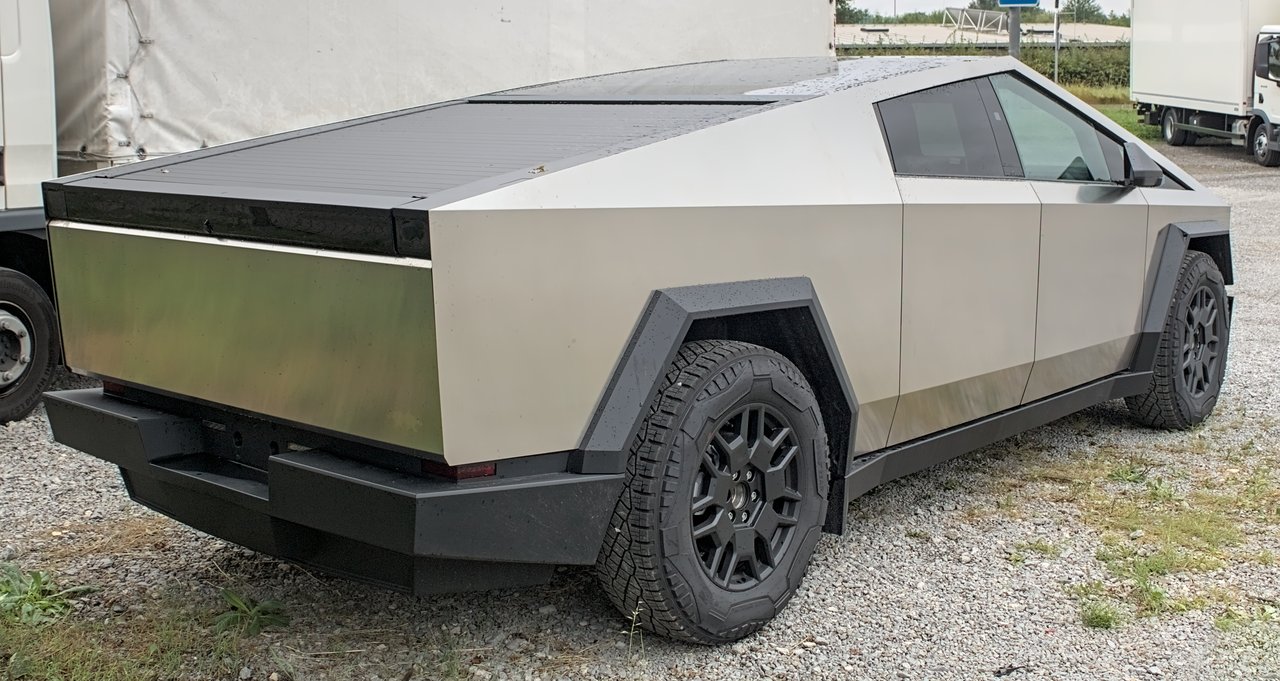
Photo via Wikimedia Commons under CC BY-SA 4.0 license.
The Brutalist Disruptor: Engineering Tesla's 845-Horsepower Cyberbeast
Detroit forged the American pickup on an unwritten covenant: ladder frames, stamped mild steel, rumbling V8s, and cautious generational iteration. Tesla dismantled that eighty-year orthodoxy with a polygon. Yet reducing the Cybertruck Cyberbeast to an internet curiosity or polarizing cultural wedge misses the profound engineering narrative unfolding beneath its unpainted surface. This vehicle represents the most audacious ground-up production re-think since Citroën revealed the hydropneumatic DS in 1955. In flagship tri-motor "Cyberbeast" specification, this machine generates 845 horsepower, rips to 60 mph in 2.6 seconds, and pulls an 11,000-pound trailer. More significantly, it acts as the rolling vanguard for long-stalled electrical and chassis architectures—specifically 48-volt low-voltage networking and mechanical steer-by-wire—that traditional automotive engineering suites have spent three decades archiving as too difficult to commercialize.
Tri-Motor Powertrain: Dissecting the Cyberbeast Architecture
The Cyberbeast ditches the dual-motor layout of the mid-tier Cybertruck for an asymmetric tri-motor configuration designed to balance ballistic straight-line launch forces with high-speed thermal stamina. The front axle houses a single induction motor rated at approximately 276 horsepower. Tesla specifically selected an asynchronous induction unit for the nose because it produces zero parasitic electromagnetic drag when de-energized during steady-state cruising, boosting overall highway efficiency.
The heavy lifting occurs across the rear axle. Here, an integrated drive unit encases two independent Permanent Magnet Synchronous Reluctance (PMSR) motors, each outputting roughly 284 horsepower and paired with dedicated silicon carbide (SiC) power inverters. Combined, the tri-motor system produces an authoritative 845 horsepower (630 kW) and 743 lb-ft of motor shaft torque. Tesla quotes an eye-watering 10,296 lb-ft of wheel torque, achieved through single-speed reduction gearing multiplying mechanical advantage at the hubs.
Engage "Beast Mode," and the thermal management system aggressively preconditions the pack, dropping cell temperatures to maximize current draw. Active cooling circuits direct refrigerant through the octovalve heat pump assembly to brace for an electrical onslaught exceeding 800 amps. From a brake-torqued standstill, the front induction motor bites instantly, the twin rear motors saturate traction limits, and the 6,843-pound wedge fires past 60 mph in 2.6 seconds (with rollout deducted). The software-managed rear axle executes true dynamic torque vectoring without a physical differential or wet clutch pack; individual motors independently overdrive, drag, or regenerate across each rear tire in single-digit millisecond windows, actively rotating the truck through tight turn-in phases.
The True Paradigm Shift: 48-Volt Topology and Mechanical Steer-by-Wire
While internet commentators fixate on panel gaps, automotive engineers marvel at the Cyberbeast's low-voltage harness. The car industry standardized on 12-volt electrical architectures in the 1950s to replace 6V systems. As modern compute loads, active suspension actuators, and radar arrays expanded, 12V architectures hit a thermal wall: supplying high wattage at 12 volts demands enormous amperage, necessitating thick, heavy copper wiring looms governed by Ohm's Law (P = I²R). By shifting the low-voltage bus to 48 volts, Tesla reduced current draw by 75 percent for equivalent power, decreasing resistive heat losses sixteen-fold.
This 48V jump unlocked a 70 percent reduction in harness copper mass. High-draw ancillaries—the air conditioning compressor, electro-mechanical steering rack actuators, 48V active suspension air compressors, and door latch solenoids—now feed directly on slender, lightweight wire runs. Paired with this is "Etherloop," a gigabit automotive Ethernet ring network. Instead of hundreds of point-to-point analog wiring runs feeding back to a centralized fuse box, distributed domain controllers communicate along a high-speed bidirectional data loop, dramatically stripping assembly complexity.
The second engineering triumph is pure steer-by-wire (SbW). There is no steering column, no intermediate shaft, and no firewall safety slip-joint. Turn the squircle steering wheel, and optical position sensors transmit hand inputs to redundant controllers commanding dual high-torque electric motors directly mounted to the front steering rack. The system operates with a fully variable ratio: at parking speeds, the ratio tightens to roughly 3:1, requiring less than 340 degrees lock-to-lock without crossing hands. At highway velocities, the ratio slackens toward 15:1 to preserve directional stability.
Crucially, steer-by-wire integrates directly with active rear-wheel steering. The rear actuator swings the rear wheels up to 10 degrees out of phase with the fronts at low speeds, slashing the turning circle to 43.5 feet—tighter than a standard Model S. At highway speeds, the rear wheels steer in-phase, allowing the Cyberbeast to execute seamless, diagonal lane changes without initial yaw delay.
Stainless Steel Exoskeleton and the 123-kWh Structural Pack
Tesla bypassed stamped automotive-grade mild steel and aluminum sheet in favor of cold-rolled 30X stainless steel alloy. Developed alongside metallurgical specialists, this alloy provides exceptional yield strength, resisting low-caliber ballistics, shopping cart dents, and stone chips without paint. Because this steel cannot be processed in conventional stamping dies without fracturing tooling, Tesla air-bends the panels along deeply scored internal laser lines, yielding the vehicle's angular, planar geometry. The outer skin functions as a structural stressed skin, bearing significant torsional loads and shedding the need for redundant internal bracing.
Bonded within the wheelbase sits a structural 123-kWh battery pack populated with second-generation 4680 dry-electrode cylindrical cells. The pack acts as the passenger compartment floor, increasing torsional rigidity to an astonishing 40,000+ Nm/degree. The pack supports 800-volt charging infrastructure, slashing DC fast-charging wait times, and introduces Tesla's "Powershare" bidirectional power system. The truck features an integrated 11.5 kW bidirectional onboard inverter capable of running 120V and 240V power tools from the bed, powering off-grid job sites, or back-feeding a residential circuit with whole-home backup power during blackouts.
Cyberbeast Mechanical Specifications
| Parameter | Engineering Specification |
|---|---|
| Powertrain Layout | Tri-Motor (Front Induction + Dual Rear Permanent Magnet SynRM) |
| Total System Power | 845 hp (630 kW) |
| Motor Shaft Torque | 743 lb-ft (10,296 lb-ft wheel torque via gearing) |
| Battery Capacity / Chemistry | 123 kWh Gross / 4680 Cylindrical Cells (800V Architecture) |
| 0–60 mph Acceleration | 2.6 seconds (Beast Mode, 1-ft rollout subtracted) |
| Top Speed | 130 mph (209 km/h) |
| Curb Weight | 6,843 lbs (3,104 kg) |
| Maximum Towing Capacity | 11,000 lbs (4,990 kg) |
| Maximum Payload | 2,500 lbs (1,134 kg) |
| Suspension Setup | Adaptive Air Suspension with Continuous Damping (12" travel) |
| Maximum Ground Clearance | 17.4 inches (Extract Mode) |
| Low-Voltage Architecture | 48-Volt Bus with Etherloop Gigabit Network |
| Base Price (MSRP) | $99,990 (Early Foundation Series $119,990) |
Chassis Dynamics: Mountain Passes, Heavy Loads, and Broken Terrain
Flinging 3.4 tons of stainless steel down a twisty mountain pass should feel like navigating a runaway cargo train. Instead, the Cyberbeast alters your understanding of pickup physics. The heavy battery pack mounted below the axle lines pins the center of gravity floor-flat. Coupled with adaptive air suspension and electronically controlled continuous damping, the truck refuses to wallow. Body roll is checked with authority.
The steer-by-wire system demands an initial calibration period. Entering a switchback, the driver's brain braces for multiple hand-over-hand rotations; instead, a 90-degree flick of the squircle wheel initiates immediate, sharp directional rotation aided by the rear wheels counter-steering. Mid-corner bumps do not kick back through the simulated steering feedback motor, isolating the chassis from rim-shattering strikes while retaining sufficient synthetic weighting to communicate lateral scrub.
Real-world truck utility brings grounding trade-offs. Hook up a maximum 11,000-pound load, and the Cyberbeast pulls with relentless diesel-equaling surge. Trailer sway is erased by the vehicle's massive footprint and active dampening software. However, aerodynamic drag takes an inescapable toll on the 123-kWh battery pack. Hauling an 8,000-pound box trailer at 70 mph elevates energy consumption from an unladen 430 Wh/mile to over 880 Wh/mile. This slashes real-world highway range down to 130–150 miles between charging stops, making long-distance logistics an exercise in frequent charging stops.
Off-road, the Cyberbeast shines on fast washboard and technical crawls, courtesy of 17.4 inches of ground clearance in Extract Mode and generous 44.3-degree approach and 33.7-degree departure angles. The electro-mechanical front locking differential partners with the twin rear motors—which simulate a virtual locking spool or cross-axle bias through precision software traction control. The truck clambers over sheer rock shelves with uncanny quietness, though its gargantuan 149.9-inch wheelbase demands close attention to breakover crests to avoid high-centering the structural underbelly.
Market Positioning, Trims, and the Global Regulatory Wall
The Cybertruck structure spans three tiers: a planned entry-level Rear-Wheel Drive model, an All-Wheel Drive Dual-Motor version ($79,990), and the flagship Cyberbeast ($99,990+). The Cyberbeast lands square in the crosshairs of three electric juggernauts:
- Rivian R1T Quad-Motor: More compact, features a luxurious interior, and offers superior technical rock-crawling finesse, though it lacks the Cyberbeast's bed length, 48V wiring efficiency, and steer-by-wire agility.
- GMC Hummer EV 3X: Packs 1,000 hp via a massive 200+ kWh pack, but tips the scales past 9,000 pounds, highlighting how much more efficient the Tesla's 6,843-pound packaging remains.
- Ford F-150 Lightning Platinum: Offers conventional fleet-ready body-on-frame utility and familiar ergonomics, but operates on legacy 400V architecture and traditional 12V wiring harnesses, making it feel decades behind technologically.
Global availability remains the Cybertruck's greatest strategic hurdle. While North American sales run briskly, the truck faces an insurmountable regulatory wall in Europe and Asia. The rigid, non-deformable 30X stainless steel exterior edges conflict with European pedestrian impact standards (ECE R127). Furthermore, its 9,169-pound Gross Vehicle Weight Rating (GVWR) pushes it out of standard passenger car driver licensing tiers across Europe, categorizing it as a commercial transport truck requiring a Category C heavy goods license.
Frequently Asked Questions
How does the steer-by-wire system guarantee fail-safe operation without a mechanical linkage?
Tesla engineered triple redundancy into the steer-by-wire hardware. The system uses two separate electric motors working together on the steering rack, paired with redundant steering wheel angle sensors, independent microprocessors, and isolated wiring harnesses. These sub-assemblies are fed by completely isolated power supplies derived from the dual 48-volt low-voltage bus. If one motor, sensor channel, or electrical loop suffers a catastrophic short, the redundant backup circuit continues steering control without disruption.
Why did Tesla switch to a 48-volt low-voltage system instead of sticking with standard 12V?
Modern vehicles require immense electrical power for drive-by-wire computers, active suspension pumps, and high-performance steering actuators. Supplying this wattage on a 12-volt system demands massive electric current, which turns wire harnesses into heavy, heat-generating copper cables. Shifting to 48 volts cuts the current to one-fourth for the same power output, dropping resistive energy loss sixteen-fold and slashing harness copper mass by over 70 percent, all while enabling rapid serial communication over Ethernet.
Can the 30X cold-rolled stainless steel body panels be repaired after an accident?
Minor impacts and low-speed parking scrapes simply bounce off the ultra-hard outer skin without denting, requiring no paint repair. However, severe high-energy collisions that bend or crease the 30X stainless steel cannot be pulled out using conventional body shop stud welders or traditional hammer-and-dolly panel beating. Damaged panels must be unbolted and completely replaced at certified service centers, potentially driving up structural repair costs and insurance rates following substantial impacts.
The MasEko Verdict: Flawed Genius on Stamped Stainless
The Tesla Cybertruck Cyberbeast is an uncompromising, abrasive machine that challenges every established convention of pickup truck design. It is easy to critique its brutalist ergonomics, the polarising exterior silhouette, and the heavy aerodynamic range penalties suffered when pulling trailers at interstate speeds. Yet looking past the exterior theater reveals a masterclass in modern vehicle engineering. By solving the production challenges of mechanical steer-by-wire, deploying an industry-first 48-volt vehicle bus, and mastering instantaneous tri-motor torque distribution, Tesla has created something genuinely historic. The Cyberbeast is not an electric homage to old pickup traditions; it is a brazen technological assault on the status quo, pulling the entire automotive industry into the digital era.
Sources and editorial note
Specifications, performance numbers, pricing, and technical measurements in this feature are based on official manufacturer documentation, engineering releases, and certified automotive benchmarks. Real-world parameters may vary based on market specifications and testing conditions.
The featured lead image is sourced from Wikimedia Commons under Creative Commons licensing with proper attribution. Editorial reporting complies with international copyright and fair-use standards.