
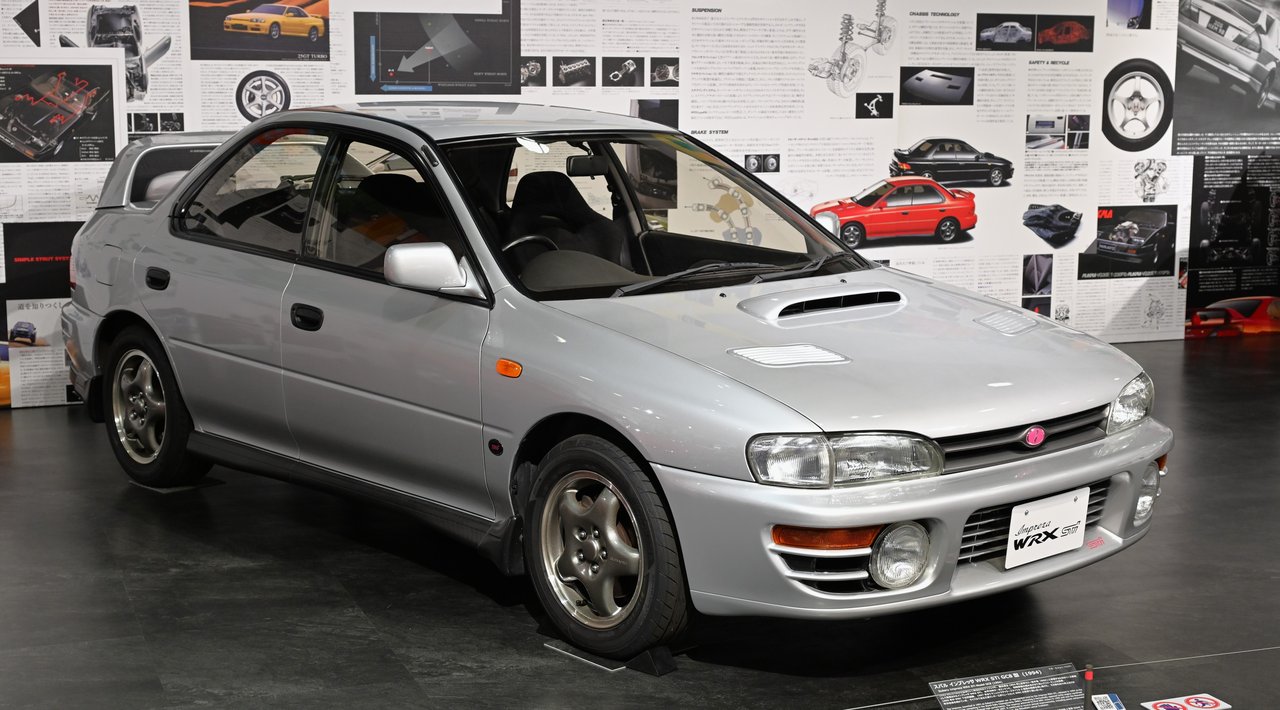
Photo via Wikimedia Commons under CC0 license.
Subaru WRX Project Midnight: A 670-Horsepower Apex Predator
When Subaru killed the next-generation WRX STI in 2022, citing seismic regulatory shifts and electrification, performance purists feared the worst. The road-going VB-generation WRX debuted as a refined, capable daily driver, but its 271-horsepower output and plastic-clad wheel arches felt uncomfortably tame for a lineage forged on the special stages of the World Rally Championship. Enthusiasts wondered whether Subaru had permanently abandoned raw, competition-grade performance.
Subaru Motorsports USA and longtime technical partner Vermont SportsCar (VSC) answered that anxiety at the 2024 Goodwood Festival of Speed with Project Midnight. This machine is neither a styling exercise nor a nostalgic tribute. It is an uncompromising, purpose-built tarmac time-attack weapon engineered to explore the mechanical limits of the WRX platform. Driven by former Formula 1 pilot and rallycross champion Scott Speed up Lord March’s famous 1.16-mile driveway, Project Midnight proved that the boxer engine and Symmetrical All-Wheel Drive configuration remain devastatingly effective when unshackled from production compromises.
Under the Hood: The 9,500-RPM Billet Boxer
Pop the quick-release pins on the carbon-fiber bonnet, and you will not find the road car’s 2.4-liter FA24 direct-injected flat-four. Production FA-series blocks, while stout for street duties, are not cast to withstand sustained motorsport abuse north of 600 horsepower. Instead, Vermont SportsCar utilized an ultra-refined evolution of Subaru Motorsports USA’s competition-proven 2.0-liter turbocharged boxer powerplant, a bespoke unit honed over years of dominance in Nitro Rallycross and Americas Rallycross.
Displacing exactly 1,994 cc, this closed-deck competition engine features custom billet internals, high-lift camshafts, and a specialized dry-sump lubrication system engineered to eliminate oil starvation under sustained lateral loads exceeding 2.0 Gs. Breathing through a massive Garrett motorsport turbocharger pushing more than 40 psi of manifold pressure, the 2.0-liter mill delivers an astonishing 670 horsepower and 680 lb-ft of torque. More remarkably, this boxer revs to an ear-splitting 9,500 rpm—a redline territory usually reserved for naturally aspirated racing V8s or motorcycle engines.
Thermal management and exhaust scavenging dictated radical packaging decisions. Exhaust gases exit through twin ceramic-coated stainless steel dump pipes protruding straight out of the carbon hood, bypassing the traditional transmission tunnel route entirely. This ultra-short exhaust path reduces backpressure to near zero, accelerates turbo spool-up, and sheds critical kilograms of piping from the vehicle's belly while shooting violent blue anti-lag flames into the driver’s line of sight.
Chassis Kinematics and the Carbon Diet
Power means little without mass control. A standard showroom WRX scales at roughly 3,390 pounds (1,538 kg). Project Midnight slashes that figure down to an astonishing 2,469 pounds (1,120 kg)—a weight reduction of nearly 1,000 pounds. It is even 300 pounds lighter than Travis Pastrana’s wild "Airslayer" Gymkhana STI.
To achieve this figure, Vermont SportsCar stripped the steel unibody to bare metal, seam-welded every structural seam, and integrated a lightweight FIA-spec chromoly roll cage that ties directly into the suspension pick-up points. Every external panel is rendered in autoclaved carbon fiber. The bodywork swells outward to accommodate a massively widened track, forming functional channels that draw high-pressure air out of the wheel wells and manage laminar flow down the car's flanks.
Underneath, the rallycross long-travel hardware was discarded in favor of dedicated road-course geometry. Project Midnight rides on custom tarmac-spec uprights, fully adjustable billet aluminum lower control arms, and bespoke multi-way adjustable racing dampers valved explicitly for ultra-stiff spring rates. Unsprung mass is drastically trimmed via forged 18x11-inch magnesium wheels wrapped in sticky 280/650R18 Yokohama ADVAN A005 tarmac racing slicks. Tucked behind the lightweight wheels sit monobloc competition brake calipers biting into massive two-piece slotted rotors, providing relentless deceleration without fade.
Aerodynamics: Engineered for Pure Adhesion
While Pastrana’s Airslayer used active aero flaps to fly flat over 200-foot jumps, Project Midnight is glued strictly to asphalt. Its aerodynamic suite takes visual cues from Subaru's championship-winning ARA rally cars, radically supersized for circuit duty.
Up front, an aggressive carbon-fiber front splitter projects forward, balanced by layered carbon dive planes mounted to the front bumper corners to press the nose into high-speed apexes. Deep extractor louvers across the hood and front fenders exhaust turbulent high-pressure air generated by the spinning 11-inch-wide magnesium wheels. At the rear, an enormous dual-element carbon wing works in coordination with an aggressive rear venturi diffuser that seals the underbody aerodynamics. The downforce generated at speed eliminates mid-corner yaw, replacing rally-style drifting with rail-like trajectory tracking.
| Specification | Subaru WRX Project Midnight | Production 2024 Subaru WRX (Reference) |
|---|---|---|
| Engine Type | Competition-spec 2.0L Turbocharged Boxer Flat-4 | 2.4L FA24 Turbocharged Boxer Flat-4 |
| Displacement | 1,994 cc | 2,387 cc |
| Peak Horsepower | 670 hp | 271 hp @ 5,600 rpm |
| Peak Torque | 680 lb-ft | 258 lb-ft @ 2,000–5,200 rpm |
| Maximum Engine Speed | 9,500 rpm | 6,000 rpm |
| Transmission | Sadev 6-Speed Sequential Dog-Box | 6-Speed Manual / Lineartronic CVT |
| Drivetrain | Motorsport Symmetrical AWD (Mechanical Diffs) | Viscous Coupling / VTD Symmetrical AWD |
| Curb Weight | 2,469 lbs (1,120 kg) | 3,390 lbs (1,538 kg) |
| Power-to-Weight | 3.68 lbs / hp | 12.50 lbs / hp |
| Wheels & Tires | 18x11-in Magnesium; 280/650R18 Yokohama Slicks | 18x8.5-in Alloy; 245/40R18 Dunlop Sport Maxx |
| Estimated 0–100 km/h | Under 2.0 seconds | 5.5 seconds |
| Price / Status | One-off Factory Works Special (Not for Sale) | Starting at $32,735 MSRP (USD) |
Driving Dynamics: Neutrality at Warp Speed
Watching Scott Speed pilot Project Midnight up the narrow Goodwood tarmac demonstrated the vast chasm between road car dynamics and true factory works engineering. Street WRXs inherently default to mild, safe understeer at the adhesion threshold, relying on brake-based active torque vectoring to pivot the nose. Project Midnight relies on raw mechanical grip and clever differential tuning.
Power reaches all four wheels through a competition-spec Sadev six-speed sequential dog-ring gearbox. Instead of computer-actuated electronic clutch packs, Project Midnight employs multi-plate mechanical limited-slip differentials front and rear, anchored by an adjustable mechanical center spool. This layout distributes torque instantaneously without latency. When Speed pinned the throttle off the starting line, there was no axle tramp or wasted tire spin. Project Midnight squat slightly, ignited its hood exhausts, and blasted toward 100 km/h in less than two seconds.
Through Goodwood's rapid Molecomb left-hander, the extreme roll stiffness and aerodynamic loading kept the chassis totally flat. The low center of gravity inherent to the horizontally opposed boxer engine paid massive dividends: side-to-side transitional response was instantaneous, devoid of the body roll that plagues taller inline-four and V6 platforms. The chassis remained neutral under trail-braking, carving directly to the clipping point where the driver could apply all 680 lb-ft of torque well before the apex exit.
Market Positioning and the Future of WRX Performance
Subaru will not sell you Project Midnight. It exists as an experimental engineering flagship, occupying a similar cultural space as the Ford Supervan 4.2 or the Porsche GT4 e-Performance. Yet its creation is critical for the Subaru brand in the current marketplace.
Presently, consumer-tier WRX performance tops out with variants like the WRX TR and the WRX tS. These models add Brembo braking hardware, stiffer electronically controlled suspension damping, and Recaro seating, yet they leave the 271-hp FA24 engine untouched. While rivals such as the Toyota GR Corolla (300 hp), Honda Civic Type R (315 hp), and Volkswagen Golf R (315 hp) battle for hot-hatch supremacy, Subaru has seemingly held back from entering the horsepower arms race.
Project Midnight serves as an emphatic reminder of what the core chassis layout can achieve. The aerodynamic research, differential tuning strategies, and high-rpm valve-train dynamics engineered by Vermont SportsCar for this project feed directly back into Subaru Tecnica International (STI) development pipelines. Even if the internal combustion STI remains paused, the technical lessons learned from harnessing 670 horsepower through an ultra-low-CG AWD chassis will dictate the architecture of future performance models, whether powered by hybrid systems or synthetic fuels.
Frequently Asked Questions
Will Subaru produce a limited run of the WRX Project Midnight for the public?
No. Project Midnight is a one-off experimental racing vehicle built exclusively by Vermont SportsCar and Subaru Motorsports USA. It is not street-legal and does not conform to mass-production safety, emissions, or noise regulations. However, aerodynamic and chassis development data gathered from the project will influence future factory performance components and competition programs.
Why did Vermont SportsCar use an older 2.0-liter engine rather than the newer 2.4-liter FA24?
The production FA24 engine is designed primarily for street longevity, moderate boost levels, and low-end torque. The 2.0-liter engine in Project Midnight is a purpose-built, closed-deck motorsport unit directly derived from Subaru’s rallycross program. Its smaller displacement, custom billet crankshaft, and optimized bore-to-stroke geometry allow it to reliably withstand over 40 psi of boost while spinning to 9,500 rpm—figures that would overwhelm the factory FA24 architecture.
How does Project Midnight's all-wheel-drive system compare to a standard WRX?
The production WRX manual utilizes a viscous-coupling center differential with open front and rear differentials that use brake intervention to simulate torque vectoring. Project Midnight utilizes a competition Sadev six-speed sequential gearbox connected to mechanical plate-type limited-slip differentials front, center, and rear. This setup locks under load mechanically, delivering instantaneous power distribution to the tires with superior mechanical grip and zero electronic braking intervention.
Verdict: MasEko's Engineering Assessment
Subaru WRX Project Midnight proves that the foundational tenets of Subaru performance—the low-slung horizontally opposed boxer layout and Symmetrical All-Wheel Drive—remain potent engineering tools when applied without commercial compromise. By discarding road-car mass and unleashing competition-derived turbocharging tech, Vermont SportsCar extracted the pure, uncut soul of the WRX. It stands as a defiant mechanical statement: internal combustion performance at Subaru is far from dead—it was simply waiting for midnight.
Sources and editorial note
Specifications, performance numbers, pricing, and technical measurements in this feature are based on official manufacturer documentation, engineering releases, and certified automotive benchmarks. Real-world parameters may vary based on market specifications and testing conditions.
The featured lead image is sourced from Wikimedia Commons under Creative Commons licensing with proper attribution. Editorial reporting complies with international copyright and fair-use standards.