
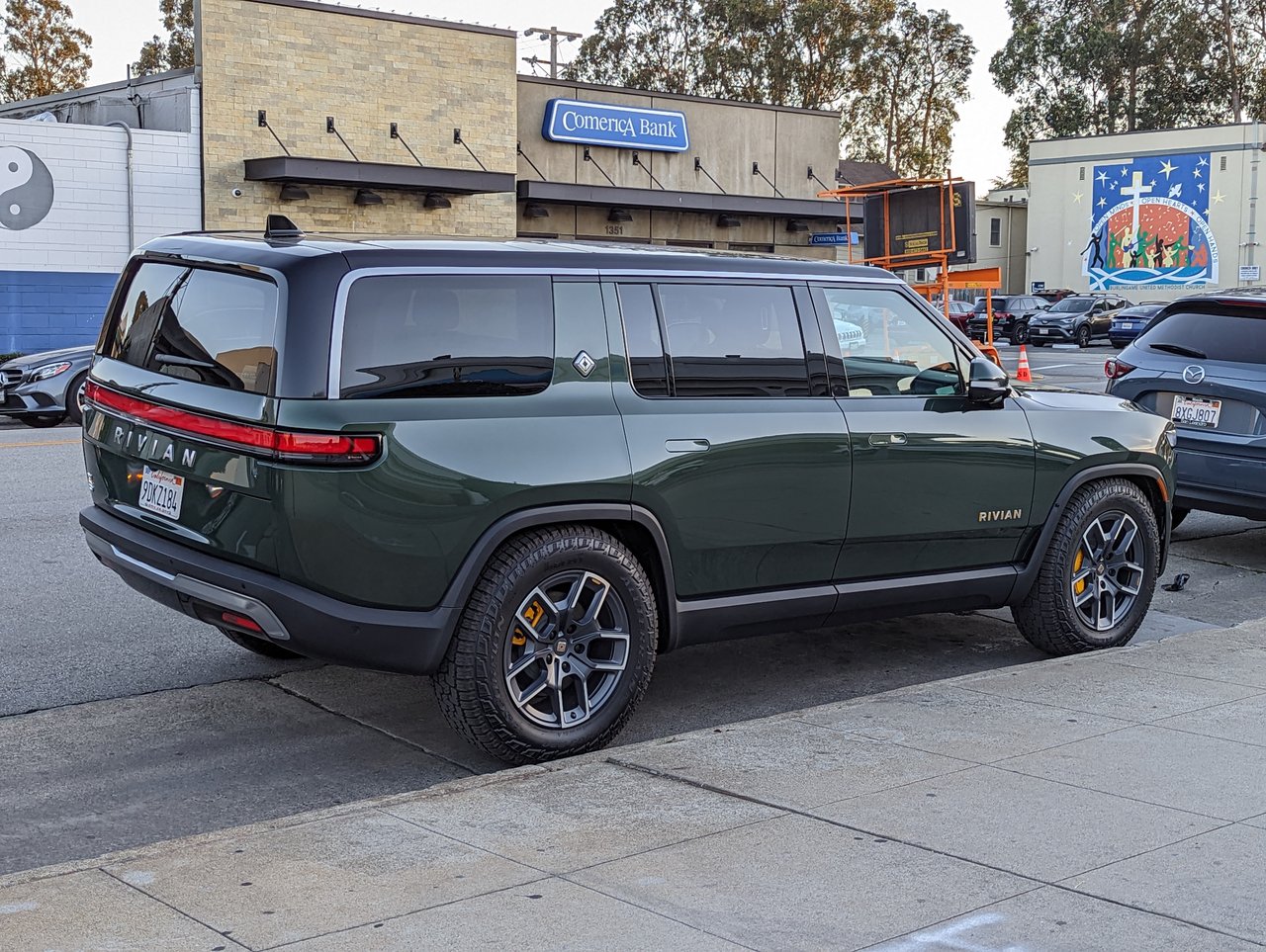
Photo via Wikimedia Commons under CC BY-SA 3.0 license.
The Democratization of Adventure: Why the Rivian R2 is the Brand’s Existential Masterstroke
Every fledgling automaker eventually encounters its crucible moment: the transition from building boutique, low-volume halo vehicles for early adopters to manufacturing a mass-market product capable of sustaining the enterprise. For Porsche, it was the Cayenne. For Tesla, the Model 3. For Rivian, that pivot rests squarely on the shoulders of the R2. The flagship R1T and R1S established RJ Scaringe’s outfit as a genuine engineering powerhouse, combining peerless off-road capability with luxury-grade quad-motor drivetrains. But six-figure adventure rigs do not generate the volume required to weather industrial headwinds. Enter the Rivian R2, a midsize electric SUV packing a projected $45,000 starting price, targeted squarely at the jugular of the global automotive mainstream.
The R2 is not merely a shrunk-down R1. While it retains the brand’s signature stadium-light face and clean, two-box proportions, beneath the sheet metal lies an entirely reimagined vehicle architecture. Rivian has executed a ruthless exercise in design-for-manufacturing, discarding unnecessary complexity to cut bill-of-materials costs while preserving the off-road credibility and utility that define the brand. With a footprint roughly 15 inches shorter and 5.5 inches lower than the R1S, the R2 squares up directly against the ubiquitous Tesla Model Y, but it brings an authentic trail-ready toughness that the soft-roader crossover segment sorely lacks.
Chassis Architecture: The 4695 Cell and the Structural Floor
The technical foundation of the R2 represents a clean break from the R1’s skateboard layout. In the R1 platform, individual 2170 cylindrical cells are grouped into modules, which sit within an enclosed structural tub that is then bolted underneath the vehicle chassis. The R2 abandons this approach in favor of an integrated cell-to-pack structural battery architecture. In this design, the top cover of the sealed battery enclosure doubles directly as the passenger compartment floorpan. Eliminating an entire layer of stamped steel and redundant floor structure yielded crucial packaging dividends, drastically improving interior vertical z-height while dropping weight out of the vehicle’s central mass.
Powering this architecture is an entirely new battery cell format: the 4695 cylindrical cell. Measuring 46 millimeters in diameter and 95 millimeters in height, these cells stand taller than Tesla’s 4680 units. That extra 15 millimeters of vertical canister volume provides a notable bump in gravimetric and volumetric energy density. Rivian engineers chose this format because larger cylindrical cells drastically reduce the total number of individual cells needed in the pack—from several thousand in the R1 to a fraction of that in the R2. Fewer cells mean fewer wire bonds, fewer thermal interface boundaries, and vastly simplified busbar layouts. Coupled with advanced tabless electrode designs, the 4695 cells offer superior current collection and lower internal resistance, facilitating sustained high-amperage DC fast-charging while maintaining thermal stability under heavy trail crawling or high-speed highway cruising. Rivian claims all battery configurations will surpass 300 miles of real-world range on a single charge.
Powertrain Matrix: Single, Dual, and a Sub-Three-Second Tri-Motor
To meet its $45,000 price target while catering to performance purists, Rivian developed a three-tier powertrain lineup utilizing its proprietary, in-house "Enduro" drive units. The entry-level R2 features a single permanent-magnet motor driving the rear axle. This rear-wheel-drive configuration is designed for maximum efficiency and affordability, offering linear throttle calibration and sufficient torque for suburban duty and light gravel paths.
The volume seller will undoubtedly be the Dual-Motor AWD variant, placing an electric drive unit on each axle. Rivian’s motor controls utilize an electro-mechanical disconnect on the front axle to decouple the motor during steady-state cruising, minimizing parasitic drag and extending range.
At the top of the hierarchy sits the Tri-Motor performance setup. This configuration employs a single drive unit up front and two discrete motors housed within a single casing on the rear axle. Because each rear wheel is powered by its own independent motor, the system bypasses mechanical differentials or brake-based vectoring entirely. Instead, the vehicle executes true dynamic torque vectoring: under heavy cornering, the outside rear motor can apply instantaneous positive torque while the inside motor regenerates, tucking the nose tightly into the apex and counteracting understeer. Rivian projects this flagship trim will rocket from 0 to 60 mph in less than 3.0 seconds, offering supercar-level acceleration on tarmac while retaining low-speed rock-crawling finesse through precision wheel-slip regulation.
Suspension Kinematics and Packaging Optimization
Suspension design reveals where Rivian made pragmatic engineering trade-offs to protect margins. The R1 platform uses an intricate, costly hydropneumatic cross-linked suspension system that eliminates traditional anti-roll bars. For the R2, engineers reverted to a more conventional, robust arrangement: double wishbones up front paired with an independent multi-link geometry out back, sprung by steel coil springs and managed by dynamic adaptive dampers.
By tuning the suspension kinematics with high anti-dive and anti-squat geometry, Rivian has managed the high-torque longitudinal forces inherent to electric drivetrains without resorting to overly stiff spring rates. Scrub radius and kingpin inclination have been dialed in to retain crisp, communicative steering off-road without tramlining over rutted asphalt. Ground clearance is rated at a generous 9.8 inches, supported by a 32-degree approach angle and a 27-degree departure angle—figures that easily outclass soft-road competitors.
Interior Packaging: The Fold-Flat Camping Machine
Automotive packaging is fundamentally a battle for millimeters, and the R2 cabin exhibits brilliant interior layout engineering. In response to camper feedback from the overland community, Rivian designed both the first and second rows of seating to fold completely flat into the floor. While folding second rows are industry standard, engineering a front row—complete with structural side-impact bolsters, internal wiring harnesses, and seat tracks—to fold forward flush with the rear floor is a genuine mechanical coup. The resulting continuous flat deck accommodates an interior air mattress, transforming the R2 into an enclosed, climate-controlled camper shell.
Ventilation and greenhouse airflow have been thoughtfully addressed through specialized glass hardware. The rear liftgate features a fully roll-down rear window, evoking the spirit of classic Toyota 4Runners. Lowering this pane allows long items, like surfboards or lumber, to hang out the back without keeping the tailgate unlatched. Complementing this feature are powered pop-out rear quarter windows, which swing open on motorized hinges to extract cabin air at speed and maintain natural flow-through ventilation during overnight camping.
Charging infrastructure logistics are equally future-proofed. The R2 abandons the legacy CCS1 standard entirely, sporting a natively integrated North American Charging Standard (NACS / J3400) charge port mounted on the rear passenger-side quarter panel. This placement aligns perfectly with Tesla Supercharger stalls, eliminating cable-reach issues and granting R2 owners plug-and-charge access to over 15,000 Supercharger dispensers across the continent without requiring clunky plastic adapters.
Rivian R2 Technical Specifications
| Specification | R2 Single Motor (RWD) | R2 Dual Motor (AWD) | R2 Tri-Motor (AWD) |
|---|---|---|---|
| Starting MSRP (Target) | $45,000 | ~$53,000 (est.) | ~$65,000 (est.) |
| Motor Layout | Single rear permanent-magnet | Dual motor (Front + Rear) | Tri-motor (1 Front, 2 Rear) |
| Battery Architecture | Structural pack with 4695 cylindrical cells; cell-to-pack floorpan integration | ||
| EPA Range (Target) | 300+ miles | 300+ miles | 300+ miles |
| 0–60 mph Acceleration | ~6.0 seconds | ~4.5 seconds | < 3.0 seconds |
| Charging Standard | Native NACS (SAE J3400) port; DC fast charge 10–80% in < 30 minutes | ||
| Dimensions (L / W / H) | 185.6 in (4,715 mm) / 75.3 in (1,905 mm) / 66.9 in (1,700 mm) | ||
| Wheelbase | 115.6 in (2,935 mm) | ||
| Ground Clearance | 9.8 in (249 mm) | ||
| Suspension Setup | Double wishbone front, multi-link rear, coil springs with adaptive damping | ||
The Rivalry: Challenging the Model Y Monopoly
When the R2 arrives in customer driveways in the first half of 2026, it lands squarely in the operational crosshairs of the Tesla Model Y. Tesla's crossover is a masterclass in production scale, aerodynamic efficiency, and software cohesion, but its generic, egg-shaped crossover silhouette has become ubiquitous. The Model Y is an urban appliance; the R2 is an aspirational lifestyle tool.
Where the Model Y scrapes its flat battery belly on rough fire roads, the R2 boasts nearly ten inches of ground clearance, short overhangs, and genuine underbody armor. Furthermore, the R2's boxy greenhouse provides superior vertical cargo volume and rear-seat headroom compared to Tesla's sloping roofline. Against other rivals like the Hyundai Ioniq 5 and Ford Mustang Mach-E, the Rivian commands attention through its distinct design language, higher towing ceiling, and thoughtful outdoor utility—including dual interior gloveboxes, deep front trunk storage, and integrated accessory attachment ports.
Initial production will take place at Rivian’s upgraded facility in Normal, Illinois, pulling forward the delivery timeline and preserving capital before the company begins expansion at its planned manufacturing hub in Georgia. Global availability for European markets will follow domestic rollout, where its tighter dimensions will make it infinitely more practical on narrow continental roads than the immense R1S.
Frequently Asked Questions
Why did Rivian select 4695 battery cells instead of the 4680 cells used by Tesla?
The 4695 form factor retains the 46-millimeter diameter standard but extends height to 95 millimeters. This additional 15 millimeters of vertical canister space provides a substantial increase in internal electrode volume per cell. Consequently, Rivian can achieve the desired energy capacity using fewer individual cells, simplifying cell manufacturing, module routing, and cooling loop architecture. The larger volume also offers an optimal thermal balance for high sustained discharge rates and prolonged DC fast charging.
How does the R2 manage off-road articulation without the R1’s cross-linked hydraulic suspension?
The R1’s electro-hydraulic system is exceptionally capable, but it is too costly and complex for a $45,000 midsize SUV. The R2 achieves solid wheel travel through carefully calculated suspension geometry: long-travel double wishbones up front, an optimized rear multi-link layout, and intelligent electronic traction control algorithms. While it won't rock-crawl with the extreme wheel articulation of an R1 on 34-inch tires, its 9.8-inch ground clearance, short front and rear overhangs, and instantaneous torque vectoring provide capabilities far beyond typical crossovers.
Where is the NACS port located, and will the R2 need an adapter at Tesla Superchargers?
The R2 features a natively integrated NACS (SAE J3400) charge port located on the passenger-side rear quarter panel. Because the port is factory-integrated, no mechanical or electrical adapters are needed at Tesla Supercharger stations. Drivers simply unholster the Supercharger connector and plug it directly into the vehicle, with billing and authentication managed automatically through vehicle-to-cloud protocols.
The MasEko Verdict
The Rivian R2 represents a mature, calculated shift in high-volume vehicle engineering. By pairing a structural 4695 battery pack with pragmatic, robust mechanical running gear and distinctive utility features—like fold-flat front seating and rolling rear glass—Rivian has avoided the trap of building a sterile, nondescript EV appliance. It retains the rugged outdoor ethos of the R1 while eliminating the production bottlenecks and high price tag that previously limited the brand's reach. If Rivian can execute its manufacturing ramp in Illinois and hold the line on that $45,000 base price, the R2 will not just challenge the Tesla Model Y—it will redefine the midsize electric segment.
Sources and editorial note
Specifications, performance numbers, pricing, and technical measurements in this feature are based on official manufacturer documentation, engineering releases, and certified automotive benchmarks. Real-world parameters may vary based on market specifications and testing conditions.
The featured lead image is sourced from Wikimedia Commons under Creative Commons licensing with proper attribution. Editorial reporting complies with international copyright and fair-use standards.