
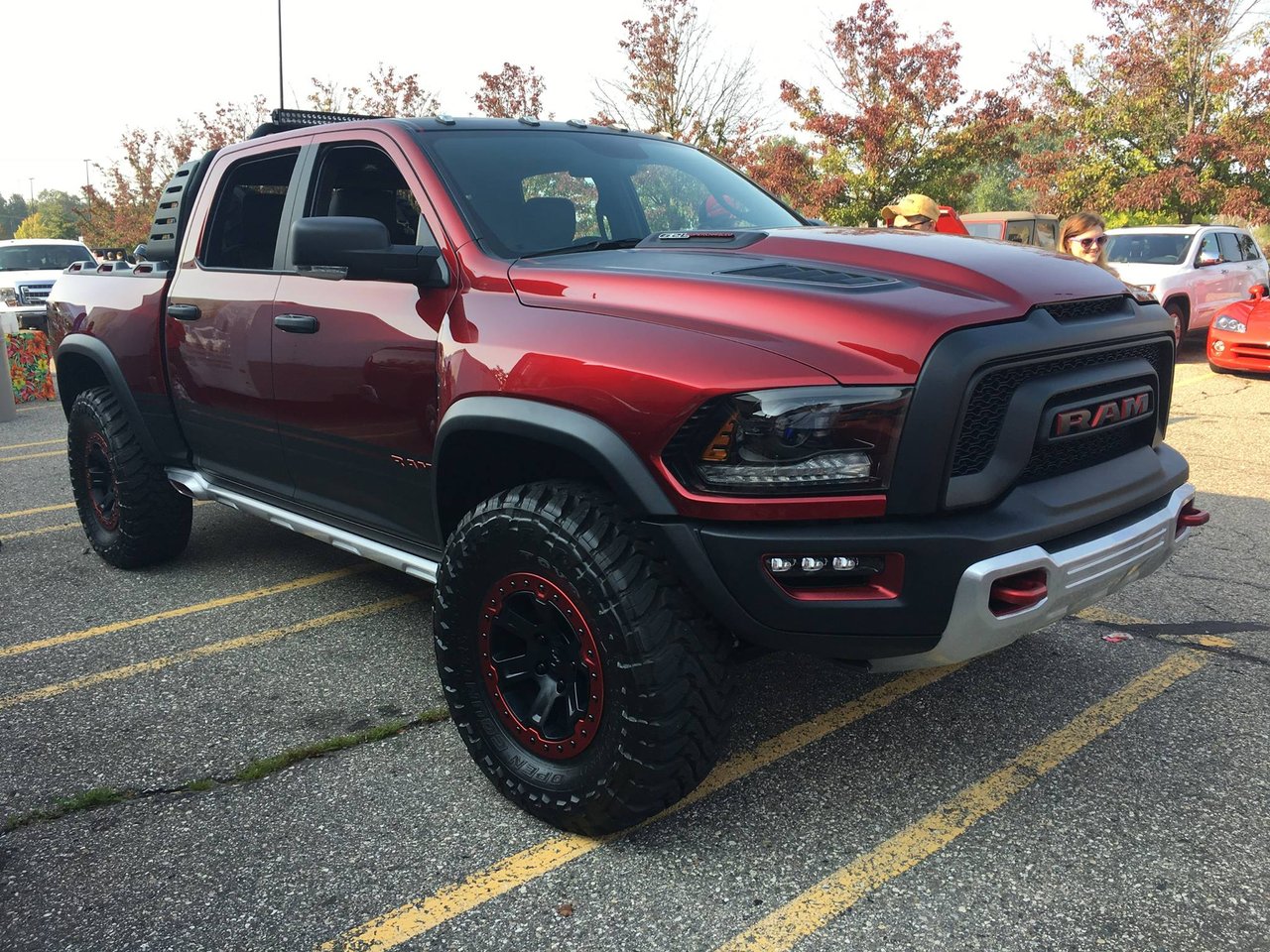
Photo via Wikimedia Commons under CC BY-SA 4.0 license.
Return of the Apex Predator: The 777-HP Ram 1500 TRX
When environmental mandates prompted automakers to rethink large-displacement engines, enthusiasts braced for the extinction of the mechanical monster. Ford seized the moment with the F-150 Raptor R, claiming uninhibited desert supremacy. Ram, however, refused to surrender the high-speed off-road mantle. Instead of retreating into modest hybridization, the engineering team in Auburn Hills doubled down on displacement, combustion efficiency, and thermal endurance. The result is the revitalized Ram 1500 TRX, a supercharged half-ton trophy truck armed with a recalibrated, high-output 6.2-liter HEMI V8 delivering an eye-watering 777-plus horsepower. This truck is not merely a production exercise; it is an aggressive mechanical statement aimed directly at Dearborn’s flagship.
The stakes in this niche are immense. Trophy-truck capability on showroom floors requires more than excess horsepower. It demands a chassis capable of absorbing repeated vertical decelerations of up to 2.0 g, a cooling package that sheds engine and supercharger heat soak in 115-degree desert ambients, and active suspension damping that reads terrain at millisecond frequencies. The TRX returns not to adapt to modern sensibilities, but to dominate them.
Powertrain Architecture: Supercharging the 6.2-Liter HEMI to 777 Horsepower
At the center of the TRX sits the deep-skirt, cast-iron block HEMI V8, engineered to withstand extreme cylinder pressures that would buckle lighter alloy casings. The block features four-bolt main bearing caps cross-bolted to the skirt, anchoring a forged-steel crankshaft with induction-hardened journals. With a 103.9-millimeter bore and a 90.9-millimeter stroke, the bottom end accommodates forged aluminum alloy pistons connected via powder-forged steel I-beam rods. The piston skirts feature diamond-like carbon coatings, minimizing frictional drag under high piston speeds while full-floating 24-millimeter wrist pins mitigate torsional stress.
Forced induction is handled by a 2.38-liter twin-screw IHI supercharger mounted directly between the cylinder banks. To achieve the 777-horsepower threshold, engineers increased charge air density by optimizing drive ratios and reshaping internal port geometry. Twin-screw rotors feature a specialized polyimide coating that maintains ultra-tight clearances throughout extreme heat cycles, compressing intake air up to 12.8 psi. Integral charge-air coolers sit directly within the supercharger housing, routing coolant through an independent low-temperature radiator circuit to hold intake air temperatures below 130 degrees Fahrenheit even during prolonged wide-open-throttle runs.
Air induction relies on an inventive dual-path system: half the intake air enters through the cavernous functional hood scoop, while the remainder is drawn through high-flow ducting behind the front grille. A massive 29-liter airbox houses radial paper filters capable of trapping 98 percent of airborne dust and sand before it reaches the 92-millimeter electronic throttle body. Fuel delivery is sustained by dual high-pressure gerotor fuel pumps feeding upgraded port injectors. Backing this powerplant is the TorqueFlite 8HP95 eight-speed automatic transmission, utilizing hardened planetary gearsets and an upgraded torque-converter clutch to dispatch 685 lb-ft of torque to a BorgWarner 48-13 full-time active transfer case with a 2.64:1 low-range reduction gear.
Chassis Engineering: Structural Rigidity and Bilstein Black Hawk e2 Kinematics
A supercharged powertrain is useless in the desert without a chassis capable of structural survivability. The foundation of the TRX is a fully boxed ladder frame comprising 98 percent high-strength, low-alloy steel. Hydroformed front rail sections eliminate weak weld points, while the central rail sections use thick-gauge steel to resist torsional twisting when launching off sand dunes. Out back, fully boxed frame rails support reinforced shock towers engineered to absorb heavy suspension impacts.
The front suspension uses an independent double-wishbone design with high-strength forged aluminum upper and lower control arms. This setup reduces unsprung mass while preserving camber stiffness throughout its 13.0 inches of usable wheel travel. The rear setup departs completely from the leaf-sprung architecture of traditional work trucks, employing a specialized five-link live axle system with forged steel trailing arms, a track bar, and application-specific progressive coil springs. Managing the rear output is a Dana 60 solid axle housing 3.55:1 axle ratios, full-floating axle shafts, and a driver-selectable electronic locking differential, netting 14.0 inches of travel.
Suspension damping is managed by Bilstein Black Hawk e2 active performance shocks featuring 2.5-inch precision-bored aluminum monotube bodies. Connected to dual external remote reservoirs via high-pressure stainless steel braided lines, the shock assemblies feature Dual Valve Technology, which independently adjusts compression and rebound damping via internal proportional solenoids in as little as 2 milliseconds. Working in tandem with Ram's proprietary algorithm, three chassis-mounted accelerometers and four independent ride-height sensors constantly feed position, velocity, and roll angle to the damping controller. When the sensors detect the wheels fully extending in mid-air, the shocks instantly ramp up rebound damping to eliminate harsh rebound snap, while staging hydraulic jounce zones to prevent chassis bottoming upon landing.
Connecting this hardware to the terrain are 35-inch Goodyear Wrangler Territory All-Terrain tires (325/65R18), engineered specifically for the TRX with an aggressive shoulder tread and reinforced D-load range sidewalls, mounted to 18x9-inch beadlock-capable aluminum wheels.
Dynamic Desert Warfare: Baja Mode Calibration
Toggling the TRX into Baja Mode immediately restructures its dynamic profile. Nominal all-wheel-drive torque distribution shifts from a street-oriented 40/60 split to a rear-biased 25/75 split, turning the 6,400-pound truck into a controllable, throttle-steerable sand weapon. Throttle mapping transforms into a hair-trigger profile, keeping the supercharger bypass valve closed to guarantee immediate manifold pressure upon tip-in.
The 8HP95 transmission alters its shift schedule, executing upshifts 50 percent faster and holding lower gear ratios past 6,000 rpm to prevent sudden balance shifts over undulating desert terrain. Crucially, the electronic stability control relaxes its yaw-rate limits, allowing up to 15 degrees of slip angle before unobtrusive rear brake vectoring stabilizes the trajectory. Through high-frequency washboard trails, the Bilstein e2 shocks dynamically soften initial high-speed compression damping to let the 35-inch Goodyears track the terrain, stiffening rebound circuits to eliminate porpoising or bucking from the heavy rear axle.
Technical Specifications: Ram 1500 TRX
| Specification Parameter | Technical Metric |
|---|---|
| Engine Configuration | 90-degree Supercharged HEMI OHV 16-Valve V8 |
| Displacement | 6.2 Liters (6,166 cc / 376 cu. in.) |
| Bore x Stroke | 103.9 mm x 90.9 mm (4.09 in x 3.58 in) |
| Forced Induction | 2.38L Twin-Screw IHI Supercharger (12.8 psi boost) |
| Peak Power Output | 777 hp @ 6,200 rpm |
| Peak Torque Output | 685 lb-ft @ 4,800 rpm |
| Transmission | TorqueFlite 8HP95 8-Speed Automatic |
| Transfer Case | BorgWarner 48-13 Full-Time Active (2.64:1 Low Range) |
| Suspension Travel (Front / Rear) | 13.0 inches (330 mm) / 14.0 inches (356 mm) |
| Dampers | Bilstein Black Hawk e2 2.5-inch Active Remote-Reservoir |
| Braking Hardware (F/R) | 15.0-inch vented discs (twin-piston) / 15.0-inch vented discs |
| Tires & Wheels | LT325/65R18 Goodyear Wrangler Territory AT on 18x9-in Wheels |
| Curb Weight | 6,439 lbs (2,921 kg) |
| 0–60 mph (0–100 km/h) | 3.7 seconds / 4.0 seconds |
| Top Speed | 118 mph (190 km/h) (tire limited) |
| Base MSRP (USD) | $98,500 |
Market Positioning: The War Against the Raptor R
The off-road super-truck landscape is a fierce two-horse battle. On one side stands the Ford F-150 Raptor R; on the other, the Ram 1500 TRX. The engineering philosophies of the two trucks diverge sharply:
- Ford F-150 Raptor R: Relies on weight optimization via its aluminum-alloy cab and bed, checking in around 6,070 pounds. Its 5.2-liter supercharged Predator V8 generates 720 horsepower and 640 lb-ft of torque. It uses Fox Live Valve 3.1 internal bypass shocks with long-travel trailing arms.
- Ram 1500 TRX: Employs an uncompromising heavy-duty approach. At roughly 6,440 pounds, it carries structural ballast, but answers with superior output: 777 horsepower and 685 lb-ft of torque. The cast-iron HEMI offers greater thermal tolerance during extended loads than lighter aluminum-block alternatives.
While the Raptor R feels slightly nimbler through tight, technical switchbacks due to its mass advantage, the TRX counters with high-speed stability and mid-range passing force. Ram's structural frame stiffness and the precision valving of the Bilstein Black Hawk e2 dampers deliver a more planted, controlled platform across deep whoops. The TRX tracks dead-straight where lighter trucks begin to deflect sideways.
The TRX is distributed globally across North America, the Middle East (where it enjoys massive popularity across the UAE and Saudi Arabia), and through specialized conversion channels like Walkinshaw Automotive in Australia for right-hand-drive homologation. Pricing starts at an MSRP of $98,500, with fully equipped trims and launch packages stretching beyond $115,000.
Frequently Asked Questions (FAQ)
Why did Ram retain the heavy cast-iron 6.2L HEMI instead of switching to the twin-turbo Hurricane inline-six?
While the Hurricane 3.0-liter twin-turbo inline-six is an exceptional engine capable of high specific output, the high-displacement supercharged HEMI provides instant, off-idle torque delivery critical for powering out of deep sand. Furthermore, the thick-wall cast-iron block provides structural rigidity under high supercharger boost pressures, resisting the cylinder-bore distortion that can challenge aluminum blocks under extended thermal stress in desert conditions.
How do the Bilstein Black Hawk e2 dampers differ from the Fox Live Valve shocks on the Raptor R?
The Bilstein Black Hawk e2 units use an external dual-valve design that controls both compression and rebound damping circuits independently through dedicated high-speed proportional solenoids. Fox Live Valve systems adjust baseline valving via electronic base valves, but Bilstein's dual-solenoid setup offers separate hydraulic tuning pathways for the inward and outward stroke, providing faster, more targeted adaptations when managing heavy axle hop over repetitive high-speed whoops.
Can the standard 35-inch Goodyear Wrangler Territory tires be upgraded to 37-inch tires without modifying the front suspension?
While 37-inch tires can physically fit inside the outer fenders, full suspension compression at lock will cause the tire tread to rub against the inner fender liners and front body mounts. To run 37-inch tires reliably without sacrificing the 13.0 inches of front wheel travel, owners must install aftermarket front-leveling upper control arms and make minor clearance adjustments to the front wheel-well plastics.
The Maseko Verdict
The refreshed Ram 1500 TRX is a triumph of focused mechanical execution over transient industry trends. By pairing 777 horsepower of supercharged V8 force with a heavy-duty chassis and the computational speed of Bilstein Black Hawk e2 active damping, Ram has constructed a production vehicle that handles brutal terrain at triple-digit speeds with total composure. It remains an unapologetic, over-engineered desert conqueror that cements its place at the top of the internal combustion food chain.
Sources and editorial note
Specifications, performance numbers, pricing, and technical measurements in this feature are based on official manufacturer documentation, engineering releases, and certified automotive benchmarks. Real-world parameters may vary based on market specifications and testing conditions.
The featured lead image is sourced from Wikimedia Commons under Creative Commons licensing with proper attribution. Editorial reporting complies with international copyright and fair-use standards.