
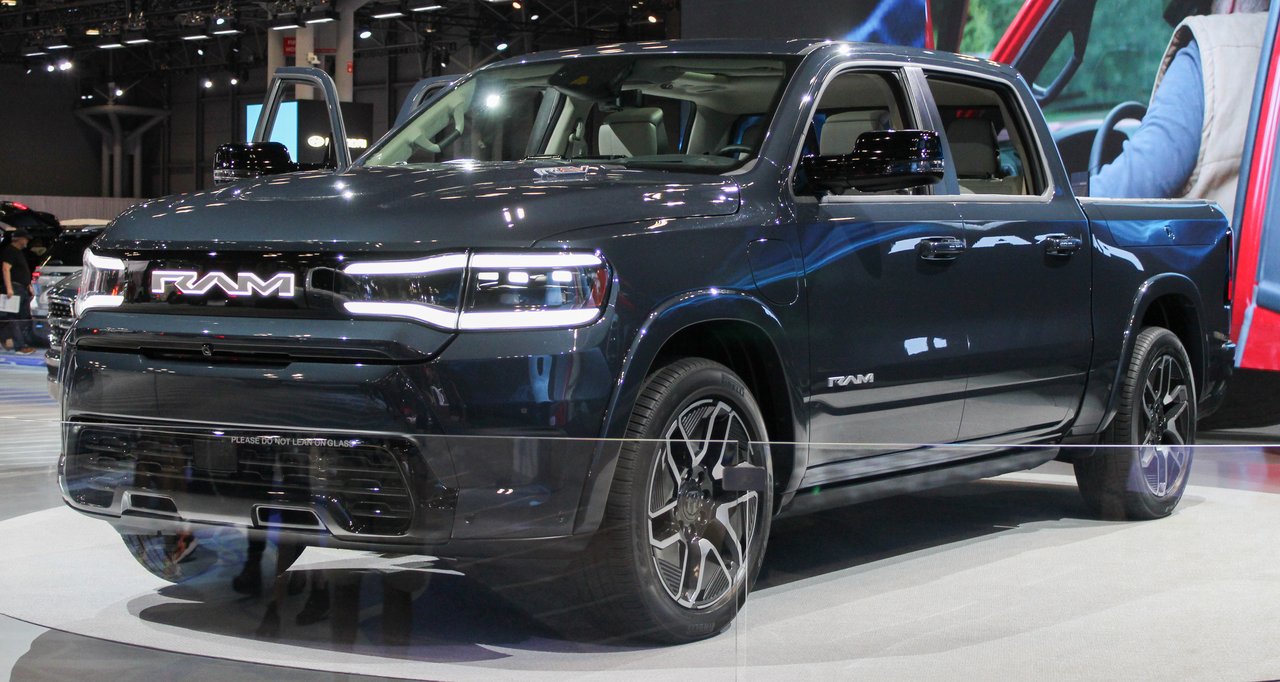
Photo via Wikimedia Commons under CC BY-SA 4.0 license.
Ram REV: The Pickup That Died and Came Back as Something Better
Remember the Ram 1500 REV? The full battery-electric pickup Stellantis promised with up to 500 miles of range, then quietly strangled in the crib as BEV truck demand evaporated faster than morning dew in Death Valley? It's dead. Officially cancelled. But the nameplate lives on — and here's the twist: what Ram has done is arguably smarter than anything the original REV ever promised. The extended-range Ramcharger concept, with its onboard gasoline generator, has been re-badged as the REV, and it might just be the most rational electrified truck Detroit has ever built.
The logic is brutally honest. Full-size truck buyers tow trailers across states, haul gravel into remote job sites, and simply cannot tolerate the anxiety of a battery-only powertrain in the middle of Nebraska. An extended-range electric vehicle — where a combustion engine never drives the wheels, only spins a generator — solves that problem elegantly. You get EV refinement and torque around town, plus total freedom on a cross-country haul. The 2027 Ram REV (as it's currently slated) is Ram's bet that this is the future of the electrified pickup. Having studied the engineering, I think they're right.
The Powertrain: A Generator With a Muscle Car's Soul
Let's be clear about the architecture, because it matters. The REV is not a hybrid in the conventional sense. The 3.6-litre Pentastar V6 under the skin never sends power to the axles. Instead, it operates as a dedicated generator, running at efficient load points to sustain the battery — a layout pioneered conceptually by the BMW i3 REx and perfected for truck duty by Ram.
Feeding off that generator and the 69.7 kWh usable battery pack are two electric motors — one per axle — producing a combined 647 horsepower and 610 lb-ft of torque. For context, that's more grunt than a supercharged Ram TRX ever mustered in stock form, delivered instantly from zero rpm. This is a truck that will hustle a full-size body to highway speed with the urgency of a performance sedan, then whisper through the neighborhood on electrons alone.
Ram estimates 145 miles of pure electric driving — genuinely usable for a week of commuting — and 690 miles of combined range with the generator humming. That latter figure is the knockout punch. No battery-electric truck on sale today comes close. Hook up a 14,000-pound trailer, and instead of watching range collapse at a terrifying rate, you simply burn gasoline like every truck has for a century. The 2,625-pound payload rating confirms this is no lifestyle poseur; it's rated to work.
The 69.7 kWh pack is deliberately modest by BEV truck standards — the Silverado EV runs packs nearly triple that size. That's the point. Less weight, less cost, less lithium, less waiting at a charger. When you do plug in, you're replenishing a smaller buffer, and the Pentastar covers the rest. It's an engineering concession to reality, and I applaud it.
Chassis and Driving Dynamics
The REV rides on the STLA Frame platform, Ram's dedicated body-on-frame architecture designed from day one with electrification in mind. The battery lives between the frame rails rather than hanging beneath the bed, preserving packaging and ground clearance. Dual-motor all-wheel drive is standard, with torque vectoring managed by software rather than mechanical differentials — instantaneous front-to-rear distribution that reacts faster than any transfer case.
Expect Ram's exemplary coil-spring rear suspension (or available air suspension) to carry over, which matters enormously. Ram has long built the best-riding full-size truck in the business, and the low-slung battery pack drops the center of gravity, improving body control under braking and through sweepers. Electric torque on tap means merging and passing are effortless, and the regenerative braking system will be tuned to blend seamlessly with the friction brakes — critical when you're slowing 8,000 pounds of truck and trailer.
The one-pedal driving capability, towing modes calibrated for the instant torque delivery, and the sheer refinement of a powertrain with no shift shock should make this the most pleasant heavy-duty hauler this side of a luxury sedan. Off-road, the electric motors' precise torque control offers a form of traction management no lockers can replicate.
2027 Ram REV Specifications (Estimates)
| Specification | Detail |
|---|---|
| Powertrain Type | Extended-Range EV (series hybrid) |
| Generator Engine | 3.6-litre Pentastar V6 (generator duty only) |
| Electric Motors | Dual motors, one per axle |
| Combined Output | 647 hp / 610 lb-ft |
| Battery | 69.7 kWh usable |
| Electric Range | 145 miles (est.) |
| Combined Range | 690 miles (est.) |
| Towing Capacity | 14,000 lbs |
| Payload | 2,625 lbs |
| Drive | AWD (dual motor) |
| Estimated Price | $60,000–$100,000 (Car and Driver estimate) |
| Launch Timing | Reported 2027 model year |
A note on pricing and timing: Car and Driver currently lists the 2027 REV at roughly $60,000 to $100,000 depending on trim, and reports place the launch in the 2027 model year. Treat both figures as estimates — Stellantis has shifted this program's timeline more than once, and final specifications, pricing, and on-sale dates remain subject to official confirmation.
Market Positioning and Rivals
The REV enters a fascinating fight. Its most direct philosophical rival is the Chevrolet Silverado EV, a pure BEV with massive range and massive price tags, but no fallback once the battery empties. The Ford F-150 Lightning plays in similar territory. Against the Rivian R1T, the REV offers real towing range and traditional truck capability at potentially similar money.
Where the REV gets genuinely interesting is against the hybrid F-150 PowerBoost and Toyota Tundra i-FORCE MAX — conventional hybrids whose engines do drive the wheels. Ram's series layout offers more EV-only range and smoother, quieter operation, at the cost of some highway efficiency versus a parallel hybrid. The $60,000 entry point, if it materializes, would undercut every serious BEV truck while delivering comparable around-town refinement. That's a compelling wedge into the market.
Global availability will initially center on North America, where full-size trucks live and breathe. Don't expect meaningful volumes in Europe or Asia — this is a fundamentally American machine solving an American problem.
Frequently Asked Questions
Does the Ram REV's gas engine ever drive the wheels?
No. The 3.6-litre V6 operates purely as a generator, charging the battery and supplying the electric motors. Drive to the wheels is electric-only, which delivers EV smoothness with gasoline-range flexibility.
Can the REV tow long distances without recharging?
Yes — that's the entire point of the layout. With a 14,000-pound towing rating and the generator extending total range to an estimated 690 miles, towing across country is feasible without planning a charging route, unlike pure BEV trucks.
When does the Ram REV launch, and what will it cost?
Reports place the launch in the 2027 model year, with Car and Driver listing an estimated price range of $60,000 to $100,000 depending on trim. Both figures are estimates and subject to Ram's official confirmation.
MasEko's Verdict
The cancellation of the pure-battery 1500 REV looked, on the surface, like another EV retreat. Look closer, and it's a strategic masterstroke. The reborn REV — series hybrid, 647 horsepower, 690 miles of range, 14,000 pounds of towing — is the electrified truck engineered for how people actually use pickups, not how press releases wish they did. If Ram delivers it at the promised price and timeline, the REV won't just survive the EV backlash. It might define the sensible middle path between gasoline and electrons. That would be a genuine engineering achievement.
Sources and editorial note
Specifications, performance numbers, pricing, and technical measurements in this feature are based on official manufacturer documentation, engineering releases, and certified automotive benchmarks. Real-world parameters may vary based on market specifications and testing conditions.
The featured lead image is sourced from Wikimedia Commons under Creative Commons licensing with proper attribution. Editorial reporting complies with international copyright and fair-use standards.