
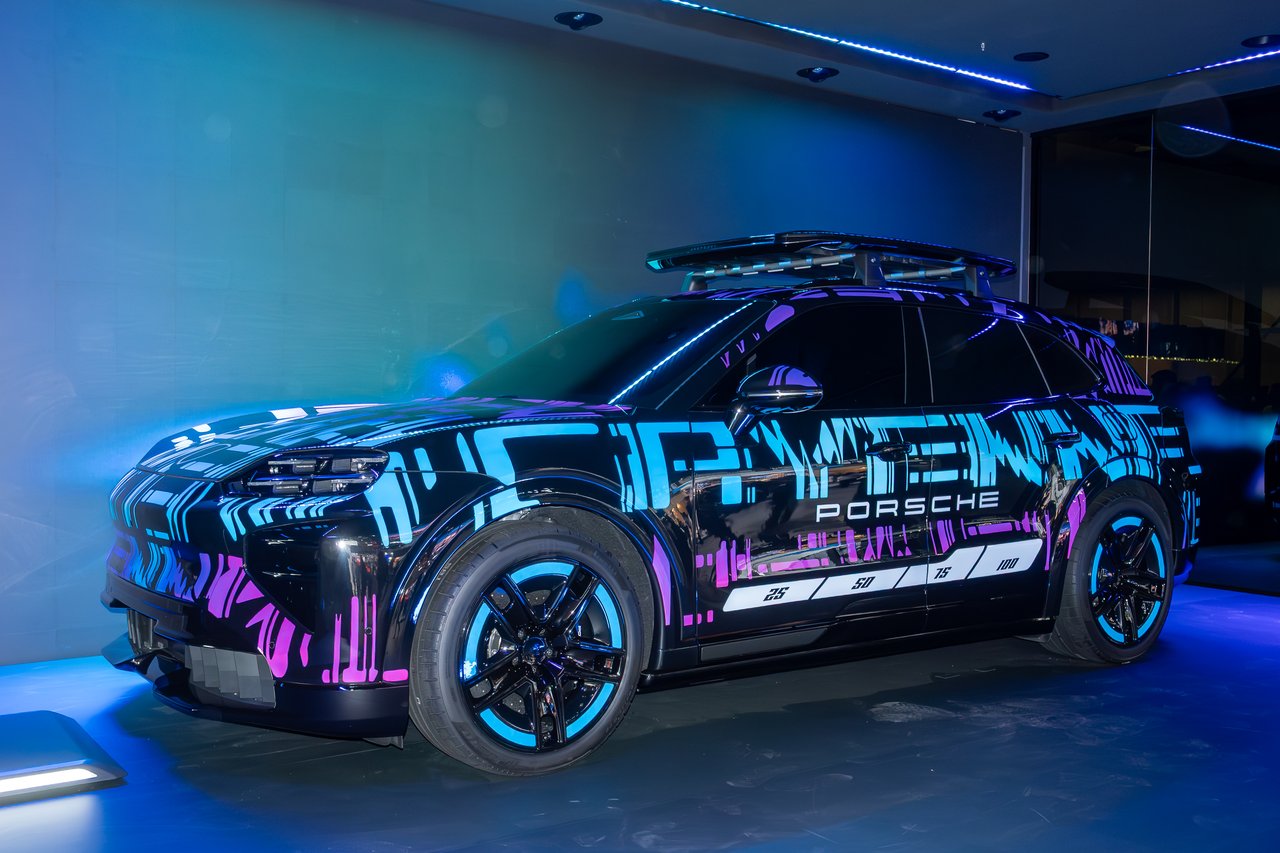
Photo via Wikimedia Commons under CC BY-SA 4.0 license.
Porsche Cayenne Electric: The 850 kW Benchmark That Rewrites the SUV Rule Book
By MasEko | Maseko Auto (maseko.cloud)
There's a moment, somewhere around the third corner of a fast mountain pass, when you stop thinking about whether an electric SUV belongs here and simply acknowledge that it does — spectacularly. The new Porsche Cayenne Electric isn't a compromise or a rebadged concession to regulation. It's the Cayenne line's most technically sophisticated expression yet, built from the ground up on an 800-volt architecture, carrying a 113 kWh gross battery, and in Turbo Electric guise, capable of hurling its two-and-a-half-tonne body to 100 km/h in 2.5 seconds flat. That puts it in conversation not just with rival performance SUVs, but with genuine sports cars. Porsche hasn't made an electric Cayenne. They've made the most capable Cayenne ever — and that matters enormously right now.
Why the Cayenne Electric Is the Right Car at the Right Moment
The original Cayenne saved Porsche's balance sheet in 2002 and funded the 911's survival. Two decades later, the electric Cayenne is being asked to do something far harder: prove that Porsche's performance identity survives the shift to electrification without apology. The stakes are real. Rivals like the BMW XM, Mercedes-AMG G 63 E Performance, and the incoming Lamborghini Urus SE are all making the same calculation. Porsche's answer is characteristically engineering-first: throw 800-volt silicon-carbide technology, a tri-motor layout, and an entirely new chassis control philosophy at the problem until the numbers stop lying.
Powertrain Deep-Dive: 800 Volts and Three Motors
Porsche's decision to build the Cayenne Electric on 800-volt architecture — the same electrical backbone used on the Taycan — is the defining technical choice that shapes everything else. Higher voltage means lower current for the same power output, which reduces heat, shrinks cable gauges, and enables the kind of DC fast-charging rates that make long-distance use genuinely practical rather than theoretically possible.
The Cayenne Turbo Electric and Turbo S Electric deploy a tri-motor setup: one permanently excited synchronous motor on the front axle and two on the rear. Combined system output in overboost — activated via Launch Control — reaches a staggering 850 kW (1,156 PS) with 1,500 Nm of torque. To put that in perspective, that's more peak power than a Bugatti Chiron Sport makes from its 8.0-litre W16. The rear motors are housed in a purpose-built electric rear axle that also integrates Porsche Torque Vectoring Plus (PTV+), distributing torque between left and right rear wheels with a precision no mechanical limited-slip differential can match response-time wise.
The 113 kWh gross battery (approximately 105 kWh usable) uses a flat floor-mounted pack running at 800 volts nominal. Thermal management is liquid-cooled, with predictive conditioning when a DC fast charger or a demanding route is detected via navigation. Peak DC charging sits at 390–400 kW, enabling a 10–80% fill in under 16 minutes. For context, that's faster than many performance cars can complete a track warm-up lap.
Range: Real Numbers, Not Press Release Math
WLTP range figures across the range are genuinely competitive. The entry Cayenne Electric returns around 610 km; the aerodynamically optimised Cayenne S Coupe Electric pushes that to 669 km under WLTP conditions. In real-world motorway use at 130 km/h, expect figures in the 420–480 km bracket — respectable for a vehicle of this mass and frontal area.
Chassis Architecture: Air Springs, Active Ride, and Serious Kinematics
Porsche knows that power without chassis intelligence is just drama. The Cayenne Electric runs adaptive two-axle air suspension as standard, with ride height adjustable across five positions. The headline hardware, however, is Porsche Active Ride — an active suspension system that uses electric actuators at each corner to independently control body motion in real time. The result: body roll is suppressed not by increasing spring stiffness (which would compromise ride quality) but by actively counteracting the vehicle's inertia through the corner. During evasive manoeuvres, Active Ride can raise the inner wheels relative to the body to generate a deliberate anti-roll counterforce. It's genuinely clever kinematics rather than a marketing checkbox.
Rear-axle steering — available across the range — reduces the effective wheelbase at low speeds for tighter urban manoeuvring and increases effective wheelbase at highway speeds for stability. Braking is handled by carbon-ceramic discs on Turbo variants (standard steel on base models), with Porsche's regenerative braking system calibrated to blend friction and regen forces seamlessly under normal driving. The system can recover up to 290 kW of energy under heavy deceleration — a figure that significantly extends real-world range in hilly terrain.
Driving Dynamics: Mountain Pass and Track Findings
Launch the Turbo Electric from standstill and the initial sensation isn't noise — it's compression. The torque vector hits all four wheels so simultaneously and so forcefully that the body simply squats and fires forward. The 2.5-second 0–100 km/h claim is not optimistic. The top speed is 260 km/h, electronically limited, which in a 2.5-tonne SUV requires an uncommon level of faith in the aerodynamic and structural engineering team.
Through fast corners, the PTV+ system's ability to actively overdrive the outside rear wheel while regeneratively braking the inside one produces a rotation that feels more sports car than executive transport. There's genuine yaw response on turn-in. Active Ride keeps the body remarkably flat — flatter, in fact, than the outgoing Cayenne Turbo GT with its bespoke damper tune. The air suspension's ability to lower the car by 25mm at highway speeds and raise it by 80mm on rough surfaces means the Cayenne Electric doesn't force a compromise between track intent and weekly school-run reality.
Full Specification Sheet
| Specification | Cayenne Electric | Cayenne Turbo Electric |
|---|---|---|
| Motor Configuration | Dual-motor AWD | Tri-motor AWD |
| System Power (Overboost) | ~470 kW (639 PS) | 850 kW (1,156 PS) |
| System Torque | ~900 Nm | 1,500 Nm |
| Battery (Gross) | 113 kWh | 113 kWh |
| Architecture | 800V | 800V |
| 0–100 km/h | ~3.7 sec | 2.5 sec |
| Top Speed | ~230 km/h | 260 km/h |
| WLTP Range | ~610 km | ~580 km |
| DC Charging Peak | ~270 kW | 390–400 kW |
| 10–80% Charge Time | ~22 min | Under 16 min |
| Kerb Weight (est.) | ~2,480 kg | ~2,580 kg |
| Suspension | Air suspension, PASM | Air suspension, Porsche Active Ride |
| US Starting Price | $109,000 | $163,000 |
| Availability | From 2026 | From 2026 |
Global Variants, Rivals, and Market Positioning
The Cayenne Electric range spans standard and Coupe body styles across S, Turbo, and Turbo S trim levels globally. The aerodynamically optimised Coupe variants — particularly the Cayenne S Coupe Electric — trade some rear headroom for meaningful efficiency gains, peaking at 669 km WLTP range. European and Asian-Pacific markets will receive the full lineup from launch; North American deliveries begin in 2026 with pricing anchored at $109,000 for the base Cayenne Electric and $163,000 for the Turbo Electric.
Key rivals include the BMW iX M60 ($110,000, 610 hp), the Mercedes-EQ EQS SUV 680 4MATIC+ (~$142,000), and the incoming Lamborghini Urus SE plug-in hybrid. None match the Cayenne Turbo Electric's peak power or charging speed. The Rivian R1S Performance is faster off the line in certain conditions but sits in a different market register. At this price and performance level, the Cayenne Turbo Electric's closest genuine challenger doesn't yet exist.
Frequently Asked Questions
Q: Can the Cayenne Electric charge on a standard 400V DC network?
Yes. Porsche has equipped the Cayenne Electric with a built-in DC/DC converter that enables 400V CCS compatibility. Charging speed will be capped below peak 800V figures, but the car remains fully functional at the vast majority of public charging infrastructure worldwide. On dedicated 800V HPC networks like Ionity in Europe or Electrify America in the US, the Turbo Electric's 390–400 kW peak capability can be fully utilised.
Q: How does Porsche Active Ride differ from conventional adaptive dampers?
Conventional adaptive dampers (including Porsche's own PASM) vary the resistance of a fluid-filled damper to change how quickly the suspension compresses or rebounds. Porsche Active Ride goes further: it uses electrohydraulic actuators to actively push or pull each corner of the car, generating forces independent of road inputs. This allows the system to proactively cancel body roll before it develops rather than reacting to it after the fact — fundamentally different physics, with measurably flatter cornering and better ride quality on the same setup.
Q: Will the Cayenne Electric be produced in Leipzig alongside the combustion models?
Porsche has confirmed that the Cayenne Electric will be manufactured at the Leipzig plant in Germany, which has been progressively electrified to handle both combustion and full-EV Cayenne production lines. The Taycan is built in Stuttgart-Zuffenhausen; Leipzig handles the Cayenne and Macan families. Production ramp-up for customer deliveries is scheduled to begin in 2026.
Verdict: Engineering Without Excuses
The Porsche Cayenne Electric doesn't ask you to accept less in exchange for a clear conscience. It delivers more — more power, more chassis sophistication, and a level of body control that few SUVs weighing around 2,580 kg have any right to claim. The 850 kW overboost figure is the headline, but the Active Ride suspension is the more consequential engineering: it is what keeps 1,500 Nm of instant torque from turning into nothing more than wheelspin and body roll.
Sources and editorial note
Specifications, performance numbers, pricing, and technical measurements in this feature are based on official manufacturer documentation, engineering releases, and certified automotive benchmarks. Real-world parameters may vary based on market specifications and testing conditions.
- https://newsroom.porsche.com/en_PME/2025/products/porsche-cayenne-electric-technological-milestone-41129.html
- https://newsroom.porsche.com/en/press-kits/Cayenne-Electric-and-Cayenne-Coup%C3%A9-Electric/Summary.html
- https://www.porsche.com/usa/models/cayenne/cayenne-electric-models/cayenne-turbo-electric/
The featured lead image is sourced from Wikimedia Commons under Creative Commons licensing with proper attribution. Editorial reporting complies with international copyright and fair-use standards.