
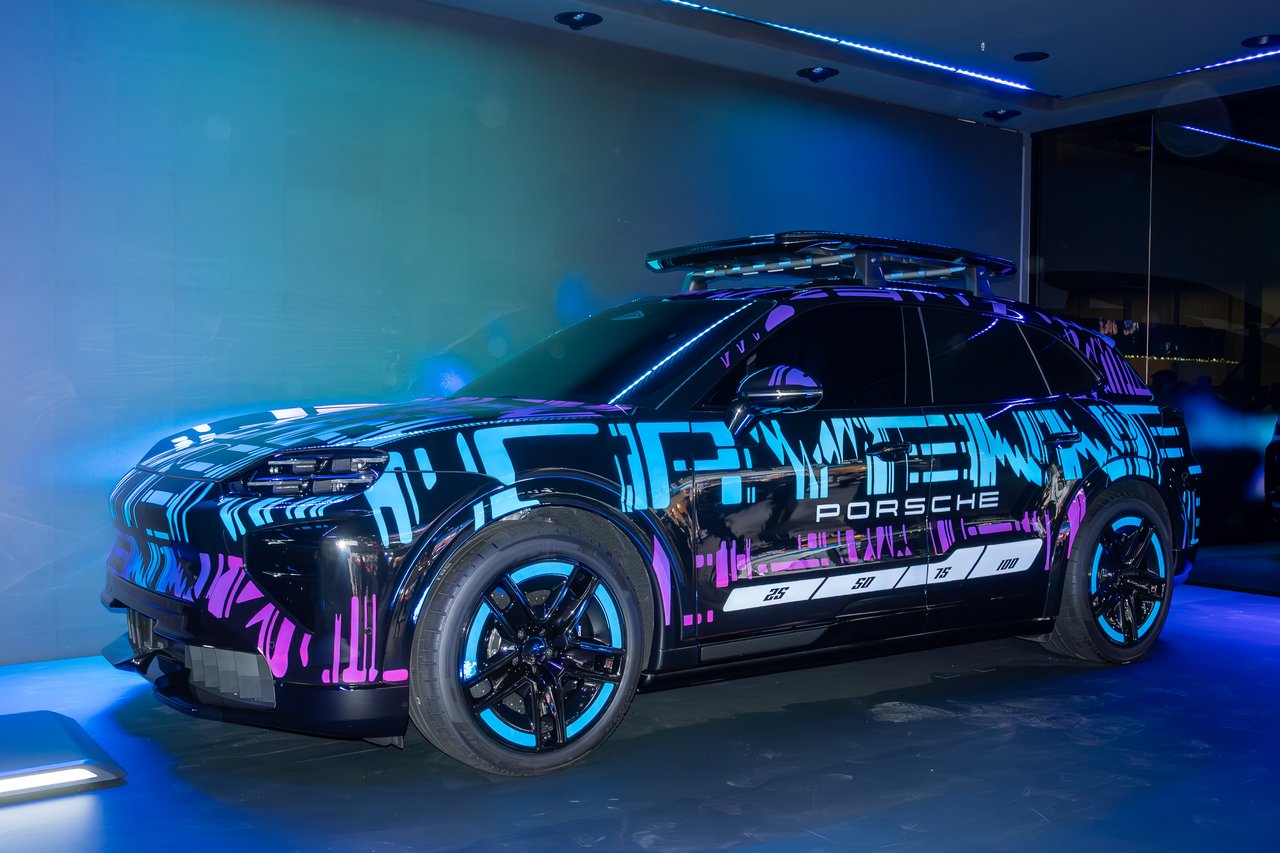
Photo via Wikimedia Commons under CC BY-SA 4.0 license.
The Heavyweight Contender: Why Porsche’s Electric Cayenne is Playing a Long Game
There is a peculiar weight attached to how the automotive industry handles transition. For decades, the Porsche Cayenne has carried two distinct burdens: funding the sports car division’s obsessive engineering habits while carrying five occupants and their luggage across continents at velocities that defy physics. Now, as the Stuttgart manufacturer introduces its first battery-electric high-rider, the stakes are existential. Yet, instead of burning the bridges of internal combustion, Porsche has built a sprawling, three-pronged highway. Alongside the familiar internal combustion engines and plug-in hybrids arrives the 2026 Cayenne Electric—starting life in base trim and the physics-melting 1,139-horsepower Cayenne Turbo Electric.
To understand this machine, one must look past the silent idle and focus squarely on the brutal reality of the large SUV duty cycle. Big SUVs haul families, cargo boxes, and heavy trailers through mountain passes and highway slogs. When electrons replace gasoline, the traditional metrics of thermal efficiency shift entirely to thermal management, high-voltage architecture, and raw torque application. Porsche isn't just building an electric SUV; they are engineering an electric locomotive capable of towing heavy loads without crying uncle under sustained high-load conditions.
Powertrain Deep-Dive: 1,139 Horsepower and the 800-Volt Advantage
At the mechanical and electrical apex sits the Cayenne Turbo Electric. Dual permanently excited synchronous motors orchestrate a staggering 1,139 horsepower and 1,106 lb-ft of torque when Launch Control is summoned. Stomp the accelerator pedal, and the standard-issue 60 mph marker vanishes in a violent 2.4 seconds. But raw acceleration figures tell only half the story. The real engineering triumph lies in how this immense energy is managed and delivered.
Beneath the floorpan sits a massive 113 kWh gross-capacity lithium-ion battery pack, anchored to an 800-volt electrical architecture. Unlike the 400-volt systems still common across the industry, the 800-volt setup slashes internal resistance, minimizes thermal buildup during heavy acceleration and high-speed towing, and enables ferocious charging speeds. When plugged into a high-power DC charger, the Cayenne Electric accepts up to 400 kW. That translates to a 10 to 80 percent state-of-charge replenishment in under 16 minutes—barely enough time to stretch your legs and grab an espresso.
Efficiency, often the Achilles' heel of heavy electric vehicles, has been addressed through rigorous aerodynamic optimization and inverter management. WLTP driving range stretches up to roughly 642 kilometers for the base variant, while the streamlined S Coupe stretches that envelope further to approximately 669 kilometers.
Chassis Dynamics and the Physics of Heavy Hauling
Physics dictates that a battery-electric SUV carrying a massive energy storage system will be heavy. Managing that mass falls entirely to the suspension kinematics and damping hardware. Porsche equips the electric Cayenne with a sophisticated air suspension system paired with Porsche Active Suspension Management (PASM) and electromechanical roll stabilization.
When towing heavy equipment—a domain where traditional EVs historically suffer severe range penalties and thermal throttling—the Cayenne Electric’s cooling circuits work overtime. The dual-motor setup is engineered to distribute torque vectoring dynamically across all four wheels, ensuring that stability is maintained whether you are trailering a two-tonne track car up a six-percent mountain gradient or carving through a sweeping B-road. The regenerative braking system absorbs up to 300 kW of kinetic energy during deceleration, blending seamlessly with friction brakes featuring massive multi-piston calipers to scrub off speed without drama.
2026 Porsche Cayenne Electric Specifications
| Specification | Cayenne Electric (Base) | Cayenne Turbo Electric |
|---|---|---|
| Powertrain | Dual-Motor AWD | Dual-Motor AWD (Performance Tuned) |
| Horsepower | Standard Output (~400 hp class est.) | 1,139 hp (with Launch Control) |
| Torque | Instant Electric Torque | 1,106 lb-ft (1,500 Nm) |
| Transmission | 2-Speed Automatic (Rear axle) | 2-Speed Automatic (Rear axle) |
| 0-100 km/h (0-62 mph) | ~5.0 seconds | 2.4 seconds |
| Battery Capacity | 113 kWh Gross | 113 kWh Gross |
| Architecture | 800-Volt System | 800-Volt System |
| Max DC Charge Rate | Up to 400 kW | Up to 400 kW |
| Charging Time (10-80%) | Under 16 minutes | Under 16 minutes |
| Max Range (WLTP) | Approx. 642 km | Approx. 590-610 km (est.) |
The Multi-Powertrain Strategy
The most revealing aspect of the 2026 Cayenne rollout isn't just the arrival of the EV; it is the deliberate decision to keep combustion engines and plug-in hybrids running on parallel assembly lines. Porsche recognizes that the global luxury market is not moving at a uniform speed. While urban European centers and tech-forward coastal regions are ready for pure electric propulsion, long-distance road trippers and heavy-duty towers in North America and parts of Asia still rely on the infrastructure flexibility of liquid fuel.
By offering ICE, PHEV, and BEV variants simultaneously under the Cayenne badge, Porsche is insulating itself against market volatility while letting the customer dictate the transition pace. Yet, make no mistake: the Turbo Electric sits at the absolute engineering summit of the lineup, proving that electrification is no longer just about saving polar bears—it is about unlocking performance thresholds that internal combustion simply cannot reach.
Frequently Asked Questions
Can the Porsche Cayenne Electric effectively handle heavy towing without severe range loss?
Yes. While all EVs experience reduced range when towing due to aerodynamic drag and rolling resistance, the Cayenne Electric’s 113 kWh battery, 800-volt thermal management, and regenerative capability mitigate the typical thermal throttling issues seen in early-generation electric tow vehicles.
How does the 800-volt architecture benefit daily use?
The 800-volt system allows the Cayenne Electric to accept up to 400 kW of DC fast-charging power. This cuts charging stops down to under 16 minutes for a 10 to 80 percent top-up, significantly reducing downtime on long journeys.
Is the electric Cayenne replacing the traditional gas-powered Cayenne immediately?
No. Porsche is employing a coexistence strategy. The electric Cayenne runs alongside heavily updated internal combustion engine (ICE) and plug-in hybrid (PHEV) models, ensuring buyers can choose the powertrain that best fits their driving habits and local infrastructure.
The Verdict by MasEko
The 2026 Porsche Cayenne Electric is a masterclass in pragmatic engineering disguised as a hyper-SUV. By refusing to abandon traditional powertrain options while simultaneously unleashing a 1,139-horsepower electric monster, Porsche has solved the immediate dilemma of luxury motoring: how to embrace the future without alienating the present. Whether you choose the base model for cross-continent cruising or the Turbo Electric for sports-car-shaming acceleration and heavy hauling, this chassis proves that the soul of a Porsche survives the transition to volts and amperes intact.
Sources and editorial note
Specifications, performance numbers, pricing, and technical measurements in this feature are based on official manufacturer documentation, engineering releases, and certified automotive benchmarks. Real-world parameters may vary based on market specifications and testing conditions.
- https://newsroom.porsche.com/en_US/2025/products/new-porsche-all-rounder-Cayenne-nameplate-expands-portfolio-to-include-electrification-41132.html
- https://newsroom.porsche.com/en/2026/products/porsche-the-new-cayenne-s-electric-41864.html
The featured lead image is sourced from Wikimedia Commons under Creative Commons licensing with proper attribution. Editorial reporting complies with international copyright and fair-use standards.