
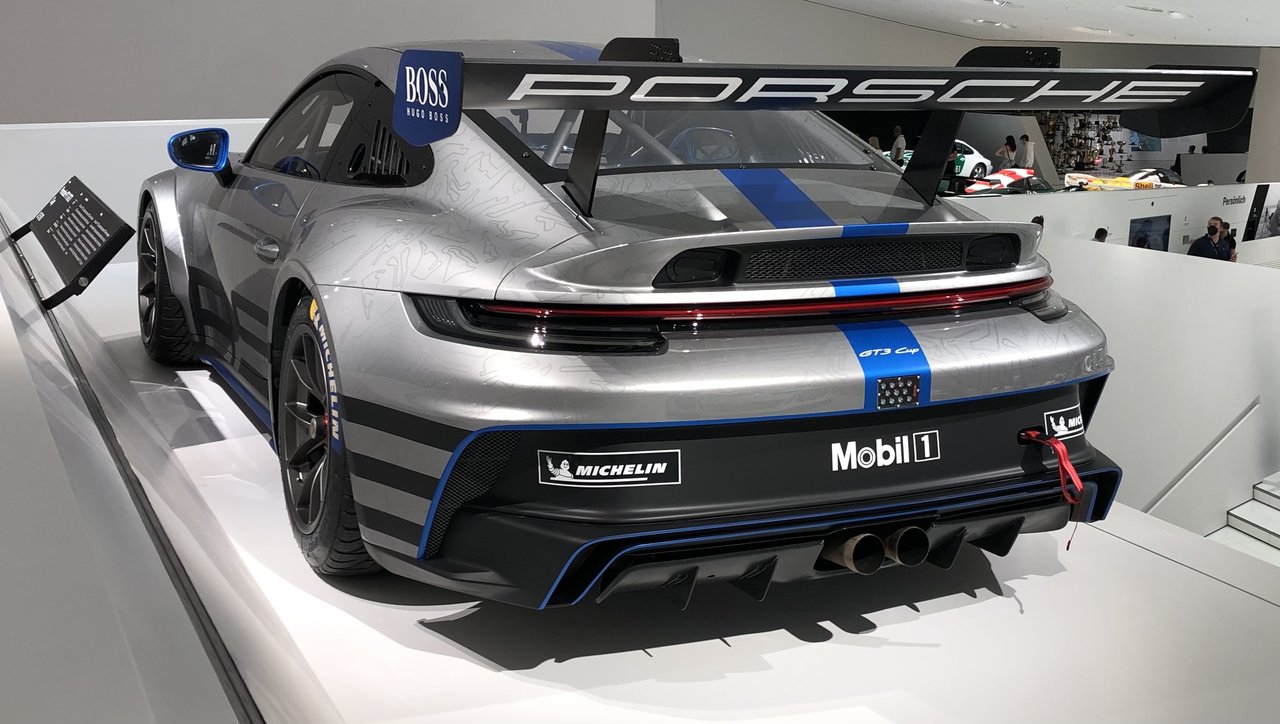
Photo via Wikimedia Commons under CC BY 2.0 license.
Porsche 911 Cup (Type 992.2): The People's Racer Gets Sharper Teeth
For nearly three decades, Porsche's one-make racing cups have been the gateway drug to genuine motorsport. Accessible, reliable, and honest in a way that modern racing rarely is, the 911 Cup represents something increasingly rare: a production-based race car you can actually afford, buy new, and drive to the grid without a corporate budget or factory backing. Now, for the 2026 season, Porsche has refreshed the formula with the new Type 992.2 911 Cup, and the changes run deeper than a simple model year update.
The outgoing 992.1 GT3 Cup was a masterclass in restraint and focus. Over 1,130 examples sold worldwide, making it the best-selling race car in production history. It dominated grids from Europe to Asia, its naturally aspirated 4.0-litre flat-six engine becoming as familiar to privateer racers as their own heartbeat. Porsche has now turned the screws tighter. The new 992.2 Cup carries forward that same accessible philosophy but with sharper performance, refined ergonomics, and the kind of detail engineering that separates Porsche from the rest. This is evolution done right—not revolution for its own sake.
The Engine: More Power, Same Honest Approach
At the heart of the 992.2 Cup sits the same 3,996cc naturally aspirated flat-six that defined the previous generation, but Porsche has squeezed an additional 10 PS from it. The new engine now produces 382 kW (520 PS) at 8,400 rpm, up from 510 PS, with torque holding steady at 470 Nm (347 lb-ft) across a broad plateau from 6,000 to 8,000 rpm. The power increase comes from revised intake and exhaust tuning, optimized fuel injection mapping, and tighter tolerances throughout the breathing system.
What matters here is not just the headline number—though 520 PS from four litres naturally aspirated is genuinely impressive—but the character of that power delivery. Without turbochargers or hybrid assistance, the 992.2 Cup engine responds instantly to throttle input. There's no lag, no electronic intervention muddying the signal between driver intent and mechanical response. That immediacy is addictive on a race track, where every fraction of a second counts and trust between driver and machine is paramount. The engine revs freely to 8,500 rpm, its mechanical symphony unfiltered by acoustic engineering or artificial valve timing tricks.
Porsche has also tightened emissions compliance and improved reliability margins. The 992.2 Cup engine is sealed and homologated for endurance racing, meaning teams can run an entire season on the same internals with minimal maintenance beyond routine servicing. That same reliability translates to lower ownership costs and fewer surprises in the paddock—crucial for gentleman racers and smaller teams running on tight budgets.
Transmission, Differential, and Mechanical Grip
The 992.2 Cup retains the proven Porsche double-clutch seven-speed gearbox, a design so fundamentally sound that Porsche has refined rather than reinvented it. Shift times remain under 100 milliseconds, and the transmission is calibrated specifically for race duty: aggressive downshift blips on engine braking, seamless power delivery on acceleration, and the ability to hold ratios through corner sequences without hunting between gears.
The differential is a limited-slip unit with electronic management, allowing drivers and engineers to adjust locking behaviour at both entry and exit. This adjustability proves critical on varied track layouts—loose, slippery venues like Spa demand different settings than high-grip Monza or technical Nürburgring. Porsche supplies multiple differential maps as standard, and engineers can fine-tune them for specific circuits.
The suspension geometry has been subtly revised for the 992.2. The front MacPherson struts and rear multi-link arrangement remain, but Porsche has retuned spring rates, anti-roll bar stiffness, and damper characteristics. The team focused on increasing front mechanical grip under braking—a critical parameter in one-make racing where aerodynamic advantage is negligible—and sharpening the car's response to mid-corner steering inputs. Anti-dive geometry has been enhanced, meaning the front end stays more level during heavy braking, preserving tire contact patch and driver confidence.
Tire sizes remain 370/710 R18 Michelin Pilot Sport Cup 2 R on both axles, mounted on Centre-Lock aluminum wheels. Braking hardware is likewise familiar: six-piston aluminium calipers up front, four-piston at the rear, gripping perforated 370mm and 330mm rotors respectively. Porsche specs high-friction brake pads optimized for repeated track cycling without fade, an often-overlooked detail that separates genuine race cars from road cars with go-fast aspirations.
Chassis Dynamics and Track Behaviour
On the track, the 992.2 Cup feels like a instrument precision-tuned rather than a blunt weapon. The steering is direct, with minimal kickback through the wheel even under trail-braking into tight corners. Weight distribution sits at 43 per cent front, 57 per cent rear—a balanced compromise that encourages turn-in without sacrificing stability on corner exit.
The real revelation is how playable the chassis is. Unlike road-going Porsches, which can feel nervous and demanding when pushed hard, the Cup car invites aggression. The suspension compliance is low but not punishing; the car communicates what the tires are doing through seat-of-pants feedback rather than electronic nannies. Driver error remains expensive, but mistakes feel earned rather than arbitrary. This feedback loop—where the driver learns the machine's limits through genuine mechanical signals—is what separates true race cars from simulation-based designs.
Aerodynamics are kept deliberately simple: a large fixed rear wing (no DRS or adjustable devices), minimal front splitter, and ducting optimized for cooling rather than downforce. This philosophy keeps costs low and emphasizes mechanical grip over aero dependency. The result is a car that rewards smooth inputs, carries speed through corners, and punishes aggression—exactly what one-make racing should encourage.
Specifications at a Glance
| Specification | Detail |
|---|---|
| Engine | 3,996cc naturally aspirated flat-six |
| Power Output | 382 kW (520 PS) at 8,400 rpm |
| Torque | 470 Nm (347 lb-ft) at 6,000–8,000 rpm |
| Transmission | 7-speed double-clutch automatic |
| 0–100 km/h | 3.3 seconds (estimated) |
| 0–200 km/h | 9.8 seconds (estimated) |
| Top Speed | 300 km/h (governed) |
| Curb Weight | 1,350 kg (2,976 lbs) |
| Length | 4,535 mm (178.5 in) |
| Width | 1,852 mm (72.9 in) |
| Height | 1,305 mm (51.4 in) |
| Wheelbase | 2,450 mm (96.5 in) |
| Front Tires | 370/710 R18 Michelin Pilot Sport Cup 2 R |
| Rear Tires | 370/710 R18 Michelin Pilot Sport Cup 2 R |
| Brakes | 6-piston front (370mm), 4-piston rear (330mm) |
| Fuel Tank | 80 litres (21.1 US gal) |
| Base Price (EUR) | €269,000 (plus local taxes) |
Global Variants and Pricing
Porsche positions the 992.2 Cup as the sole offering in this category—there are no diluted "GT" versions or customer-spec variants. What you buy is what everyone else buys, ensuring a level competitive field across all one-make championships. The €269,000 starting price represents an €44,000 increase over the 992.1's €225,000 base, a jump justified by the performance upgrades, revised chassis, and additional tech integrations. In key markets, pricing translates as follows:
- Europe: €269,000 (VAT not included)
- United States: Approximately $295,000 USD
- United Kingdom: Approximately £245,000 GBP
- Asia-Pacific: Pricing varies by market; Japan typically EUR 330,000 equivalent due to import duties
This pricing makes the 992.2 Cup the most affordable genuine race car Porsche builds new. A GT2 RS costs three times as much and remains largely a road car; the 911 Carrera Cup world cars (GT3 RS-based) command premiums pushing half a million euros. The Cup car's value proposition remains unmatched for drivers serious about racing on a realistic budget.
Market Position and Key Rivals
The 992.2 Cup competes in a category almost entirely of Porsche's own making. No other manufacturer offers a new-build, purpose-designed one-make race car at this price point. The BMW M440i xDrive and Mercedes-AMG C63 S E Performance can be raced through customer sport programmes, but they lack the Cup car's mechanical purity and racing heritage. Lamborghini's Super Trofeo platform operates at a higher price tier and emphasizes V10 drama over efficiency. For privateer racers, the 992.2 Cup remains the gateway to legitimate motorsport competition with manufacturer support, integrated logistics, and genuine prize money.
The backbone of the Porsche Carrera Cup (Europe's premier championship) and the Mobil 1 Supercup, the 992.2 Cup will attract a broad demographic: experienced amateurs seeking next-level competition, semi-professional drivers building race credentials, and wealthy enthusiasts for whom track days feel insufficient. The 992.1's sales volume—1,130 examples over its production run—suggests Porsche will shift comparable numbers of the 992.2 despite the higher entry cost.
Frequently Asked Questions
Q: How does the 992.2 Cup's power compare to the 911 GT3 RS road car?
The GT3 RS produces 518 PS from its 4.0-litre flat-six, just 2 PS shy of the Cup car. However, the Cup engine is a race-homologated unit with optimized fuel octane rating (100 RON race fuel), sharper tuning, and no catalytic converters or emissions hardware. In practice, the Cup engine feels slightly more immediate and responsive. More importantly, the Cup car's weight (1,350 kg) is 150 kg lighter than the RS, making the power-to-weight ratio notably superior on circuit.
Q: Can I actually run this in club-level racing, or is it Carrera Cup only?
While the Cup is homologated primarily for official Porsche championships, many national motorsport federations permit 992.2 Cup cars in broader GT3 racing categories. You'll need to verify your regional governing body (FIA, IMSA, etc.), but the car's performance envelope sits comfortably within most club-level GT3 regulations. Porsche also offers guidance on running spec variants in amateur competition, though you'll be racing against cars modified outside homologated parameters.
Q: Is €269,000 actually affordable for a race car, and what are total ownership costs?
Context matters. Yes, it's expensive by normal standards, but it's genuinely the entry point for new-build, factory-supported racing. A used GT3 RS might cost €100,000, but without race preparation, support, or warranty. The Cup car includes factory backing, spares availability, and competitive parity with rivals. Annual running costs (fuel, tires, brakes, insurance) run €15,000–€25,000 depending on mileage and crash frequency. Maintenance is straightforward; Porsche supplies documented service schedules and parts availability is bulletproof.
Verdict: Engineering Purpose Distilled
The 992.2 Cup represents everything a race car should be: focused, honest, and engineered with discipline rather than excess. The 10 PS increase matters less than the philosophical refinement Porsche has applied across the platform. Every change—revised suspension geometry, enhanced braking feel, tighter engine mapping—points toward a single goal: making customers faster and safer while preserving the mechanical directness that defines racing at its best.
In an era when motorsport increasingly hides behind software, aerodynamic tricks, and hybrid complexity, the 992.2 Cup remains refreshingly analog. You drive it; it doesn't drive you. That simplicity, paired with Porsche's engineering rigour and racing heritage, makes the 992.2 Cup the most legitimate path to genuine motorsport competition money can currently buy new.
Sources and editorial note
Specifications, performance numbers, pricing, and technical measurements in this feature are based on official manufacturer documentation, engineering releases, and certified automotive benchmarks. Real-world parameters may vary based on market specifications and testing conditions.
- https://newsroom.porsche.com/en/2025/motorsports/porsche-911-gt3-cup-race-car-season-2026-40089.html
- https://racing.porsche.com/mobil-1-supercup/911-gt3-cup
The featured lead image is sourced from Wikimedia Commons under Creative Commons licensing with proper attribution. Editorial reporting complies with international copyright and fair-use standards.