
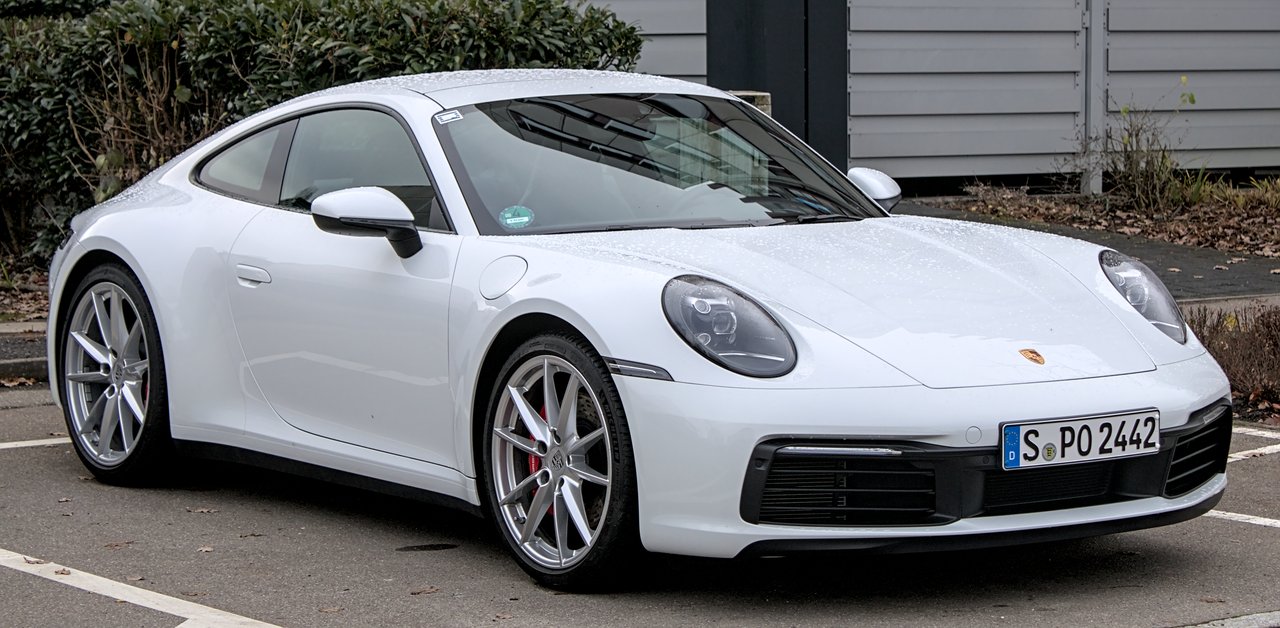
Photo via Wikimedia Commons under CC BY-SA 4.0 license.
The Electrified Rubicon: Why the 992.2 Carrera GTS Matters
For sixty-one years, the Porsche 911 has stood as the sports car world’s most fiercely guarded redoubt of mechanical continuity. Every monumental pivot in Zuffenhausen history—from torsion bars to MacPherson struts in the 964, air cooling to water cooling in the 996, and atmospheric induction to ubiquitous turbocharging in the 991.2—was initially met with pure existential dread by the faithful. Yet, each evolution proved faster, more usable, and mechanically superior to what came before.
Now comes the genuine Rubicon: the 992.2-generation Carrera GTS T-Hybrid. This is the first road-legal production 911 to feature a hybrid powertrain. Porsche knew that bolting heavy plug-in hardware or an oversized battery into the rear-engine architecture would ruin the delicate polar moment of inertia that defines the car. Instead, Weissach engineers devised a purpose-built, high-voltage performance hybrid system derived directly from endurance racing triumphs at Le Mans. The stakes could not be higher. If Porsche got this wrong, they compromised an automotive deity; if they got it right, they redefined the performance sports car for the next decade.
Powertrain Architecture: Inside the T-Hybrid and the 3.6-Liter Flat-Six
Discard any preconceptions born of mundane commuter hybrids or overweight plug-in grand tourers. The Carrera GTS T-Hybrid features an ultra-compact 400-volt electrical architecture designed exclusively to maximize energy density and throttle response, not to creep through city centers on zero-emissions electric power alone.
The All-New 3.6-Liter Boxer Core
At the center of this powertrain sits a clean-sheet horizontally opposed six-cylinder engine. Displacement grows from the outgoing 3.0 liters to 3.6 liters (3,591 cc), achieved via an enlarged 97 mm bore and an 81 mm stroke. Porsche ditched the entire mechanical belt drive assembly: the air-conditioning compressor and coolant pumps are driven electrically by the 400V system. By purging belts and pulleys, engineers decreased the engine's installed height by 110 mm. This newly liberated packaging volume allowed the inverter and DC-DC converter to nest directly above the boxer engine without compromising rear luggage shelf clearance or the car's famously low center of gravity. Operating at an optimal stoichiometric fuel-air ratio ($\lambda = 1.0$) across its entire rev band, the combustion unit alone generates 485 hp (357 kW) and 570 Nm (420 lb-ft) of torque.
The Wastegate-Free Electric Turbocharger (eTurbo)
Rather than relying on twin turbos like the outgoing GTS, the 3.6-liter boxer breathes through a solitary, massive exhaust gas turbocharger developed with BorgWarner. Sandwiched between the compressor wheel and the turbine wheel on the central shaft sits an ultra-compact permanent magnet electric motor capable of delivering up to 11 kW (15 hp).
This electric motor serves two radically distinct functions:
- Lag Elimination: Off throttle or at low exhaust mass flows, the motor spools the compressor wheel instantly to target boost pressures in under 400 milliseconds, eradicating turbo lag entirely.
- Exhaust Energy Harvesting: Under heavy throttle at elevated engine speeds, excess exhaust gas volume spins the turbine past the required boost threshold. Instead of venting this surplus kinetic energy to the atmosphere through a traditional mechanical bypass valve, the electric motor switches instantly to generator mode. It draws power from the exhaust stream, generating up to 11 kW to feed the high-voltage battery or supply the traction motor directly. Consequently, this turbocharger has no conventional wastegate.
PDK Traction Motor and the 1.9 kWh Traction Battery
Integrated within the bellhousing of the reinforced eight-speed dual-clutch transmission (PDK) is a permanent magnet synchronous motor (PMSM). This unit delivers up to 40 kW (54 hp) and 150 Nm (110 lb-ft) of supplemental twist straight into the driveline from zero rpm, acting as both an auxiliary power source and a seamless engine starter.
Electrical energy is stored in a liquid-cooled, 400V lithium-ion battery packing 1.9 kWh of gross capacity. Weighing just 27 kilograms, its physical footprint matches a conventional lead-acid battery, allowing it to sit low in the front luggage compartment for ideal 37:63 front-to-rear static weight distribution. The ancillary 12V electrical system is handled by a separate, lightweight lithium-iron-phosphate (LiFePO4) battery tucked behind the rear parcel shelf. Combined system output climbs to an authoritative 534 hp (398 kW / 541 PS) and 610 Nm (450 lb-ft).
Chassis Kinematics: High-Voltage Handling Precision
Electrifying a 911 introduces an inevitable adversary: mass. The 992.2 Carrera GTS tips the scales at 1,595 kg (DIN curb weight), representing a modest gain of roughly 50 kg over the pure-ICE 992.1 GTS. Weissach countered this mass via integrated chassis kinetics operating on high-voltage power.
Rear-axle steering is now standard equipment, recalibrated with aggressive yaw-rate mapping to sharpen turn-in bite while stabilizing the rear platform under heavy high-speed braking. The standard PASM (Porsche Active Suspension Management) sport suspension lowers ride height by 10 mm relative to the base Carrera, featuring stiffer anti-roll bars, recalibrated adaptive twin-tube dampers, and helper springs at the rear axle to maintain spring seating during full rebound extension.
Critically, the optional Porsche Dynamic Chassis Control (PDCC) active roll stabilization system is integrated directly into the 400-volt high-voltage bus. Utilizing electro-hydraulic actuators instead of traditional 12V or 48V mechanisms, the system generates instantaneous counter-roll torque, keeping the chassis completely flat through high-load transitional corners while decoupling the anti-roll bars in straight-line travel to improve ride compliance. Deceleration duties are managed by massive 408 mm front cast-iron discs clamped by six-piston monobloc calipers (with carbon-ceramic PCCB units optional), integrated seamlessly with regenerative braking algorithms that prioritize firm, uncompromised pedal feel.
Comprehensive Technical Specifications
| Specification | Porsche 911 Carrera GTS (992.2 T-Hybrid) |
|---|---|
| Combustion Engine | 3.6-liter (3,591 cc) horizontally opposed 6-cylinder, 24-valve |
| Aspiration | Single electric exhaust gas turbocharger (eTurbo) without wastegate |
| Electric Traction Motor | PDK-integrated permanent magnet synchronous motor (40 kW / 150 Nm) |
| Traction Battery | 400-volt, 1.9 kWh gross capacity, liquid-cooled lithium-ion (27 kg) |
| Total Combined Output | 534 hp (398 kW / 541 PS) @ 6,500 rpm |
| Total System Torque | 610 Nm (450 lb-ft) @ 1,950–5,000 rpm |
| Transmission | 8-speed dual-clutch transmission (PDK), Rear-Wheel Drive (AWD available) |
| 0–100 km/h (0–62 mph) | 3.0 seconds (Sport Chrono Package) |
| Top Track Speed | 312 km/h (194 mph) |
| Nürburgring Lap Time | 7:16.93 minutes (8.7 seconds faster than 992.1 GTS) |
| Curb Weight (DIN) | 1,595 kg (3,516 lbs) Coupe, RWD |
| Dimensions (L x W x H) | 4,553 mm x 1,852 mm x 1,298 mm | Wheelbase: 2,450 mm |
| Starting Price (Base MSRP) | $164,900 USD / £132,600 GBP / €170,600 EUR |
Driving Dynamics: The Mountain Pass and the Track Reality Check
Throw the 992.2 GTS into a string of third-gear mountain switchbacks, and the traditional characteristics of turbocharged driving evaporate. Step on the throttle mid-corner, and the latency typical of an exhaust-driven impeller never materializes. The eTurbo spins instantly on electrical impulse while the PDK motor injects 150 Nm into the crankshaft. The resulting thrust feels distinctly naturally aspirated in its linearity, yet carries the brutal torque curve of a high-displacement forced-induction powerplant.
The steering retains Porsche's benchmark electromechanical rack: communicative, weighted with surgical precision, and resistant to kickback over mid-corner pavement seams. When turning into a technical apex, the rear axle steps in subtly, pivoting the car's mass with supernatural agility. On the Nürburgring Nordschleife, factory pilot Jörg Bergmeister clocked a blistering 7:16.93 on Michelin Pilot Sport Cup 2 R rubber—a massive 8.7-second evisceration of the 992.1 GTS's benchmark. That time places this "everyday" GTS squarely in the historic territory of the 991 GT3 RS, proving that the hybrid powertrain easily neutralizes its own 50 kg weight penalty.
Purist Sacrilege or Mechanical Nirvana?
The purist fraternity will inevitably lament two casualties: the manual gearbox is dead for the GTS, and electrification has officially breached the 911 citadel. Because the electric traction motor is embedded directly into the PDK casing and requires microsecond torque matching during transient shifts and kinetic harvesting, a traditional three-pedal manual transmission was architecturally impossible to implement.
Yet, dismissing the T-Hybrid as an eco-compromise misunderstands Weissach’s execution. This car is not a compliance special built for electric tax breaks. It does not carry a charging plug, and it cannot run on silent pure EV power for your morning commute. The hybrid components exist for one solitary purpose: mechanical violence. The exhaust note remains a howling, uneven boxer growl, sharpened by the single turbine and high-compression combustion chamber. It respects the car's athletic lineage through authentic engineering problem-solving.
Market Positioning and Global Rivals
The 992.2 Carrera GTS sits in an enviable sweet spot within the modern sports car pantheon. Available globally in Coupe, Cabriolet, and all-wheel-drive Targa 4 configurations, it occupies the wide performance chasm between the base 911 Carrera and the track-focused GT3.
Looking outward, rivals present wildly divergent philosophies:
- Chevrolet Corvette Z06: The American alternative brandishes an exotic 5.5-liter flat-plane-crank atmospheric V8 shouting to 8,600 rpm. It offers unmatched acoustic theater at a lower price point, but lacks the surgical packaging, all-weather usability, and high-speed braking stability of the 911.
- Mercedes-AMG GT 63 4MATIC+: Packing a thundering 4.0-liter twin-turbo V8, the AMG delivers sledgehammer straight-line performance and grand-touring opulence, but its porky 1,970 kg curb weight renders it cumbersome on tight technical circuits compared to the lithe Porsche.
- McLaren Artura: A carbon-tubbed plug-in hybrid V6 offering superior power-to-weight metrics and pure EV range, but commanding a dramatically higher price tag alongside ongoing questions regarding everyday ergonomics and long-term durability.
Frequently Asked Questions
Why did Porsche choose a performance hybrid instead of a Plug-in Hybrid (PHEV)?
A PHEV setup mandates a massive battery (typically 15 to 25 kWh) to provide meaningful electric-only driving range. That battery hardware would add 200 to 300 kilograms of dead weight, fundamentally ruining the 911’s iconic rear-engine handling characteristics, luggage capacity, and braking dynamics. The compact 1.9 kWh T-Hybrid system prioritizes performance output, rapid energy cycling, and extreme weight efficiency over zero-emissions commuter range.
Can I order the 992.2 Carrera GTS with a manual transmission?
No. The Carrera GTS T-Hybrid is exclusively equipped with the eight-speed dual-clutch transmission (PDK). The electric motor is physically packaged inside the PDK bellhousing, and the hybrid energy management strategy requires sub-millisecond throttle-and-torque handoffs that are mechanically impossible to harmonize with an analog foot clutch and manual gear selection.
How does the eTurbo control boost pressure without a traditional wastegate?
Traditional turbochargers use a pneumatic or electronic wastegate valve to divert excess exhaust gases away from the turbine wheel to prevent over-boosting. In the T-Hybrid, the electric motor mounted to the turbo shaft acts as an electromagnetic brake. When target boost is achieved, the motor generates resistance on the shaft to cap rotational speed, converting that otherwise wasted kinetic exhaust energy into up to 11 kW of electrical power to charge the high-voltage battery.
The Verdict: MasEko's Engineering Take
The 992.2 Carrera GTS T-Hybrid is a triumphant engineering masterclass. Instead of bending the knee to bloated, disconnected electrification, Porsche channeled high-voltage technology to save forced induction from its own worst vices. By engineering an electric turbocharger that functions simultaneously as a lag-killer and an exhaust gas power plant, Weissach delivered razor-sharp throttle fidelity and colossal mid-range punch without saddling the car with crippling bulk.
Losing the manual transmission stings the traditional enthusiast heart, but from a purely mechanical perspective, this machine is an astonishing achievement. The hybrid 911 has arrived, and it remains the undisputed king of the usable, high-performance sports car universe.
Sources and editorial note
Specifications, performance numbers, pricing, and technical measurements in this feature are based on official manufacturer documentation, engineering releases, and certified automotive benchmarks. Real-world parameters may vary based on market specifications and testing conditions.
The featured lead image is sourced from Wikimedia Commons under Creative Commons licensing with proper attribution. Editorial reporting complies with international copyright and fair-use standards.