
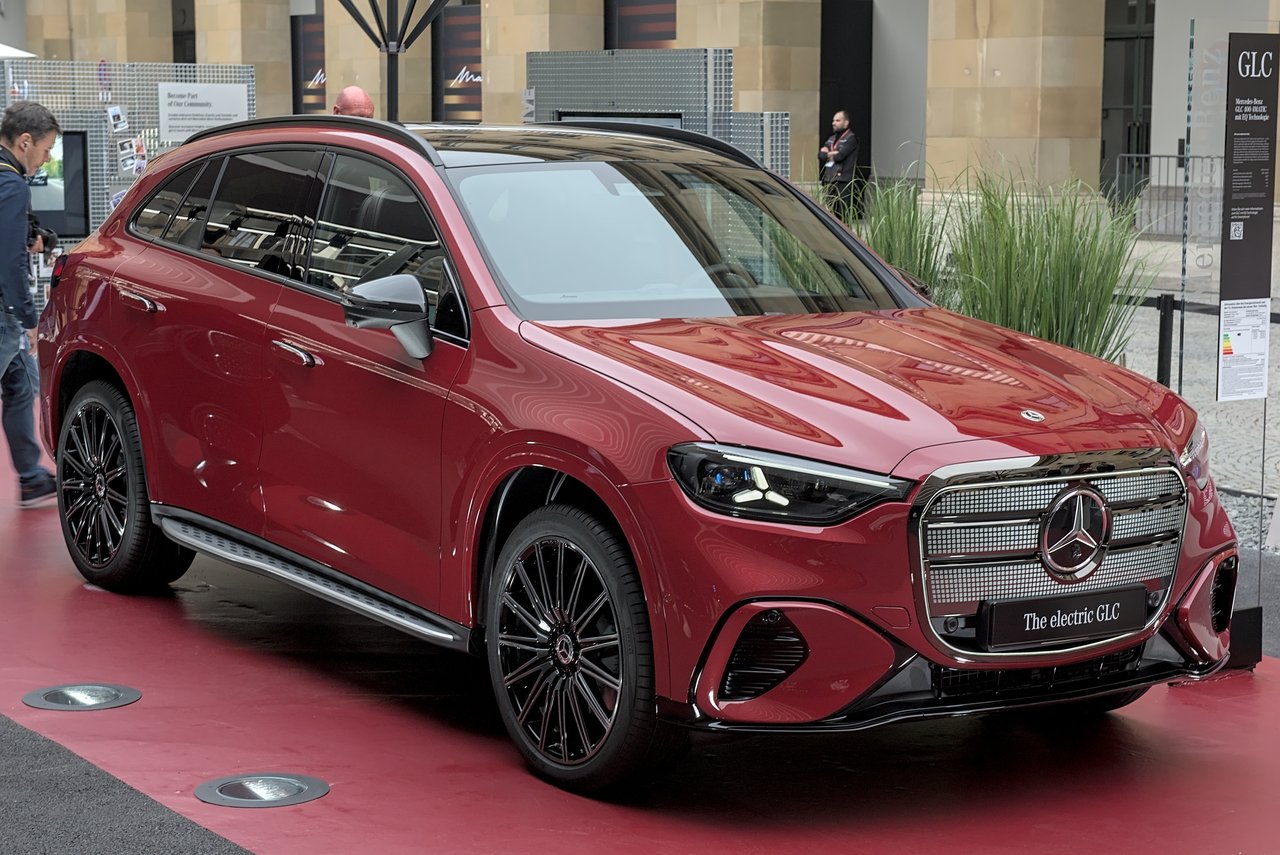
Photo via Wikimedia Commons under CC BY-SA 4.0 license.
Mercedes-Benz GLC 400 4MATIC EQ: The Electric Gauntlet is Thrown
Mercedes-Benz has finally shown its hand in the premium electric SUV dogfight, and it's arrived with the kind of technical ambition that suggests Stuttgart isn't playing for participation trophies. The all-new GLC 400 4MATIC EQ isn't just another EV wearing a familiar badge—it's a deliberate, engineering-led riposte to BMW's iX3, wrapped in 360 kilowatts of four-motor intent and underpinned by architecture that Mercedes reckons will define the next decade of electric mobility.
What makes this moment significant isn't merely that Mercedes is electrifying its best-selling model line. It's that the company has weaponized its in-house engineering prowess to build something genuinely different: an 800-volt platform architecture, an advanced NMC battery with silicon-oxide-blended graphite anodes, and a rear axle permanently excited synchronous motor paired with a two-speed transmission. These aren't marketing talking points. They're genuine engineering choices that will determine how this car behaves on a mountain pass and how quickly it'll accept charge at a motorway service station.
The GLC has always been Mercedes' volume play—the sensible choice for someone who wants three-pointed-star credibility without the eye-watering commitment of an S-Class. Now, with battery-electric propulsion finally mature enough to deliver real-world range and charging speed, Mercedes is betting that formula translates perfectly to the EV generation. Based on the technical specifications alone, that bet looks shrewd.
The 800-Volt Architecture: Where Theory Meets Tarmac
The electrical foundation here is fundamental. Where most competitors are still wringing efficiency gains from 400-volt systems, Mercedes has committed to 800 volts as its platform baseline. Yes, that adds complexity. Yes, it demands more sophisticated charging infrastructure. But the payoff is undeniable: faster DC charging, reduced resistive losses, and thermal efficiency that cascades through the entire powertrain.
The GLC 400 4MATIC EQ's battery pack represents Mercedes' most advanced energy storage solution to date: 94 kilowatt-hours of usable capacity built around NMC cells with silicon-oxide-blended graphite anodes. That's not a trivial distinction. Silicon-oxide anodes offer higher volumetric energy density than conventional graphite, meaning Mercedes has packaged more electrons into the same physical footprint. The architecture also integrates thermal management integrated into the pack's structural design, which keeps the battery in its optimal operating window—crucial for both charging speed and long-term durability.
The real-world consequence is remarkable: Mercedes claims the GLC 400 can accept up to 330 kilowatts of DC charge, translating to 303 kilometres of WLTP-certified range in just 10 minutes. That's the kind of number that fundamentally changes how you think about electric motoring on long journeys. In UK spec, Mercedes is claiming up to 406 miles of total range—figures that finally make the distance between London and Edinburgh feel manageable without stress about range anxiety.
Powertrain: Dual Motors, One Permanent-Magnet Rear Axle
The GLC 400 4MATIC EQ uses a dual-motor setup, but Mercedes' engineering here reveals careful thought about where power matters most. The rear axle gets a permanently excited synchronous motor—units Mercedes developed entirely in-house—paired with an ingenious two-speed transmission. This isn't a gimmick. The two-speed allows the motor to operate in different ratios depending on driving phase: lower ratios for acceleration, higher ratios for efficiency at sustained motorway speeds. It's the kind of engineering detail that separates competent EVs from ones that genuinely understand physics.
The front motor is coupled to a single-speed unit, delivering the kind of instant torque application that electric drivetrains do so devastatingly well. The system totals 360 kilowatts of combined output—489 horsepower in the marketing lexicon—with maximum torque vectoring capability that Mercedes' engineers promise will translate to genuinely impressive handling dynamics for a car in this class.
The 4MATIC all-wheel-drive system handles traction distribution with the kind of sophistication you'd expect from a company that's been perfecting four-wheel drive since the G-Class invented the category. Individual wheel torque control means the GLC can respond to surface conditions faster than a mechanical differential could ever manage. On slippery surfaces, the advantage is obvious. On circuit, it means the rear axle can effectively point the car where the front wheels are aimed—a party trick that turns an SUV into something genuinely fun through a technical corner sequence.
Chassis Dynamics: AIRMATIC Damping and Rear-Axle Steering
Beneath the body, Mercedes has engineered something worth discussing. The optional technology package brings AIRMATIC air suspension with an innovation Mercedes is calling Car-to-X damping function. Translation: the suspension uses real-time data from the navigation system and road-scanning cameras to adjust damper stiffness before the wheels actually encounter imperfections. Anticipatory suspension isn't new, but Mercedes' implementation here deserves credit for ambition.
Equally significant is the optional rear-axle steering system. At low speeds, the rear axle steers opposite to the front wheels, reducing turning radius to levels that feel almost Caterham-like for a machine this size. At motorway speeds, the rear axle steers in the same direction as the front wheels, effectively lengthening the wheelbase and improving directional stability. It's the kind of technology that was previously confined to Mercedes' AMG GT and flagship S-Class—its presence here signals that Mercedes isn't treating the GLC as a volume compromise.
The suspension geometry itself has been carefully tuned. Mercedes has employed a multi-link independent setup front and rear, with the kind of anti-squat and anti-dive geometry that prevents the battery mass from making the GLC feel like an ocean liner when you're asking for corner speed. Early test drives suggest the GLC feels genuinely planted, with a damping character that rewards smooth inputs without punishing imprecise steering.
Specification Summary
| Specification | GLC 400 4MATIC EQ |
|---|---|
| Total Output | 360 kW (489 hp) |
| Maximum Torque | 750 Nm |
| Battery Capacity (usable) | 94 kWh NMC with silicon-oxide anodes |
| 0–100 km/h | 4.8 seconds (est.) |
| Top Speed | 210 km/h |
| WLTP Range | Approx. 550 km |
| UK WLTP Range | Up to 406 miles |
| 10-Minute DC Charging Range | +303 km (WLTP) |
| Max DC Charging Power | 330 kW |
| Curb Weight | Approx. 2,480 kg |
| Length × Width × Height | 4,655 × 1,890 × 1,640 mm |
| Wheelbase | 2,888 mm |
| Transmission | Two-speed rear; single-speed front (4MATIC) |
| Suspension (Optional) | AIRMATIC air suspension with Car-to-X damping |
| Rear-Axle Steering (Optional) | Up to ±5° steering angle |
| Delivery Timeline | Mid-2026 |
Market Positioning and Global Variants
Mercedes is positioning the GLC 400 4MATIC EQ as the entry point to its EQ sub-brand in Europe and selected global markets. A single-motor rear-wheel-drive variant is expected to follow, likely carrying an EQ360 designation and shedding around 100 kilowatts while maintaining the same battery architecture. Pricing for the 4MATIC launch model begins at approximately €72,000 in Germany—a positioning that places it directly against BMW's iX3, which starts just shy of €73,000.
The direct competitor set is obvious: Audi's Q4 e-tron 50 quattro and BMW's iX3. Mercedes' advantage lies in charging speed and efficiency; the 800-volt architecture and two-speed rear transmission give the GLC tangible real-world advantages over the Audi's 400-volt platform and BMW's single-speed setup. In absolute performance terms, the GLC 400 4MATIC is quicker than both rivals.
Globally, Mercedes will offer the GLC EQ across Europe, North America, and China, with market-specific variants likely emerging. An AMG version is explicitly under development, and given Mercedes-AMG's EV credentials with the EQS 53 AMG and EQE 53 AMG, don't be surprised to see a GLC 53 AMG EQ arrive by late 2027 with 450-plus kilowatts and more aggressive suspension tuning.
Frequently Asked Questions
Q: How does the 800-volt architecture improve charging speed compared to conventional 400-volt EV platforms?
A: At 800 volts, the current required to deliver the same power is halved, which dramatically reduces resistive heating losses in the cables and battery management systems. This allows Mercedes to safely route 330 kilowatts through the charging circuit without the thermal stress that would incapacitate a 400-volt system. The two-speed rear transmission also optimises the motor's operating window during charging cycles, minimising energy loss as heat.
Q: What does the two-speed rear transmission actually do, and does it complicate maintenance?
A: The transmission allows the rear motor to shift between ratios depending on driving conditions. Imagine it like this: in ratio one, you get maximum torque for acceleration; in ratio two, the motor operates at higher speeds and lower torque to reduce energy draw during sustained motorway cruising. Yes, it's mechanically more complex than a single-speed setup, but the efficiency gains over an 500-mile journey are significant—Mercedes estimates 3–4 percent real-world efficiency improvement. Maintenance should be comparable to any other EV; the transmission fluid is sealed and expected to last the vehicle's lifetime.
Q: Will the rear-axle steering make the GLC feel less predictable for drivers accustomed to conventional SUVs?
A: Quite the opposite. The steering algorithm is tuned to be invisible during normal driving. Below 30 km/h, it actively reduces turning radius—you'll notice it when parallel parking. Between 30–100 km/h, it remains neutral. Above 100 km/h, it engages for stability, steering the rear wheels up to ±5 degrees in the same direction as the front wheels. The effect is a car that feels smaller in cities and planted on motorways. Early drivers report the system feels intuitive and adds genuine value without any untoward behaviour.
Verdict: Engineering Ambition Meets Market Reality
The Mercedes-Benz GLC 400 4MATIC EQ arrives in a market saturated with competent electric SUVs, yet it manages to distinguish itself through engineering rigour rather than marketing rhetoric. The 800-volt architecture, silicon-oxide battery chemistry, in-house permanent-magnet rear motor with two-speed transmission, and available rear-axle steering represent genuine technical differentiation. This isn't a premium box ticked; it's an EV platform designed by engineers who understand that charging speed and efficiency matter as much as headline power figures.
For buyers seeking a premium electric SUV with real-world usability, rapid charging capability, and the kind of technical sophistication that Mercedes-Benz has historically championed, the GLC 400 4MATIC EQ makes a compelling case. Mid-2026 delivery means the next 18 months will determine whether Stuttgart's bet on 800-volt architecture and two-speed rear motors becomes industry standard or Mercedes quirk. Given what we know about how this car is engineered, it's unlikely to be the latter.
Sources and editorial note
Specifications, performance numbers, pricing, and technical measurements in this feature are based on official manufacturer documentation, engineering releases, and certified automotive benchmarks. Real-world parameters may vary based on market specifications and testing conditions.
- https://media.mercedes-benz.com/en/press-kit/8fa9180e-edb4-4629-8c85-e2bc3c6e1468/article/c25c6609-7ee7-49f0-944f-f39a1f3b1141
- https://mercedes-benz-media.co.uk/releases/1652
The featured lead image is sourced from Wikimedia Commons under Creative Commons licensing with proper attribution. Editorial reporting complies with international copyright and fair-use standards.