
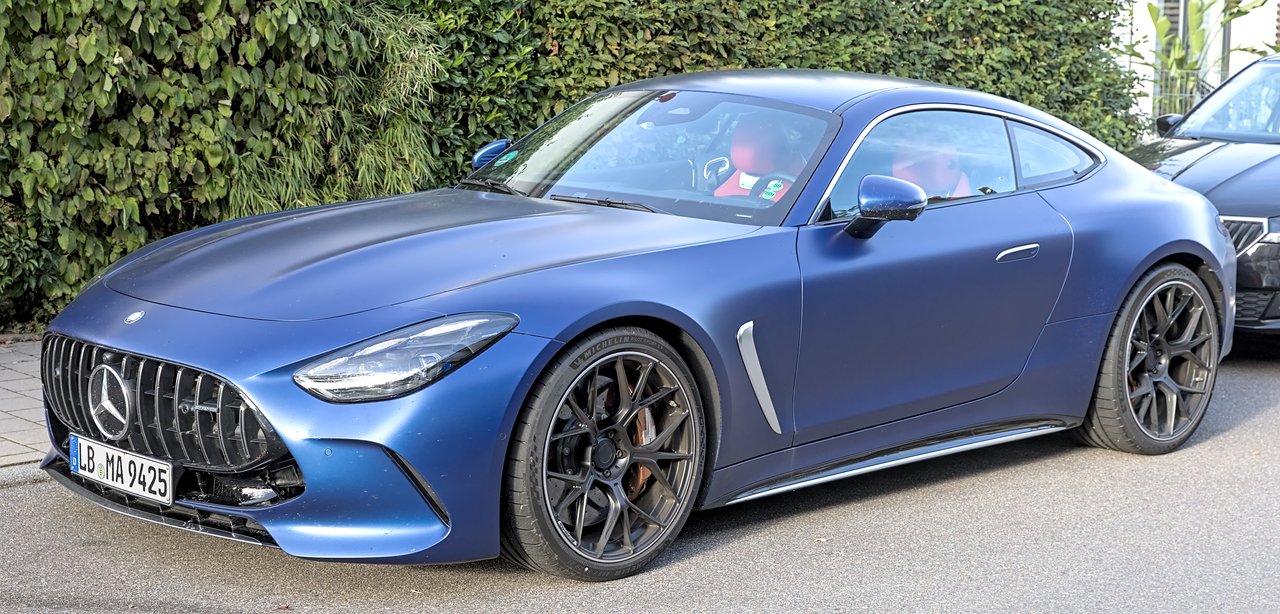
Photo via Wikimedia Commons under CC BY-SA 4.0 license.
The Megawatt Sledgehammer: Engineering the Mercedes-AMG GT 63 S E Performance
Affalterbach has abandoned the gentrified path of hybrid efficiency. While mainstream electrification focuses on zero-emission range and compliance credits, Mercedes-AMG has repurposed hybrid hardware as a weapon of sheer kinetic violence. The result is the GT 63 S E Performance—available in both the imposing four-door grand tourer and the newly engineered second-generation two-door coupe. It is a technological flagship that merges old-school internal combustion fury with Formula 1-derived electrical energy deployment.
The headline figures demand respect: a staggering 805 horsepower (816 PS) and 1,047 lb-ft (1,420 Nm) of combined torque in the two-door coupe, executing 0-60 mph in a blistering 2.7 seconds on its way to a 199-mph terminal velocity. Yet, the raw data only scratches the surface of what AMG has achieved. By rejecting off-the-shelf plug-in hybrid architecture in favor of a bespoke, motorsport-grade transaxle configuration, AMG engineers have built an uncompromising grand tourer engineered to bend the laws of physics on track while preserving legitimate road-trip ergonomics.
Powertrain Architecture: Hot-V Meets Brixworth Electron Density
Under the long, sculpted hood sits an engine that needs no introduction: the M177 4.0-liter twin-turbocharged V8. Configured in a classic "hot inside V" layout, its twin-scroll turbochargers nestle between the cylinder banks for razor-sharp throttle response and minimal exhaust manifold runner length. In this iteration, the combustion engine alone delivers 603 hp and 627 lb-ft of torque. It is dry-sump lubricated, features direct piezoelectric injection operating at up to 200 bar, and breathes through water-to-air charge-air coolers optimized for thermal stability under prolonged track loading.
The revolutionary engineering, however, lives entirely at the rear axle. Co-developed with Mercedes-AMG High Performance Powertrains in Brixworth—the mastermind facility behind Mercedes’ dominant F1 hybrid powertrains—AMG installed a self-contained Electric Drive Unit (EDU). This compact modular assembly integrates a permanently excited synchronous electric motor (PSM), an automated two-speed gearbox, and an electronically controlled limited-slip rear differential into a single housing.
The electric motor generates a peak 201 hp (150 kW) and 236 lb-ft of torque. Because the EDU is mounted aft, its power bypasses the primary front-mounted transmission entirely, translating immediate torque into forward thrust without driveline elasticity or gear-ratio inertia. To prevent the electric motor from running out of breath as speeds climb, the integrated two-speed gearbox utilizes an electric actuator to shift into its taller second ratio at approximately 87 mph (140 km/h)—the threshold where the motor approaches its 13,500-rpm redline.
Formula 1 Thermal Science: The High Performance Battery (HPB)
Feeding the rear motor is AMG’s proprietary High Performance Battery (HPB). Unlike traditional EV and PHEV batteries designed for slow continuous discharge and maximum energy density, the Affalterbach unit focuses on rapid power throughput and instantaneous regeneration. With a modest gross capacity of 6.1 kWh operating on a 400-volt architecture, the pack weighs just 196 pounds (89 kg).
The engineering secret lies in direct liquid cooling. Standard hybrid packs rely on cooling plates beneath or beside cell arrays, causing internal heat gradients that trigger power derating under stress. AMG developed high-tech non-conductive dielectric fluid that circulates around all 560 cylindrical cells individually. Fourteen liters of coolant flow continuously through an optimized heat exchanger, maintaining an ideal battery operating window of 45 degrees Celsius regardless of how violently the driver cycles between wide-open throttle and maximum energy recuperation (which can pull up to 100 kW back into the pack across four selectable driver levels).
Drivetrain Kinematics: The Mechanical-Electrical Matrix
Routing internal combustion power to the ground is the AMG SPEEDSHIFT MCT 9G (Multi-Clutch Transmission). In place of a conventional hydraulic torque converter, it employs a wet start-off clutch pack. This configuration sheds rotational inertia, sharpens launch response, and allows aggressive multi-gear downshifts under braking.
The truly ingenious mechanical nuance is the bidirectional nature of the AMG Performance 4MATIC+ all-wheel-drive system. While the electric motor sits directly on the rear axle, it is not mechanically isolated from the front wheels. Should the rear tires break traction under full electric deploy, the electronic rear differential and mechanical propshaft can mechanically divert electric torque back through the central transfer case to the front wheels. The mechanical and electrical powertrains do not merely coexist; they actively balance one another through mechanical linkage and milliseconds-fast algorithm adjustments.
Chassis Engineering: Taming Inertia with Active Hydraulics
Tipping the scales at roughly 4,674 lbs (2,120 kg) for the 2-Door Coupe and over 5,100 lbs for the 4-Door, controlling mass transfer was the single greatest kinematic hurdle for AMG chassis development. Affalterbach tackled this with AMG ACTIVE RIDE CONTROL suspension, discarding conventional mechanical anti-roll bars in favor of an interconnected hydraulic stabilization system.
Each adaptive damper features two hydraulic connections—one on the compression stage, one on the rebound stage. The fluid circuits of all four wheels are hydraulically cross-linked via proportional valves connected to central accumulators. When cornering, the system pumps hydraulic fluid to the outside dampers while relieving pressure on the inside units, physically arresting body roll without making the ride harsh in a straight line. During single-wheel road imperfections, the system decouples wheel kinematics entirely, delivering grand-touring compliance previously unattainable on track-focused platforms.
Complementing the hydraulics is active rear-axle steering. Below 62 mph (100 km/h), the rear wheels turn up to 2.5 degrees out of phase with the fronts to effectively shorten the wheelbase, tucking the nose sharply into tight hairpins. Above that speed, the rears steer in phase up to 0.7 degrees, virtually extending the wheelbase for high-speed stability through fast sweepers. Scrubbing off velocity falls to standard AMG ceramic high-performance composite brakes: monstrous 420 mm carbon-ceramic front discs clamped by bronze-painted six-piston fixed calipers, working alongside 380 mm rear discs.
Technical Specifications: Mercedes-AMG GT 63 S E Performance
| Mechanical Parameter | GT 63 S E Performance Coupe (C192) | GT 63 S E Performance 4-Door (X290) |
|---|---|---|
| Engine Type | 4.0L M177 Twin-Turbo Hot-V V8 | 4.0L M177 Twin-Turbo Hot-V V8 |
| Displacement | 3,982 cc | 3,982 cc |
| Combustion Output | 603 hp @ 5,500–6,500 rpm / 627 lb-ft | 630 hp @ 5,500–6,500 rpm / 664 lb-ft |
| Electric Motor Output | 201 hp (150 kW) / 236 lb-ft (320 Nm) | 201 hp (150 kW) / 236 lb-ft (320 Nm) |
| Total System Output | 805 hp (816 PS) / 1,047 lb-ft (1,420 Nm) | 831 hp (843 PS) / 1,032 lb-ft (1,400 Nm) |
| Battery Architecture | 6.1 kWh gross, 400V, Direct Liquid Cooling | 6.1 kWh gross, 400V, Direct Liquid Cooling |
| Primary Transmission | 9-speed AMG SPEEDSHIFT MCT (Wet Clutch) | 9-speed AMG SPEEDSHIFT MCT (Wet Clutch) |
| Secondary Transmission | 2-speed Automated Dog Box (Rear Axle) | 2-speed Automated Dog Box (Rear Axle) |
| Driveline | Fully Variable 4MATIC+ AWD w/ Propshaft Pass-Through | Fully Variable 4MATIC+ AWD w/ Propshaft Pass-Through |
| 0–60 mph Acceleration | 2.7 seconds | 2.8 seconds |
| Top Track Speed | 199 mph (320 km/h) | 196 mph (316 km/h) |
| Curb Weight (EST) | 4,674 lbs (2,120 kg) | 5,100 lbs (2,313 kg) |
| Base Price (MSRP USD) | Est. $205,000 | $194,900 |
Behind the Wheel: Track Assault and Dynamic Decoupling
Drop into the heavily bolstered AMG Performance bucket seats, press the knurled starter button on the steering wheel, and the car awakens in default "Electric" mode with eerie, silence. But twist the rotary drive-mode controller to "Race," and the V8 snaps to life with a guttural, bass-heavy idle that rattles your ribcage.
Charging into turn two at a damp circuit exposes the chassis wizardry. With over two tons of mass, entry speed should theoretically push the front Michelin Pilot Sport 4S tires into stubborn understeer. Instead, the active rear steering pivots the chassis aggressively toward the apex while hydraulic roll control locks the vehicle flat against the asphalt. There is almost zero body roll to telegraph weight transfer; the lateral grip simply builds until your neck muscles strain.
The defining revelation is apex exit. In a traditional rear-drive or even conventional all-wheel-drive GT, 600-plus pound-feet of low-rpm turbo torque requires calculated throttle feathering to avoid unsettling the rear footprint. In the E Performance, you plant your right foot, and the electronic management suite executes a mechanical miracle. The electric motor fills the fractional turbo spool lag instantly, driving the rear axle forward. As the rear tires approach their slip limit, the mechanical all-wheel-drive hardware seamlessly routes surplus electric torque forward through the propshaft. The car hooks up, fires out of corners with unholy traction, and presses you deep into the upholstery.
Cabin Ergonomics, 2+2 Utility, and Market Positioning
Unlike the previous two-seat GT Coupe, the new two-door platform adopts a versatile 2+2 architecture, sharing structural packaging advances with the SL roadster. Up front, modern luxury reigns: the 11.9-inch portrait MBUX touchscreen is intuitive, the turbine air vents are milled with jewelry-grade precision, and high-definition telemetry screens display real-time cell temperatures, motor RPM, and hybrid torque split percentages.
Practicality has taken a noticeable leap forward. The rear seats in the Coupe are admittedly occasional accommodation—suitable primarily for luggage, gear bags, or small children under five feet tall—but their inclusion dramatically expands daily usability. Fold those rear seatbacks down, and the hatchback rear cargo area effortlessly swallows two full-sized golf bags or weekend luggage. The 4-Door variant remains the executive express of choice, providing genuine executive rear legroom alongside executive-class high-speed cruising comfort.
In the market, the GT 63 S E Performance Coupe squares off directly against the benchmark Porsche 911 Turbo S and Aston Martin DB12, while the 4-Door battles the Porsche Panamera Turbo E-Hybrid and Bentley Continental GT Speed. The AMG lacks the lightweight scalpel purity of a 911 Turbo S, but counters with violent mid-range torque, effortless everyday utility, and an exhaust sound that no flat-six or hybrid V6 can match.
Frequently Asked Questions (FAQ)
Why does the car have such a small 6.1 kWh battery with only ~7 miles of EV range?
The High Performance Battery was never intended for commuter EV cruising. AMG engineered this pack strictly as an electrical booster and energy recuperation sponge. A massive 25 kWh battery would add another 400 to 600 pounds of dead weight, ruining the car's agility. The 6.1 kWh direct-cooled battery allows maximum charge and discharge rates continuously, ensuring that full boost is always on tap even during aggressive track driving.
How can the rear electric motor drive the front wheels if it is mounted in the back?
Unlike electronic all-wheel-drive setups (like those in Toyota or Lexus hybrids where the rear motor operates disconnected from the engine), AMG retains a mechanical propshaft running down the center tunnel. The rear Electric Drive Unit is mechanically tied into the rear differential, which connects directly to the central 4MATIC+ transfer case. If the rear axle breaks traction, the mechanical driveshaft can physically redirect electric power forward to the front wheels.
Does the massive curb weight dull the sports car sensations on track?
Straight-line acceleration and corner-exit punch are undeniably heightened, but physics cannot be entirely erased. While the AMG ACTIVE RIDE CONTROL hydraulic anti-roll suspension and active rear-axle steering disguise the car's 4,600+ pound weight remarkably well through medium- and high-speed transitions, prolonged lapping will inevitably test tire wear and thermal limits. It behaves not like an ultra-lightweight track special, but like an astonishingly athletic grand tourer engineered to crush lap times with brute force and computational precision.
The Verdict: An Engineering Tour de Force
The Mercedes-AMG GT 63 S E Performance is not an apology for the internal combustion engine; it is its ultimate evolutionary reinforcement. Affalterbach has refused to dilute the soul of the AMG brand, using electrical hybridization exclusively to augment the mechanical excellence of its twin-turbo V8. By marrying Formula 1 battery cooling technology, bespoke transaxle electric packaging, and groundbreaking hydraulic roll control, Mercedes-AMG has constructed a ferociously quick, immensely capable grand tourer that redefines modern performance engineering.
Sources and editorial note
Specifications, performance numbers, pricing, and technical measurements in this feature are based on official manufacturer documentation, engineering releases, and certified automotive benchmarks. Real-world parameters may vary based on market specifications and testing conditions.
The featured lead image is sourced from Wikimedia Commons under Creative Commons licensing with proper attribution. Editorial reporting complies with international copyright and fair-use standards.