
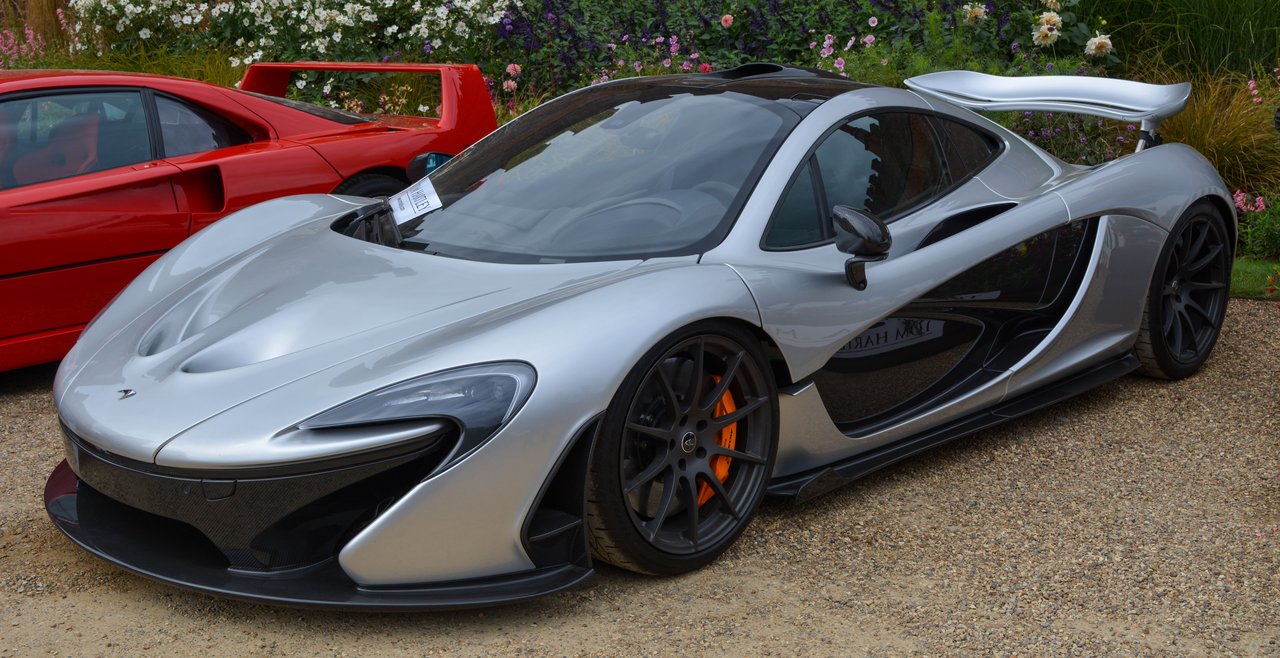
Photo via Wikimedia Commons under CC BY-SA 4.0 license.
The Heir to F1 and P1: Why the McLaren W1 Matters Right Now
When Woking invokes the "1" designation, the automotive landscape undergoes a seismic recalibration. The provenance is sacred. In 1992, Gordon Murray's McLaren F1 rewrote the supercar canon with its atmospheric BMW V12, central driving position, and uncompromising carbon-composite engineering. Twenty years later, the 2012 McLaren P1 pioneered the modern hybrid hypercar trinity, introducing torque-fill electrification alongside the LaFerrari and Porsche 918 Spyder. Now, twelve years after the P1 made instant electric response an essential weapon in high-performance driving, the McLaren W1 arrives.
The stakes could not be higher. Hypercar rivals have largely surrendered to the easy traction of heavy front-axle electric motors and multi-clutch all-wheel-drive hardware. McLaren has deliberately chosen a different, far more demanding path. The W1 is stubbornly, brilliantly rear-wheel drive. By rejecting driven front wheels, McLaren preserved two foundational tenets of pure driver engagement: uncorrupted electro-hydraulic steering feedback and obsessive weight discipline. At 1,399 kg dry, the W1 is an engineering line in the sand, demonstrating that true hypercar supremacy comes from aerodynamic mastery, packaging density, and mechanical fidelity rather than raw curb-weight inflation.
Powertrain Architecture: The MHP-8 V8 Meets Radial-Flux Electrification
Behind the cockpit sits the mechanical nucleus of the W1: an all-new 4.0-liter 90-degree twin-turbocharged V8 codenamed the MHP-8. Contrary to initial paddock speculation, this is not a refreshed iteration of the venerable M838T or M840T engine families that powered the 720S and Senna. The MHP-8 is a clean-sheet engine featuring a lightweight aluminum block, revised cylinder heads, and optimized bore-and-stroke geometry with a 90-degree flat-plane crankshaft.
To extract reliable power at astronomical engine speeds, McLaren engineered a valvetrain utilizing diamond-like carbon (DLC) coated finger-followers and plasma-transferred wire arc (PTWA) thermal-sprayed cylinder bores. Combined with hollow-stem valving, these frictionless internals allow the internal combustion engine to scream to a stratospheric 9,200 rpm redline. Fuel delivery relies on a sophisticated dual-injection strategy: ultra-high-pressure 350-bar direct injection misting directly into the combustion chambers under peak load, supplemented by low-pressure port injection to smooth light-throttle calibration and clean up emissions. On internal combustion alone, the twin-scroll turbocharged V8 delivers 928 metric horsepower—an incredible 232 hp per liter—and 900 Nm of torque.
Bolted directly to the transmission case is an ultra-dense, motorsport-derived radial-flux electric motor. While conventional electric motors rely on axial-flux designs or heavy permanent-magnet casings, the W1’s E-module spins up to 24,000 rpm, producing 342 horsepower and 440 Nm of torque while weighing an astonishing 20 kilograms. Total energy storage comes from a 1.384 kWh high-rate battery pack housed within a structural carbon-fiber tub. Designed around a 400-volt electrical architecture, the battery prioritizes extreme discharge and charge recovery rates over long-distance electric cruising.
Total combined system output stands at 1,258 horsepower (1,275 PS) and 1,340 Nm (988 lb-ft) of torque. This immense mechanical violence routes exclusively to the rear tires through an eight-speed dual-clutch transmission (DCT) equipped with an electronic locking differential (E-diff). McLaren eliminated mechanical reverse entirely; the radial-flux motor drives the car backward, cutting mass from the internal gear cluster.
Chassis Dynamics and Aerocell Packaging
The structural backbone of the W1 is the Aerocell carbon monocoque, an entirely new carbon-fiber architecture engineered around strict aerodynamic packaging principles. In standard supercars, seating assemblies ride on metal rails that consume valuable vertical and longitudinal space. In the W1, the seat cushions are molded directly into the composite tub. This engineering choice shortened the wheelbase by 70 mm, lowered the roofline, and dramatically narrowed the frontal cross-sectional area. Drivers adjust their seating position by sliding an articulated, floor-mounted billet aluminum pedal box and adjusting the reach and rake of the steering column.
Directing the airflow generated by the reduced frontal area is the McLaren Active Long Tail rear wing. Powered by dual electric linear actuators, the rear wing does not merely tilt to adjust trim angle; in Race mode, it motors 300 mm rearward. By extending past the rear bumper line, the wing operates as an aerodynamic extension of the underfloor venturi tunnels, effectively tripling the working volume of the rear diffuser.
At the front, active aerodynamic flaps articulate across multiple axes to balance front-to-rear center of pressure. When Race mode is engaged, the front suspension hydraulically drops 37 mm and the rear drops 17 mm. At 280 km/h (174 mph), the W1 generates a monstrous 1,000 kg (2,205 lbs) of downforce—350 kg across the front axle and 650 kg pinned over the rear—transforming high-speed stability without imposing brutal straight-line drag penalties.
Track Dynamics: The Hydraulic Steering Difference
On circuit, the W1 handles with an immediacy that shames every modern hypercar reliant on electric power steering (EPS). McLaren engineers have retained an electro-hydraulic steering rack, tuning the valve bodies to relay pure front-tire contact patch data directly to the driver's palms. When pitching into a third-gear apex, load buildup across the front axle is communicated with analog clarity. You feel the tire carcass flex, the tread blocks squirm, and the precise micron where understeer threatens to bloom.
Suspension kinematics are dictated by the RaceActive Chassis Control III (RCC III) system. The front axle utilizes Formula 1-inspired inboard pushrods actuated by forged aluminum double wishbones, paired with internal titanium torsion bars and active heave springs. This architecture mechanically decouples pitch and roll from vertical heave displacement. Under crushing aerodynamic loading in high-speed sweepers, the heave springs firm up to prevent the chassis from bottoming out, while the roll circuits remain compliant enough to absorb aggressive curbing without breaking traction.
Deceleration is managed by the McLaren Carbon Ceramic Racing Plus (MCCR+) braking package. The 390 mm discs feature an extra friction layer developed for race-series heat resistance, clamped by bespoke six-piston monobloc front calipers with internal fluid ducting. Stomping the left pedal from 200 km/h brings the W1 to a dead stop in just 100 meters, aided significantly by the Active Long Tail wing rotating instantly into an airbrake configuration.
McLaren W1 Technical Specifications
| Parameter | Specification |
|---|---|
| Engine Type | 4.0-liter (3,988 cc) 90° Twin-Turbo Flat-Plane V8 (MHP-8) |
| Electric Motor | Radial-Flux E-module (24,000 rpm max) + 1.384 kWh Battery |
| Total System Output | 1,258 hp (1,275 PS / 938 kW) |
| Total System Torque | 1,340 Nm (988 lb-ft) |
| Internal Combustion Redline | 9,200 rpm |
| Transmission | 8-Speed Dual-Clutch Transmission (DCT) with E-Diff |
| Drivetrain Layout | Mid-Engine, Pure Rear-Wheel Drive (RWD) |
| Dry Weight | 1,399 kg (3,084 lbs) |
| 0–100 km/h (0–62 mph) | 2.7 seconds |
| 0–200 km/h (0–124 mph) | 5.8 seconds |
| 0–300 km/h (0–186 mph) | < 12.7 seconds |
| Maximum Downforce | 1,000 kg (Race mode @ 280 km/h) |
| Top Speed | 350 km/h (217 mph, electronically limited) |
| Base Price | Approx. £2,000,000 GBP ($2,600,000 USD) |
Market Positioning, Rivals, and Global Allocation
The hypercar stratosphere is currently split along theological lines. In Maranello, the Ferrari F80 takes aim with a twin-turbo V6 hybrid, all-wheel drive, and heavy digital driver integration. In Weissach, Porsche continues formulating its production Mission X concept around electric propulsion. The McLaren W1 occupies the space collectors and purists value most: visceral mechanical drama paired with lightweight, pure rear-wheel-drive handling.
McLaren announced a strict global production cap of 399 units. Despite an entry price of £2.0 million ($2.6 million USD) prior to personalization through McLaren Special Operations (MSO), every allocation was assigned and contractually secured before the vehicle made its public debut. The W1 is homologated globally, with deliveries scheduled to commence in 2026.
Frequently Asked Questions (FAQ)
Why did McLaren choose pure rear-wheel drive instead of all-wheel drive for 1,258 horsepower?
Packaging a driven front axle requires half-shafts, front differentials, and additional electric motors that contribute over 100 kg of parasitic mass. This weight blunts front-end agility, raises the center of gravity, and forces the adoption of electric power steering. McLaren used advanced electronic differential controls, high-downforce aerodynamics, and bespoke Pirelli P Zero Trofeo RS rubber to ensure the chassis manages 1,258 horsepower entirely through the rear wheels.
Can the McLaren W1 be driven solely on electric power?
Yes, but purely as an ancillary function. The W1 features an electric-only mode designed strictly for silent garage departures, urban low-emission compliance, and low-speed maneuvering. The 1.384 kWh battery is engineered for rapid energy deployment and dynamic regeneration during aggressive track driving, offering roughly 2 kilometers of pure zero-emissions range.
How does the fixed-seat Aerocell monocoque fit drivers of different sizes?
By fixing the seat cushions directly into the carbon tub, McLaren structurally rigidified the chassis while dropping overall vehicle height. To ensure optimal ergonomics for drivers of varying heights, the billet aluminum pedal assembly unlatches via a spring-loaded pull lever, sliding longitudinally along precision rails, while the steering column telescopes and tilts over a generous mechanical sweep.
The MasEko Verdict: Engineering Purity Triumphant
The McLaren W1 is a staggering triumph of focused automotive engineering. In an era where hypercar manufacturers regularly mask chassis weight by piling on more driven axles and computing power, McLaren stood firm on fundamental dynamics. The MHP-8 flat-plane V8 is an internal combustion masterpiece that honors the lineage of the F1, while the Active Long Tail and radial-flux hybridization elevate the aerodynamic and performance benchmarks first set by the P1. The W1 is not just the fastest road-legal machine ever to roll out of the McLaren Technology Centre; it is an uncompromising declaration that lightness, hydraulic steering feedback, and rear-wheel-drive purity remain the undisputed apex of high-performance motoring.
Sources and editorial note
Specifications, performance numbers, pricing, and technical measurements in this feature are based on official manufacturer documentation, engineering releases, and certified automotive benchmarks. Real-world parameters may vary based on market specifications and testing conditions.
The featured lead image is sourced from Wikimedia Commons under Creative Commons licensing with proper attribution. Editorial reporting complies with international copyright and fair-use standards.