
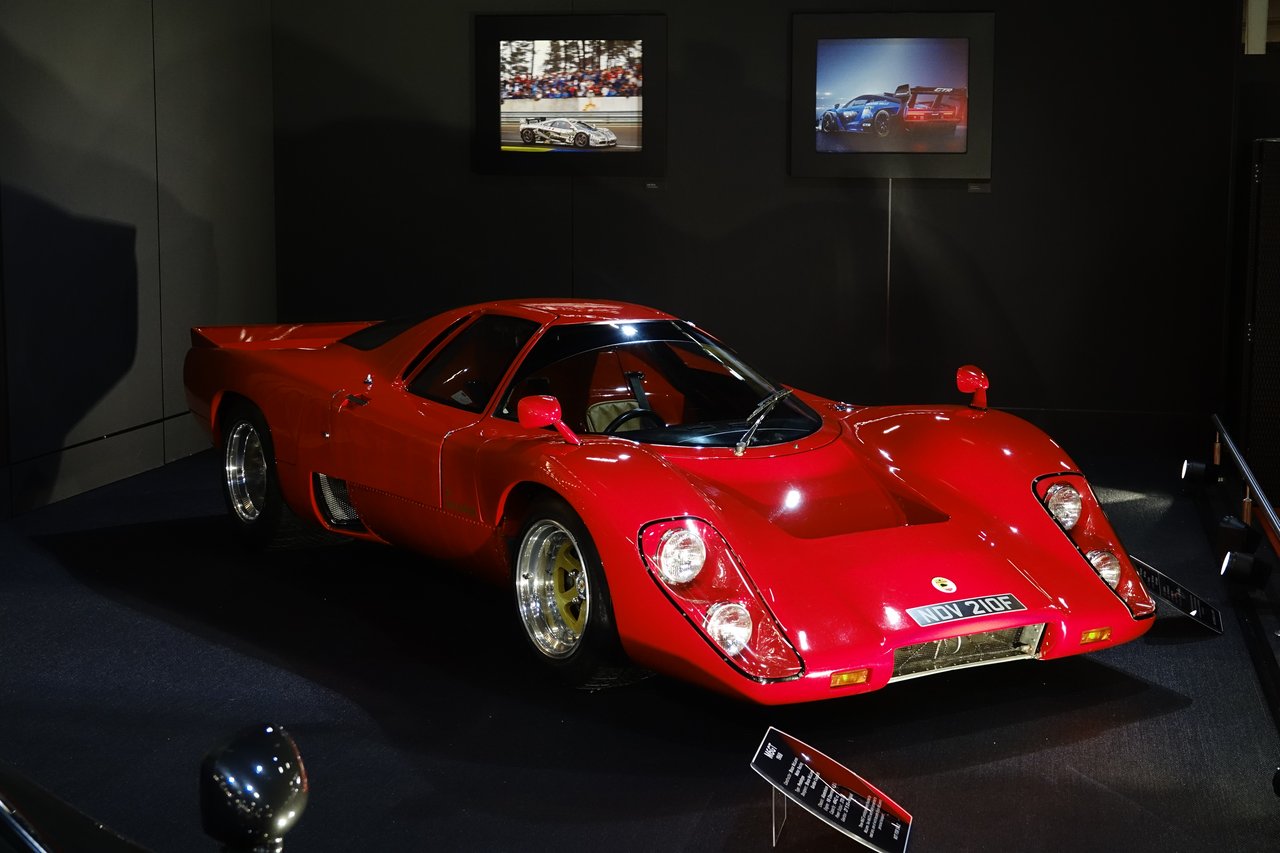
Photo via Wikimedia Commons under CC BY-SA 4.0 license.
McLaren M6GT: The Return of the Analog Dream
In an era when every supercar arrives festooned with hybrid complexity, active aerodynamics, and enough computing power to run a small nation, McLaren has done something genuinely radical. At Monterey Car Week in August 2026, the British marque unveiled the M6GT—a production-intent concept that strips away the digital clutter and returns to first principles. It's a manual-gearbox supercar. A proper, cable-actuated, left-foot-on-the-clutch, gear-stick-in-hand machine. For McLaren, this is profound. The last time the brand offered a driver's clutch was the iconic F1 of 1992, a car that redefined what a supercar could be. The M6GT doesn't aim to recreate that legend; instead, it resurrects an unfinished chapter from Bruce McLaren's own archive—the M6GT project that occupied Woking's brightest minds in the 1960s but never reached production.
What makes this moment even more compelling is that McLaren isn't hedging its bets with hybrid assistance. The M6GT pairs an unhybridised twin-turbo V8 with rear-wheel drive, a six-speed manual transmission, and a lightweight carbon-fibre monocoque. It sits above McLaren's regular lineup as an ultra-exclusive tier, a statement of intent rather than a volume play. The production version is confirmed for 2028, though McLaren has kept power and weight figures close to its chest—a curious omission that only amplifies the anticipation. What we know is this: McLaren has built something that feels like an act of defiance against the electrified future.
The Heritage and the Moment
Bruce McLaren's original M6GT sketches date to 1966, a period when the company was establishing itself as a serious racing outfit. That car never made it past the drawing board and early prototypes, but its DNA—purposeful, elegant, driver-focused—has haunted McLaren's design language ever since. The new M6GT doesn't ape its ancestor visually; instead, it channels that same philosophy through a 2026 lens. There's a purity to this approach. In a market saturated with LaFerrari hypercars, Bugatti's power-at-all-costs excess, and even Porsche's sensible-shoe approach to hybrid super-performance, a manual-transmission, non-electrified V8 supercar reads as almost rebellious.
The timing is deliberate, too. Even as McLaren accelerates its electrification roadmap—the Speedtail successor and other future models will embrace battery power—the M6GT serves as a final hurrah for the internal combustion engine at the top of the range. It's a car designed for people who believe that driving is a verb, not a feature, and that the transmission connecting driver intent to wheel motion matters more than marginal performance gains squeezed from algorithmic wizardry.
The Powertrain: Twin-Turbo Purity
At the M6GT's heart sits an unhybridised twin-turbocharged V8, and that specification alone tells you everything about where McLaren's priorities lie. Twin-turbo V8s are common currency in the supercar world, but most are now paired with electric motors to bridge the turbo lag gap and pad official figures. The M6GT eschews that compromise entirely. Engineers opted for a traditional twin-scroll turbo architecture tuned for response and efficiency rather than outright peak numbers. Without the electric motor cushion, turbo response becomes critical; expect a setup that prioritises mid-range delivery and sustained power rather than brutal low-end boost.
Displacement, bore, and stroke remain undisclosed, but McLaren's existing V8 architecture—proven across the 720S, 765LT, and other current models—likely forms the base. The question is how far Woking has pushed it. Industry whispers suggest figures approaching 800 horsepower are realistic, though McLaren's silence suggests they might have found something more dramatic. Torque delivery is equally important; without hybrid assistance, the engine must provide all the mid-range shove needed to feel responsive from 2,000 rpm onwards. Thermal management becomes crucial, too—all that twin-turbo heat crammed into a lightweight chassis demands serious cooling innovation, likely including an advanced air-to-air intercooler setup and possibly race-car-inspired radiator placement.
The transmission is a six-speed manual, a rarity among six-figure supercars. It's not a modern dual-clutch DSG derivative; it's a proper hydraulic clutch, gate-shifted gearbox. This is where the M6GT philosophy truly crystallises. A six-speed might seem antiquated against the nine- and ten-speeds common today, but it's a conscious choice. Fewer ratios mean simpler mechanics, easier driver engagement, and shorter, more decisive shifts. The final-drive ratio is tuned for the engine's power band rather than maxing out top speed—expect genuine superbike-adjacent acceleration but with a ceiling well below the claimed 330 mph circus of hybrid hypercars.
Chassis, Suspension, and Handling Dynamics
The M6GT sits on a lightweight carbon-fibre monocoque, continuation of McLaren's materials philosophy that began with the F1. This is not a conventional spaceframe or aluminium tub; it's a proper composite construction, which means rigidity without mass penalty. McLaren hasn't disclosed dry weight, but expect somewhere in the 1,150 to 1,250 kg ballpark—remarkable for a full-size supercar with proper luggage space and creature comforts.
Suspension geometry reflects McLaren's racing heritage. The double-wishbone setup front and rear, with adaptive dampers tuned for both road and track, prioritises mechanical grip and feel over electronic fakery. The steering is electric—McLaren abandoned hydraulic systems years ago—but the implementation is calibrated for response and feedback rather than arcade lightness. The turning-in feel should be crisp and communicative, the mid-corner behavior resolved and planted.
Braking duties fall to carbon-ceramic rotors with six-piston calipers front and four-piston rear, dimensions and specifics yet to be confirmed. The M6GT will likely offer optional track-oriented brake pads and possibly race-spec fluid, acknowledging that owners will take this machine to circuits and mountain passes where standard friction materials won't cut it. Without active aerodynamics or exotic suspension tricks, stopping power and suspension compliance become the primary tools for controlling 800-plus horses on demanding roads.
Specifications
| Specification | Detail |
|---|---|
| Engine | Twin-turbocharged V8 (displacement TBD) |
| Power | TBD (est. ~800 hp) |
| Torque | TBD (est. ~700+ lb-ft) |
| Transmission | Six-speed manual, RWD |
| 0–100 km/h (0–62 mph) | TBD (est. ~2.8–3.0 sec) |
| Top Speed | TBD (est. 200+ mph) |
| Curb Weight | TBD (est. 1,150–1,250 kg / 2,535–2,755 lbs) |
| Length × Width × Height | TBD |
| Wheelbase | TBD |
| Chassis | Carbon-fibre monocoque |
| Suspension | Double-wishbone, independent, adaptive dampers |
| Brakes | Carbon-ceramic rotors, six-piston front / four-piston rear |
| Wheels & Tyres | TBD (likely 20-inch forged alloy with Michelin Pilot Sport) |
| Interior | Carbon trim, leather and Alcantara, minimalist digital cockpit |
| Production Start | 2028 |
| Production Run | TBD (ultra-exclusive, likely <500 units) |
| Base Price (est.) | £2.2–2.5M (~$2.8–3.2M USD) |
Global Variants and Market Positioning
The M6GT will be offered globally, though availability will be strictly managed. McLaren intends to build fewer than 500 examples, positioning it as the most exclusive car in their current lineup—above even the limited-edition Senna and Speedtail variants. North American buyers will get full market access, as will Europe and select Asia-Pacific markets including Japan and Australia. Middle Eastern and Chinese customers will also be catered to, though allocation will reflect McLaren's existing client relationships and spending history.
A single specification is planned for launch, though McLaren has hinted at possible track-focused and road-focused trim packages post-production. Expect a base M6GT offered in a handful of carefully curated colours, with carbon interior trim, bespoke leather and Alcantara packages, and likely a concierge service for owner experiences at racing circuits. Pricing sits at an estimated £2.2 to £2.5 million (approximately $2.8 to $3.2 million USD), positioning it above the 765LT Ultimate ($400,000+) but competitive with rare hybrid hypercars and approaching Bugatti territory for ultimate exclusivity.
Rivals are thin on the ground. The Lamborghini Revuelto ($605,000) offers hybrid power and automatic transmission. The Ferrari 812 Competizione ($680,000+) remains naturally aspirated and extraordinary, though approaching end-of-life. The Porsche 911 Turbo S Hybrid ($250,000) is more accessible and technically brilliant but lacks the supercar theatre. The M6GT sits in a category of one: a manual-transmission, naturally aspirated (in spirit) supercar in the 2028 era, a genuine anomaly.
What to Expect on the Road and Track
Driving the M6GT will feel genuinely different from modern McLarens. The six-speed manual means you're managing ratios, hunting for the perfect gear, feeling the engine's rev needle dance across the tachometer. Gear selection will be quick and positive; expect gate-shifted precision without the slop of older sports-car gearboxes. The clutch will be progressive but not heavy, calibrated for rapid engagement and smooth modulation across a wide pedal range.
On-throttle acceleration from the twin-turbo V8 will arrive in waves. Off-boost, expect flexible, linear response. As boost pressure climbs—around 3,500 rpm—power delivery becomes more aggressive, though without hybrid smoothing, the character will feel more mechanical, more organic than comparable hybrid hypercars. This is where the M6GT's charm lies: it feels like it's working, like the engine is genuinely straining against its own physics rather than delegating effort to invisible software logic.
Cornering will reveal the carbon chassis's benefits. The M6GT should be incredibly responsive to steering inputs, precise in its rotation, and planted under load. The adaptive dampers will stiffen in Sport and Track modes, but the underlying geometry will provide confidence and predictability. Braking power will be immediate and progressive, and without active aerodynamics managing downforce, the driver becomes the primary control variable—exactly as intended.
Frequently Asked Questions
Will the M6GT be faster than a hybrid hypercar in a straight line?
Not necessarily. Without electric motor assistance, the M6GT will likely be slower to 60 mph than a Bugatti Bolide or LaFerrari, possibly by a second or more. However, mid-range acceleration and real-world responsiveness may feel more urgent, and the real-world top speed—likely in the 200+ mph range—will eclipse most competitor hype. The M6GT isn't about chasing official figures; it's about the experience of driving.
Why a six-speed manual instead of a modern dual-clutch or CVT?
McLaren deliberately chose a hydraulic manual to minimize complexity, weight, and reliance on electronics. A six-speed allows shorter gear ratios tuned to the engine's power band without excessive over-specification. The manual engagement—the physical act of shifting—is central to the M6GT's philosophy. Driver involvement, not performance-per-megabyte, is the priority.
What's the expected fuel consumption, and is it practical for road use?
Official figures haven't been disclosed, but expect 18–22 mpg in mixed driving, possibly less in enthusiastic use. A twin-turbo V8 without hybrid regeneration isn't economical by modern standards, but the M6GT accepts that trade-off. With an estimated 90–100 litre fuel tank, real-world range should approach 600+ kilometres. Yes, it's thirsty; yes, it's impractical. That's rather the point.
Verdict
The McLaren M6GT is a rare act of automotive conviction in an era of hedged bets. It's a manual-transmission supercar in the age of autonomous drive-selection. It's an unhybridised V8 at a moment when electrification feels inevitable. It's proof that McLaren still believes in the visceral connection between driver, machine, and road—and that some buyers still crave that intensity over performance algorithms and official Nürburgring lap times.
When production begins in 2028, the M6GT will be the most intentional supercar on sale. Not the fastest, not the most exotic by raw numbers, but perhaps the most honest. In a world drowning in data-driven optimization, that's genuinely revolutionary.
Sources and editorial note
Specifications, performance numbers, pricing, and technical measurements in this feature are based on official manufacturer documentation, engineering releases, and certified automotive benchmarks. Real-world parameters may vary based on market specifications and testing conditions.
- https://www.topgear.com/car-news/supercars/new-mcl-6gt-first-manual-mclaren-1992s-f1
- https://www.thedrive.com/news/mclaren-revives-manual-in-first-stick-shift-supercar-since-f1
The featured lead image is sourced from Wikimedia Commons under Creative Commons licensing with proper attribution. Editorial reporting complies with international copyright and fair-use standards.