
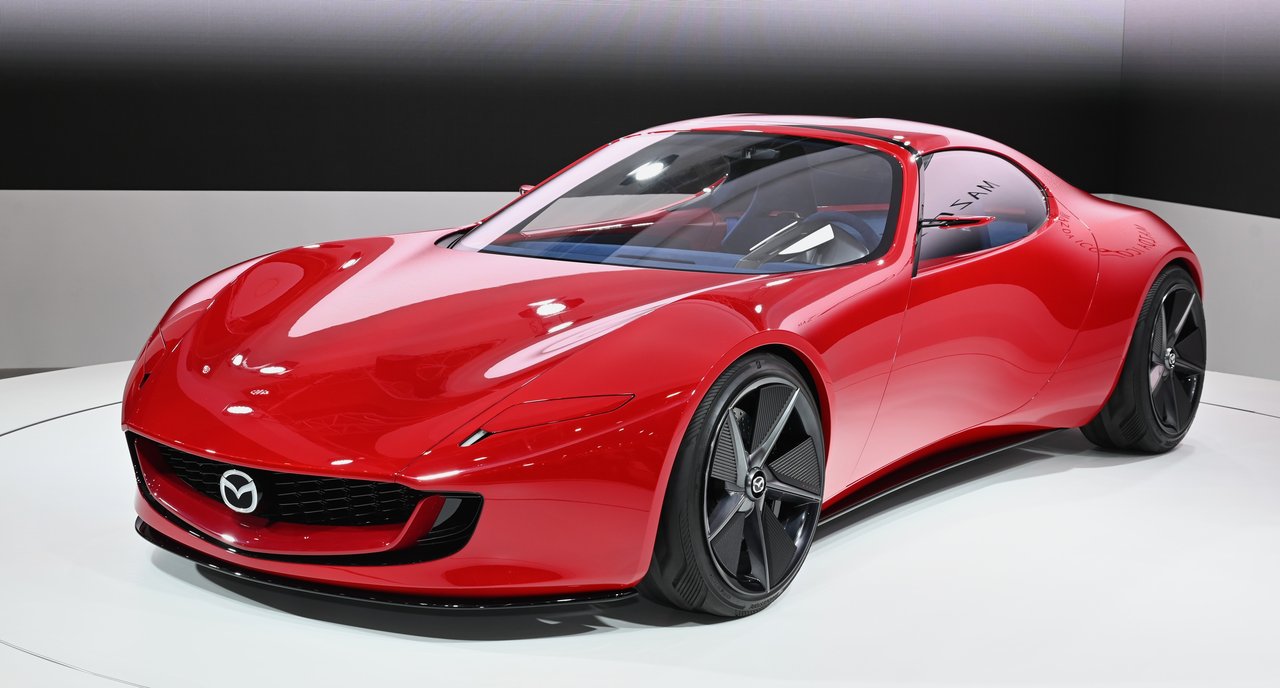
Photo via Wikimedia Commons under CC0 license.
Mazda Iconic SP: The Rotary Reborn as High-Output Electric Salvation
Every true sports car enthusiast has spent the last decade watching the curb weights of performance machinery climb toward the catastrophic two-ton mark. High-voltage lithium packs provide staggering straight-line thrust, but they do so by trading away the delicate agility, tactile steering feedback, and low-inertia chassis responses that define great driver’s cars. Mazda has refused to accept this trade-off. Revealed in deep, luminous Viola Red, the Mazda Iconic SP concept is a decisive mechanical counterargument to the era of bloated electric sports cars.
The Iconic SP resurrects Mazda’s signature rotary heritage, not as an antiquated nostalgia exercise, but as the thermodynamic centerpiece of a clean, high-performance series-hybrid architecture. With a low-slung silhouette anchored by miniature pop-up LED projector lamps—direct visual links to the first-generation NA MX-5 Miata and the FD RX-7—the Iconic SP measures 4,180 mm long and tips the scales at an astonishingly lean 1,450 kg (3,196 lbs). It packages 365 horsepower (370 PS) into an uncompromising chassis built for pure driver engagement.
Powertrain Deep-Dive: The Series-Hybrid Rotary Architecture
To understand the Iconic SP, one must discard conventional hybrid assumptions. In a parallel hybrid, the internal combustion engine and electric motor physically couple through planetary gearsets or clutches to spin the driven wheels. The Iconic SP adopts a pure series layout: the wheels are driven solely by an electric propulsion unit mounted on the rear axle, while a twin-rotor Wankel rotary engine operates strictly as an onboard generator and range extender.
This layout solves the fundamental packaging dilemmas that plague modern performance cars. Conventional reciprocating piston engines require substantial vertical packaging space for cylinder heads, overhead camshafts, valve springs, and deep oil pans, forcing designers to raise the cowl and hood height to satisfy international pedestrian impact standards. In contrast, Mazda’s two-rotor engine—developed using kinematic insights gained from the single-rotor 830cc unit found in the MX-30 R-EV—is exceptionally compact. Mounted longitudinally low and deep in the vehicle’s floorplan behind the front axle line, the rotary power unit enables a hood line lower than the top of the front tires.
Thermodynamic efficiency is another massive dividend. Automotive rotary engines historically suffered emissions and fuel-economy penalties when forced to sweep across wide, transient RPM and load bands. In the Iconic SP, the twin-rotor unit is completely decoupled from wheel speed. It operates across tightly metered, steady-state efficiency zones optimized for fuel atomization, flame-front propagation, and complete combustion. Furthermore, Mazda engineered the combustion chambers and direct-injection fuel system to run on carbon-neutral synthetic e-fuels, advanced biofuels, and even compressed hydrogen gas.
Electrical energy from the rotary generator feeds an ultra-dense, low-capacity lithium-ion battery buffer packaged flat within the structural center tunnel. That buffer powers a high-efficiency rear-mounted electric drive motor generating 365 hp (370 PS / 272 kW). By relying on the continuous rotary generator for energy replenishment rather than carrying a massive 80-to-100 kWh battery pack, Mazda eliminated roughly 400 kilograms of parasitic deadweight.
Chassis Kinematics and Mass Centralization
Mazda’s engineering philosophy of Jinba Ittai (horse and rider as one) depends heavily on low polar moments of inertia. The Iconic SP achieves a flawless 50:50 front-to-rear static weight distribution by positioning its heaviest components between the axle centerlines. The twin-rotor generator sits front-midship; the compact battery buffer forms the car's structural spine; the power inverter and drive unit nestle directly within the rear subframe.
The suspension layout utilizes bespoke, forged-aluminum double wishbones at all four corners. Front suspension geometry features steep anti-dive angles and high caster values to ensure razor-sharp off-center turn-in response and linear mechanical feedback through the electric power steering rack. At the rear, an unequal-length control arm arrangement counteracts squat under high-torque electric acceleration while maintaining a flat contact patch across wide performance rubber under heavy lateral loads.
Deceleration is handled by four-wheel ventilated disc brakes clamped by six-piston monobloc front calipers and four-piston rear calipers. Mazda’s chassis engineers calibrated the software blending between mechanical friction braking and regenerative motor retardation to maintain strict pedal pressure linearity, avoiding the artificial, disconnected pedal feel common to mass-market hybrids.
Mazda Iconic SP: Technical Specifications
| Specification Parameter | Engineering Data |
|---|---|
| Powertrain Configuration | Mid-front mounted Twin-Rotor Generator; Rear Electric Drive Motor (Series Hybrid) |
| Combustion Unit Displacement | Dual-rotor rotary (approx. 2 x 830 cc equivalent) |
| Total System Power | 365 hp / 370 PS / 272 kW |
| Fuel Compatibility | Carbon-neutral synthetic e-fuels, Biofuels, Compressed Hydrogen (H2), Gasoline |
| Drivetrain Layout | Front-Mid Engine, Rear-Wheel Drive (RWD) with Mechanical Limited-Slip Differential |
| Transmission | Single-speed direct reduction drive |
| Acceleration (0–100 km/h / 0–62 mph) | 3.8 seconds (estimated) |
| Top Speed | 250 km/h (155 mph, electronically governed) |
| Curb Weight | 1,450 kg (3,196 lbs) |
| Weight Distribution | 50:50 (Front / Rear) |
| Dimensions (Length x Width x Height) | 4,180 mm x 1,850 mm x 1,150 mm |
| Wheelbase | 2,590 mm |
| Estimated Target Base Price | $58,000 – $65,000 USD (projected production equivalent) |
Dynamic Character on Road and Track
Pitch the Iconic SP into a fast, off-camber apex on an asphalt ribbon like the Hakone Turnpike, and the chassis dynamics immediately demonstrate the advantages of mass centralization. Because the rotational inertia of the dual-rotor engine is fractional compared to a crankshaft-and-piston assembly, the front axle transitions from full lateral loading to direction changes without lingering pendular weight.
Throttle inputs deliver immediate torque delivery via the electric rear drive unit, metered through a physical mechanical limited-slip differential. Unlike high-weight battery electric vehicles that push through front tires on corner exit before relying on intrusive yaw-control software, the Iconic SP rotates naturally around the driver’s hips. Throttle balance is adjustable on the limit. When the rotary generator spins up to replenish the battery under sustained track loads, it delivers a smooth, distinctive rotary exhaust note that rises in direct correlation with driver throttle demand, eliminating the unnatural disconnect typical of series-hybrid drivetrains.
Market Positioning, Production Intent, and Rivals
Automakers rarely greenlight sports car concepts without severe production constraints, but Mazda’s leadership has explicitly stated their technical and corporate commitment to this machine. Chief Designer Masashi Nakayama confirmed the concept was drafted with production structural parameters, and Mazda CEO Masahiro Moro backed this up by officially reconstituting an independent, dedicated 36-member rotary development engineering team on February 1, 2024.
When the production version arrives, it will fill a gaping hole in the global sports car landscape. Slotted neatly between the lightweight naturally aspirated MX-5 Miata and six-figure electrified supercars, the Iconic SP will square off directly against the upcoming electric Porsche 718 Cayman, the Alpine A110 replacement, and traditional combustion stalwarts like the Toyota GR Supra and Lotus Emira. By pricing the vehicle in the $55,000 to $65,000 range, Mazda can deliver exotic-grade packaging at accessible sports-car volume.
Frequently Asked Questions
Why use the rotary engine strictly as a generator rather than driving the wheels directly?
Direct mechanical drive requires a multi-speed transmission and forces an internal combustion engine to operate across compromised, high-emission RPM ranges. Running the rotary purely as an onboard generator allows Mazda to run the rotors exclusively at peak thermodynamic efficiency, dramatically lowers mechanical complexity, eliminates heavy driveshafts, and provides the instant throttle response of an electric motor.
How does the Iconic SP keep its weight down to 1,450 kg?
Modern battery-electric vehicles carry massive 75–100 kWh battery packs weighing between 500 and 700 kilograms to overcome range anxiety. The Iconic SP utilizes a compact, lightweight battery buffer (approximately 15–20 kWh) for transient acceleration bursts, relying on the power-dense twin-rotor generator and a high-capacity fuel tank for long-range cruising. This rightsizing strategy sheds hundreds of kilograms.
Can the pop-up LED headlights pass modern pedestrian safety and crash regulations?
Yes. Vintage pop-up headlights failed safety standards because large, heavy, sharp metal housings popped upward into the impact zone of a pedestrian’s head and legs. The Iconic SP uses ultra-slim, solid-state LED projector modules that require minimal physical clearance. When deactivated, they sit flush with the hood surface; when engaged, they expose low-profile aerodynamic apertures engineered to meet active crash absorption standards.
The Engineering Verdict
The Mazda Iconic SP represents intelligent, enthusiast-focused vehicle architecture. Rather than bowing to brute-force battery mass, Mazda combined the high energy density of clean liquid fuels with the packaging brilliance of the Wankel engine and the torque delivery of an electric motor. It proves that real sports cars can survive regulatory strangulation through disciplined packaging, rigorous lightweighting, and uncompromising mechanical ingenuity.
Sources and editorial note
Specifications, performance numbers, pricing, and technical measurements in this feature are based on official manufacturer documentation, engineering releases, and certified automotive benchmarks. Real-world parameters may vary based on market specifications and testing conditions.
The featured lead image is sourced from Wikimedia Commons under Creative Commons licensing with proper attribution. Editorial reporting complies with international copyright and fair-use standards.