
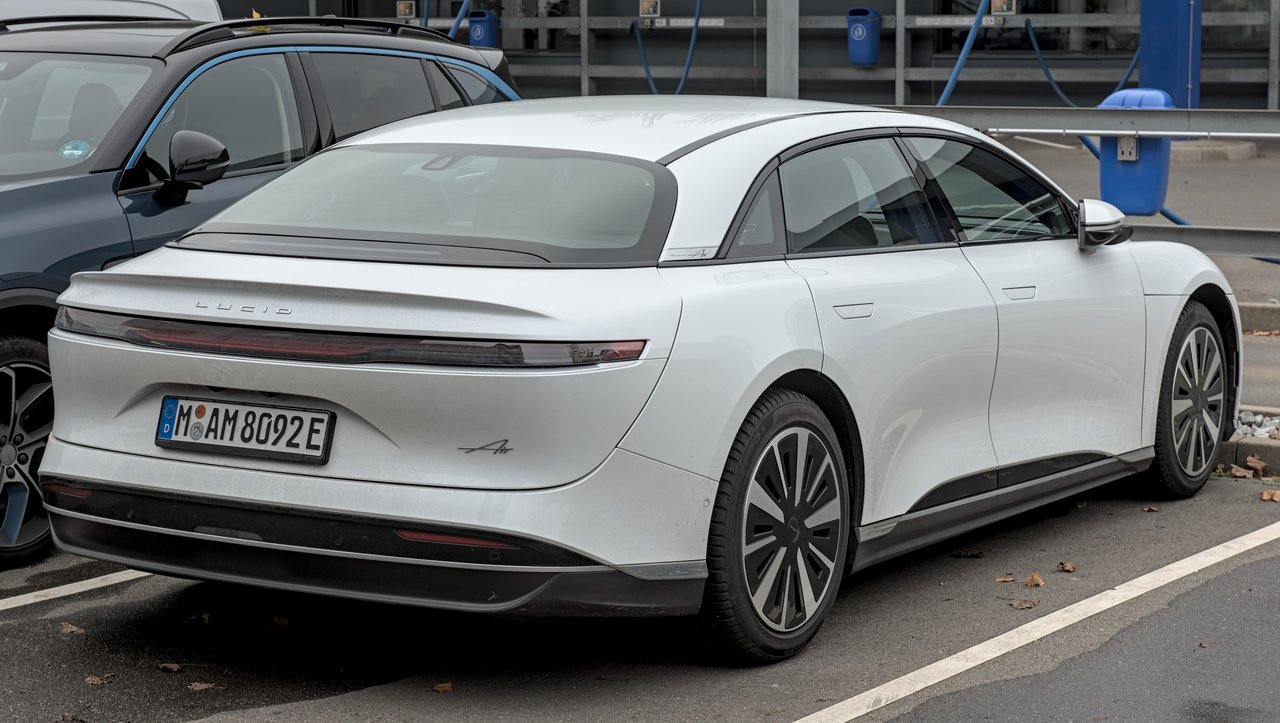
Photo via Wikimedia Commons under CC BY-SA 4.0 license.
Lucid Gravity: The Ruthless Physics of Three-Row Electrification
Designing a competitive luxury sedan on an electric skateboard is an exercise in aerodynamic discipline; engineering a full-size, seven-passenger electric sport utility vehicle is an all-out thermodynamic war. Upright profiles, massive frontal areas, and the dead weight of three rows have historically forced EV manufacturers into a blunt compromise: cram in an unwieldy 130-to-150-kWh battery pack to overcome aerodynamic drag, inflating curb weight beyond three tons and compromising dynamic agility. The Lucid Gravity upends this crude engineering philosophy. Following the ground-breaking benchmarks established by the Air sedan, Lucid CEO and former Lotus chief engineer Peter Rawlinson has applied the gospel of miniaturization to the family hauler, delivering an SUV that balances seating for seven with sports-car acceleration and an astounding 440 miles of target range.
The stakes could not be higher. While the luxury EV sedan market remains a boutique niche, three-row luxury crossovers drive high-margin volume in North America, the Middle East, and beyond. In this arena, the Gravity must counter the software supremacy and falcon-wing theatre of the Tesla Model X, alongside the adventurous, quad-motor off-road brawn of the Rivian R1S. Lucid's response is an unapologetic masterclass in volumetric efficiency and mechanical packaging.
Proprietary Powertrain: Miniaturization Taken to the Bleeding Edge
At the mechanical core of the Gravity are Lucid's proprietary, in-house-developed permanent-magnet synchronous electric drive units. Where legacy manufacturers routinely purchase off-the-shelf motors that require separate cooling circuits, inverters, and reduction gear sets, Lucid bundles the rotor, stator, silicon-carbide (SiC) MOSFET inverter, and planetary differential into a singular, hyper-dense structural casting. Each motor assembly weighs roughly 163 pounds (74 kg) yet generates up to 400 horsepower, netting a power density that outclasses every volume EV competitor in production.
In dual-motor Grand Touring trim, the combined output clears 800 horsepower and north of 800 lb-ft of instantaneous torque. The high-efficiency stator utilizes continuous copper hairpin winding, optimizing slot-fill factor to minimize Joule heating losses during high-draw sustained loads. The integrated inverter switches via high-frequency silicon-carbide transistors operating along a 900-volt-plus electrical backbone. This ultra-high voltage drastically reduces current requirements (amperage) across wiring harnesses, dropping thermal resistance and enabling sustained peak acceleration runs without the immediate thermal de-rating that plagues lower-voltage architectures.
Energy storage comes from an advanced lithium-ion pack nestled into the floorpan. By engineering the module architecture to sit flush beneath the cabin occupants' heels without elevating the floor height, Lucid extracts a target 440-mile EPA range from a battery pack estimated to hover around 118 kWh. Crucially, the 900V+ "Wunderbox" bidirectional onboard charging unit allows DC fast-charging rates exceeding 300 kW. When plugged into a high-output 350 kW DC dispenser, the Gravity absorbs electrons at an astonishing pace, recovering 200 miles of driving range in approximately 15 minutes.
Aerodynamic Mastery and Suspension Kinematics
To extract 440 miles of range without towing an excessively massive energy pack, Lucid's aerodynamicists labored to produce a coefficient of drag (Cd) of just 0.24. For a full-sized, three-row vehicle standing nearly 66 inches tall and spanning over two meters wide with mirrors, this figure stands as a class-leading benchmark. The nose lacks a traditional cooling aperture; instead, high-pressure air at the front bumper is directed through active air flaps, routed around front vortex generators, and channeled cleanly over the flush wheel arches. An uninterrupted underbody tray terminates in an aggressive, upswept rear diffuser, while the roofline features a sculpted drop that terminates in a functional cantilevered rear spoiler designed to manage the turbulent wake.
Controlling dynamic loads across a vehicle capable of sprinting to 60 mph in under 3.5 seconds requires sophisticated chassis hardware. The Gravity rides on an independent multilink configuration at both the front and rear axles, coupled to an optional dual-chamber adaptive air suspension setup known as "Zero Gravity." The air springs adjust dynamic spring rates on the fly while semi-active dampers react to wheel stroke velocities in milliseconds. Rear-wheel steering delivers up to 3 degrees of counter-phase articulation at low speeds to shrink the turning radius to that of a compact crossover, transitioning to in-phase steering at highway speeds to provide unwavering yaw stability during lane changes.
Braking duties are managed via an integrated electro-hydraulic braking system. Lucid maps the pedal to harvest up to 0.4g of decelerative force purely through regenerative braking before the six-piston front and sliding single-piston rear friction calipers bite into massive ventilated steel rotors. The blend is linear, transparent, and engineered to eliminate the numb, stepped transition that plagues rival regenerative brake pedals.
Cockpit Packaging: The 34-Inch 6K OLED and Volumetric Magic
Inside, the Gravity trades the sedan-oriented low cowl of the Air for an airy, glass-dominated greenhouse. The centerpiece is Lucid’s 34-inch curved 6K ClearView OLED display. Floating above a redesigned two-spoke squircle steering wheel, the panel places critical speed, navigation, and driver-assist telemetry cleanly in the driver's primary line of sight without requiring a traditional head-up display projector. Secondary functions, climate adjustments, and media controls reside on a centrally mounted, haptic-feedback touch surface that sits atop the center console, complemented by physical knurled aluminum toggle switches for primary HVAC functions.
The interior architecture highlights the functional dividends of Lucid's compact mechanical layout. Because the electric drive units occupy fractions of the space demanded by rival powertrains, interior volume is maximized:
- Second-Row Versatility: The 40/20/40-split second-row seats slide fore and aft on integrated floor rails, offering executive-class legroom and optional folding seatback convenience tables.
- Legitimate Third-Row Seating: Deep footwells allow actual adult occupants to sit without their knees elevated into their chests—a fatal flaw common to the Tesla Model X.
- Cavernous Frunk: The clamshell hood lifts to reveal over 8 cubic feet of forward storage. Lucid engineers shaped the front structural crush rails to create a broad, deep basin that seats two adults when parked, complete with integrated USB-C power ports and cupholders.
- Total Utility: With both the second and third rows folded flat into the floor, the cargo floor offers over 112 cubic feet of continuous storage space.
Technical Specifications
| Specification | Lucid Gravity Grand Touring | Lucid Gravity Touring |
|---|---|---|
| Powertrain Configuration | Dual Permanent-Magnet Synchronous Motors (AWD) | Dual Permanent-Magnet Synchronous Motors (AWD) |
| System Output | Over 800 hp (>596 kW) | Est. 620 hp (462 kW) |
| Peak Torque | Est. 850 lb-ft (1,152 Nm) | Est. 650 lb-ft (881 Nm) |
| Battery Architecture | 900V+ Lithium-Ion (Est. 118 kWh) | 900V+ Lithium-Ion (Est. 90-100 kWh) |
| Target EPA Range | Up to 440 miles (708 km) | Est. 340 miles (547 km) |
| DC Fast Charging Speed | Up to 300+ kW (200 miles in ~15 mins) | Up to 300+ kW |
| 0-60 mph (0-100 km/h) | <3.5 seconds (<3.6 seconds) | Est. 4.1 seconds (4.3 seconds) |
| Drag Coefficient | 0.24 Cd | 0.24 Cd |
| Towing Capacity | 6,000 lbs (2,721 kg) | 6,000 lbs (2,721 kg) |
| Seating Capacity | Up to 7 occupants | Up to 7 occupants |
| Base Price (MSRP) | Starting at $94,900 | Starting under $80,000 |
Dynamic Demeanor: Mountain Pass Realities
Point the Gravity up a serpentine mountain pass, and the packaging work translates immediately into dynamic composure. Full-throttle acceleration from a standstill does not merely launch the vehicle; it bends reality as 800 horsepower transfers through the wheels with imperceptible slip. Lucid's torque vectoring processes motor control cycles thousands of times per second, metering power output across individual axles far faster than any mechanical differential lock could ever dream of.
In aggressive switchbacks, the Gravity masks its roughly 5,500-pound curb weight through a microscopic roll center and near-even front-to-rear static weight distribution. The adaptive air suspension stiffens immediately upon lateral turn-in, quelling roll without the secondary harmonic chassis shudder that frequently rattles large, air-suspended SUVs over mid-corner pavement seams. Steering feedback through the squircle rim is communicative by modern drive-by-wire standards, with quick off-center weighting and pinpoint directional accuracy. While the Rivian R1S leans on sheer tire contact patch and hydraulic anti-roll wizardry, the Gravity relies on low-slung mass and chassis rigidity. It dives toward apexes like a performance wagon, entirely divorced from the ponderous, high-center-of-gravity wobble that typically afflicts three-row haulers.
Market Positioning, Trims, and Global Rollout
The Lucid Gravity is targeted directly at the weak points of its primary rivals. The Tesla Model X, while quick and blessed with Tesla's Supercharger footprint, rides on an aging platform compromised by compromised third-row head clearance, inconsistent build quality, and polarizing falcon doors. The Rivian R1S is an exceptional overland tool, but its upright frontal area, truck-based dynamics, and higher energy consumption restrict real-world highway range. The Gravity carves out the golden median: ultra-aerodynamic luxury touring capability merged with authentic family practicality.
Launch production focuses on the range-topping Grand Touring model, starting at an MSRP of $94,900, with deliveries initiating in late 2024 for the North American market. The more affordable Touring trim, pegged to start under $80,000, follows in late 2025. Following initial North American deliveries, Lucid plans to scale global availability across core European territories (specifically Germany, the UK, Norway, and the Netherlands) and its financial stronghold in Saudi Arabia and the broader Gulf Cooperation Council (GCC) markets.
Frequently Asked Questions
How does Lucid manage 440 miles of range with a battery pack smaller than its rivals?
Lucid achieves this through sheer structural and mechanical efficiency. The class-leading 0.24 drag coefficient drastically minimizes high-speed aerodynamic load. Simultaneously, Lucid’s miniaturized motors and silicon-carbide inverters operate with an efficiency rate exceeding 90 percent across varied torque bands, meaning significantly fewer kilowatt-hours are lost as ambient heat per mile traveled compared to the Rivian R1S or Mercedes-Benz EQS SUV.
Can the Lucid Gravity handle serious off-road terrain like the Rivian R1S?
No, and it is not intended to. While the Gravity features an off-road ride-height setting that elevates the air suspension to provide roughly 8 to 9 inches of ground clearance for light trails, snow, and gravel, it lacks the extreme articulation, rock sliders, and dedicated underbody armor plating of the Rivian. The Gravity is dynamically tuned for high-speed Grand Touring, canyon carving, and all-weather pavement performance.
How does real-world 900V charging work at Tesla Supercharger stations?
The Lucid Gravity adopts the North American Charging Standard (NACS) port, providing native hardware access to the Tesla Supercharger network. However, because most Tesla V3 Superchargers run on a 400-volt architecture, the Gravity’s Wunderbox acts as an onboard DC-to-DC boost converter, stepping up the 400V supply to mate with its 900V+ battery chemistry. Peak charging speeds of 300+ kW will still require true 800V-to-1000V high-power DC fast chargers (such as Electrify America or Ionity 350 kW dispensers).
The Verdict
The Lucid Gravity is an engineering triumph. Instead of using brute-force battery mass to compensate for brick-like proportions, Lucid has demonstrated the power of fundamental physics, aerodynamic optimization, and drive-unit miniaturization. It is practical, blindingly fast, genuinely spacious across all three rows, and resets the standard for electric packaging. By proving that seven-passenger utility does not require dynamic numbness or range anxiety, the Gravity establishes itself as the defining high-performance electric SUV of its era.
Sources and editorial note
Specifications, performance numbers, pricing, and technical measurements in this feature are based on official manufacturer documentation, engineering releases, and certified automotive benchmarks. Real-world parameters may vary based on market specifications and testing conditions.
The featured lead image is sourced from Wikimedia Commons under Creative Commons licensing with proper attribution. Editorial reporting complies with international copyright and fair-use standards.