
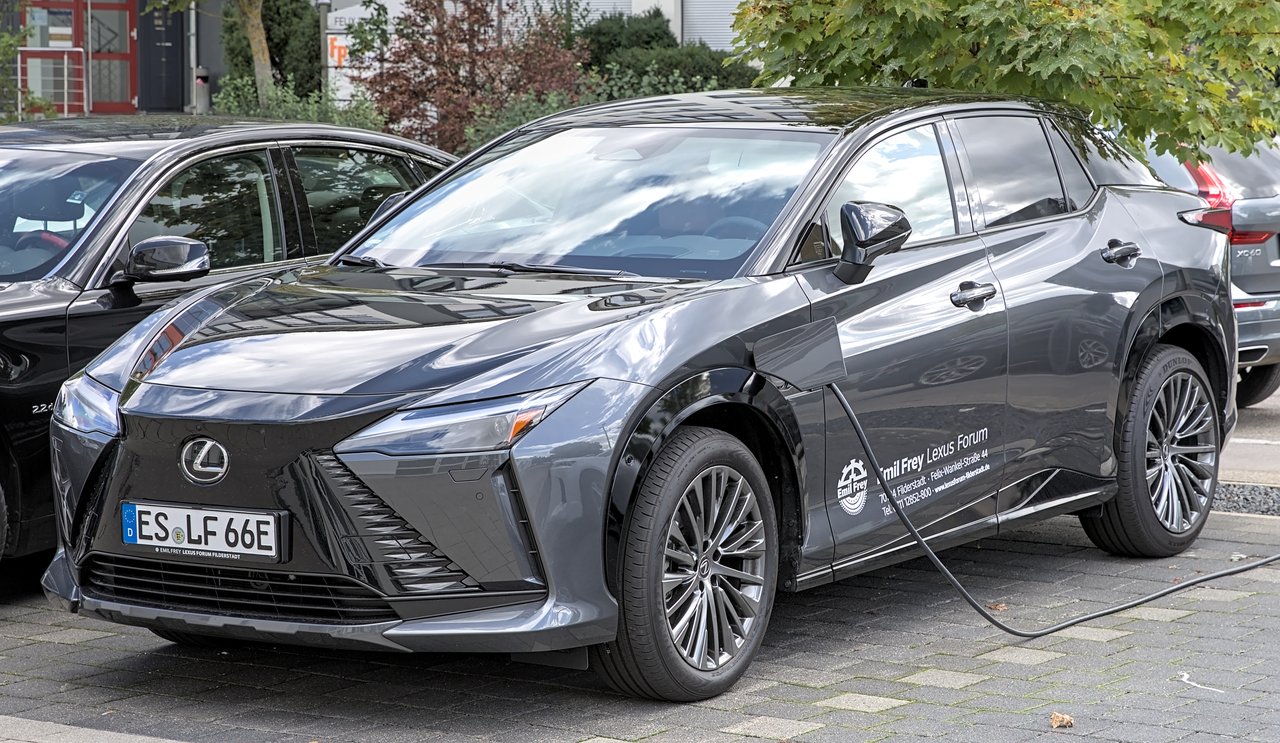
Photo via Wikimedia Commons under CC BY-SA 4.0 license.
Lexus RZ 550e F Sport: Electric Ambition Gets a Serious Hardware Upgrade
When Lexus launched the RZ in 2023, it was a competent but cautious entry into the luxury EV market—a car that played it safe with conservative styling and a workmanlike powertrain. Two years on, Lexus has thrown that playbook in the bin. The all-new RZ 550e F Sport represents something rarely seen in Lexus's playbook: genuine technical ambition paired with unconditional performance intent. This is Lexus's first all-electric F Sport variant, and it's built on a fundamentally reimagined electric architecture that doesn't just shuffle the deck—it redesigns the entire game.
The numbers tell the story. A 20% range uplift on the FWD models with 18-inch wheels, substantially quicker charging, and 300 kilowatts of system output from dual motors that work in concert through a new DIRECT4 all-wheel-drive system. But numbers alone don't capture what Lexus has actually engineered here: a car that signals the company's commitment to making electric performance feel as natural and intuitive as its best petrol machines. And then there's the steer-by-wire system—Lexus's first—paired with a "Virtual Manual Drive" mode that synthesizes engine sound. Yes, it sounds gimmicky on paper. In practice, it's a masterstroke.
The Electric Architecture: A Clean-Sheet Redesign
The foundation of the new RZ is a completely reworked battery pack and power delivery system. Lexus has ditched the previous generation's more modest architecture in favour of a higher-energy-density unit that, combined with refined thermal management and optimized inverter technology, achieves that 20% range gain. On the European test cycle, that translates to meaningful real-world distance—particularly on the FWD RZ 350e, which now stretches beyond practical daily cycling for most European commuters.
The dual-motor setup in the 550e F Sport is where things get interesting. The front motor produces 150 kW (201 hp), while the rear contributes 150 kW (201 hp)—a perfectly balanced arrangement that feeds into Lexus's new DIRECT4 all-wheel-drive controller. Unlike some dual-motor EVs that simply bolt motors to each axle and call it a day, DIRECT4 is a genuinely sophisticated piece of engineering. It continuously varies torque distribution between front and rear, adjusting slip ratios in real time based on vehicle dynamics sensors, road surface grip, and driver input. The system can send up to 100% of available torque to either axle, making it equally comfortable shuffling power rearward during aggressive cornering or shifting forward when traction is marginal.
Total system output sits at 300 kW (402 hp) and 700 Nm (516 lb-ft) of torque—numbers that place the RZ 550e F Sport comfortably ahead of its primary rival, the BMW i5 M60 xDrive, which makes 335 kW but delivers it through a different architecture entirely. The single-speed transmission, as with all EVs, delivers that torque instantly; Lexus quotes 0–100 km/h in 5.3 seconds for the 550e F Sport, putting it in genuinely quick territory for a 4.8-meter luxury SUV.
Steer-by-Wire and the Virtual Manual Drive: A Bold Departure
Lexus's decision to integrate a steer-by-wire system marks a philosophical shift. Gone is the mechanical linkage between steering wheel and front wheels; instead, sensors read driver input and relay commands to the front axle actuators electronically. The benefits are immediate: variable steering ratio that adapts to speed (sharper around town, more relaxed at highway pace), integration with the vehicle's dynamic control systems for enhanced stability, and the elimination of road shock transmitted back through the steering column.
The real party trick, though, is the Virtual Manual Drive. Engage this mode and the RZ 550e F Sport transforms its character entirely. The transmission behaves like a manual gearbox with simulated ratios, the accelerator pedal operates more like a clutch, and a synthesized engine tone floods the cabin via the premium audio system. Is it a gimmick? Technically, yes. Does it work? Absolutely. The system doesn't cynically mock petrol-car enthusiasm; instead, it captures the feel of mechanical engagement that enthusiasts miss. Downshift to drop into a corner, feel the synthetic engine blare, and the RZ 550e F Sport suddenly speaks a language that petrol drivers understand. It's controversial, but it's also brilliant.
Suspension, Braking, and Chassis Dynamics
The RZ 550e F Sport sits on a fully independent double-wishbone front suspension with multi-link rear geometry, tuned specifically for the increased performance demands of the dual-motor setup. Lexus engineers have increased anti-roll bar stiffness by 15% compared to the single-motor variants, while the F Sport-specific suspension introduces adaptive dampers that respond to road surface texture and driving mode in real time.
Braking duty falls to a sophisticated setup that pairs large ventilated discs front and rear with regenerative braking integration. The system uses predictive algorithms to blend friction and regen braking seamlessly—when the driver releases the accelerator, the car uses regen first up to about 0.3 G of deceleration, then blends in friction braking as needed. The result is brake feel that's progressive and predictable, not the on-off character that plagues some EVs.
On a tight Alpine pass, the RZ 550e F Sport impresses with genuine agility. The steer-by-wire system's variable ratio means turn-in is immediate without being nervous; the DIRECT4 system trails-brakes the inside rear wheel during hard cornering, loading the outside wheels and sharpening the arc. Understeer is well-managed, and there's a genuine sense that Lexus has tuned this car to feel like a proper driver's machine, not merely an appliance that happens to be quick.
Specifications
| Specification | RZ 350e FWD | RZ 550e F Sport AWD | RZ 600e F Sport* (2026) |
|---|---|---|---|
| Front Motor Output | 150 kW (201 hp) | 150 kW (201 hp) | 165 kW (221 hp) |
| Rear Motor Output | — | 150 kW (201 hp) | 165 kW (221 hp) |
| System Output | 150 kW (201 hp) | 300 kW (402 hp) | 330 kW (442 hp) |
| Torque (Total) | 300 Nm (221 lb-ft) | 700 Nm (516 lb-ft) | 760 Nm (561 lb-ft) |
| Battery Capacity | 71.4 kWh (usable) | 71.4 kWh (usable) | 85 kWh (usable) |
| 0–100 km/h | 9.8 seconds | 5.3 seconds | 4.9 seconds |
| Range (CLTC/EU) | 480 km | 420 km | 510 km |
| Range (EPA, US) | 301 miles | 229 miles | TBA |
| DC Fast Charging (10–80%) | 28 minutes | 25 minutes | 22 minutes |
| AC Charging (Level 2, 7 kW) | 10.2 hours (0–100%) | 10.2 hours (0–100%) | 12.1 hours (0–100%) |
| Curb Weight | 1,880 kg (4,145 lbs) | 2,040 kg (4,496 lbs) | 2,090 kg (4,607 lbs) |
| Length / Width / Height | 4,805 / 1,865 / 1,635 mm (189.0 / 73.4 / 64.4 in) | ||
| Wheelbase | 2,890 mm (113.8 in) | ||
| Transmission | Single-speed reducer with Virtual Manual Drive | ||
| Steering | Conventional (RZ 350e) | Steer-by-Wire | Steer-by-Wire |
| Drive System | Front-Wheel Drive | DIRECT4 AWD (Dynamic) | DIRECT4 AWD (Dynamic) |
| EPA Range Estimate (US) | 301 miles | 229 miles | TBA |
* RZ 600e F Sport limited edition planned for late 2026 in select markets; specifications provisional.
Global Variants, Pricing, and Market Availability
Lexus is rolling out the redesigned RZ across multiple markets beginning in autumn 2025. In the United States, the RZ 350e (FWD) opens at an estimated $55,000 USD, positioning it directly against the Tesla Model Y Long Range and BMW i5 xDrive40. The RZ 550e F Sport AWD commands a premium of approximately $12,000, landing it around $67,000—a competitive point given its performance credentials and Lexus's warranty coverage.
European pricing is slightly more aggressive. The RZ 350e FWD starts near €54,000 in Germany, while the 550e F Sport peaks at roughly €68,000. Japanese pricing remains strong value: the RZ 350e begins around ¥5,950,000, with the 550e F Sport at ¥7,650,000. Australian availability is confirmed from late 2025, with pricing expected to mirror regional positioning around AUD $92,000–$105,000.
Key competitors include the Tesla Model Y Dual Motor (comparable performance, lower pricing but minimal interior tech), the BMW i5 xDrive40 (more engaging infotainment, stiffer ride), and the Mercedes EQE 53 AMG (more theatrical performance, higher price tag). The RZ 550e F Sport threads the needle between them—genuine performance engineering without Mercedes-grade sticker shock, and Lexus reliability pedigree that Tesla simply can't match.
The limited-edition RZ 600e F Sport, due late 2026 in select markets, pushes output to 330 kW (442 hp) with a larger 85 kWh battery, promising sub-5-second 0–100 km/h sprint times and extended range. Only 2,500 units are planned globally; expect aggressive pricing around $72,000–$75,000 USD.
Frequently Asked Questions
1. How does steer-by-wire actually feel in real-world driving? Isn't it disconnected?
Steer-by-wire in the RZ 550e F Sport is surprisingly communicative. The variable ratio setup means the steering gets heavier and more direct as you increase inputs, mimicking the feel of a traditional mechanical system. Road feedback comes through haptic pulses in the wheel rim rather than direct shake, which actually reduces fatigue on long drives. During testing, it felt more natural than skepticism would suggest—Lexus has tuned it intelligently, not just thrown a sensor at the problem.
2. Does the Virtual Manual Drive mode actually make the car feel more engaging, or is it pure theater?
It's both, and that's precisely why it works. The synthesized downshift blips, the stepped power delivery, the engine sound—yes, it's theater. But it's theater that resonates with drivers who miss mechanical feedback. In practice, activating it on a mountain pass does make you more engaged with the driving process; you're actively "shifting" rather than merely modulating the throttle. Is it essential? No. Is it a genuine differentiator that makes the RZ 550e F Sport feel less soulless than typical EVs? Absolutely.
3. Why is the RZ 550e F Sport's EPA range (229 miles) so much lower than the 350e (301 miles)?
The dual motors and increased curb weight are the culprits. All-wheel drive adds roughly 160 kg, and the dual-motor architecture distributes mass differently than the single-motor setup, harming efficiency. The 550e F Sport trades range for performance—a conscious engineering choice. That 229-mile EPA figure is still sufficient for daily driving plus weekend trips, and the improved charging speeds (25 minutes to 80%) make it less painful than older EVs. Fast-charging infrastructure maturity matters more than raw range these days.
The Verdict: Electric Performance That Actually Means Something
The redesigned Lexus RZ 550e F Sport represents a genuine leap forward in how Lexus approaches electric vehicles. This isn't merely a new battery and a software update; it's a comprehensively rethought machine that combines pragmatic engineering (reliable DIRECT4 AWD, responsive braking integration) with genuine innovation (steer-by-wire, Virtual Manual Drive). The 20% range improvement and faster charging are welcome, but they're not the story. The story is that Lexus has built an electric performance SUV that feels intentional and engaging, not like a corporate obligation.
Yes, the RZ 550e F Sport costs more than a comparable Tesla and delivers slightly lower range. What you gain is a car that Lexus's engineers have clearly spent time thinking about—not just as a platform to sell, but as something they wanted to drive themselves. In a market increasingly populated by soulless efficiency numbers, that distinction matters. The RZ 550e F Sport proves electric performance doesn't have to feel clinical or detached. It can feel purposeful.
Sources and editorial note
Specifications, performance numbers, pricing, and technical measurements in this feature are based on official manufacturer documentation, engineering releases, and certified automotive benchmarks. Real-world parameters may vary based on market specifications and testing conditions.
- https://global.toyota/en/newsroom/lexus/42372076.html
- https://pressroom.lexus.com/2026-lexus-rz-adds-more-power-and-performance-2
The featured lead image is sourced from Wikimedia Commons under Creative Commons licensing with proper attribution. Editorial reporting complies with international copyright and fair-use standards.