
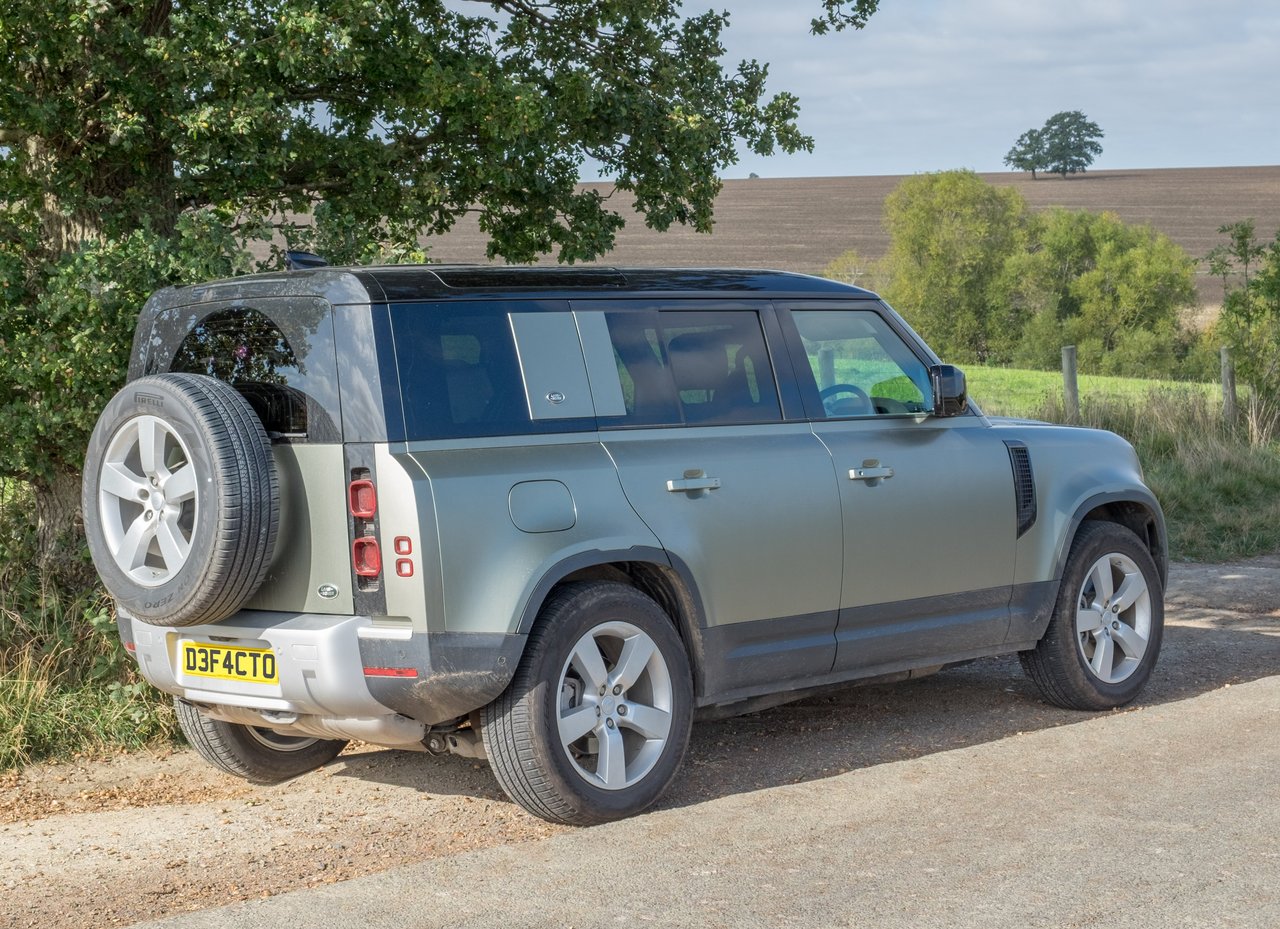
Photo via Wikimedia Commons under CC BY-SA 4.0 license.
The Apex Defender: Solihull Reinvents its Icon
When Land Rover retired the original, ladder-chassis Defender in 2016, traditionalists feared the marque was permanently trading grease-stained utility for Chelsea tractor optics. The arrival of the monocoque D7x platform in 2020 proved capable, yet purists still questioned whether Solihull could produce an uncompromised high-performance halo vehicle capable of dismantling the Mercedes-AMG G 63 on tarmac while retaining genuine expedition credibility. The Land Rover Defender OCTA is the definitive engineering answer to that question.
Named after the octahedral geometry of a diamond—the hardest naturally occurring mineral on Earth—the OCTA represents a radical philosophical departure for Land Rover's Special Vehicle Operations (SVO). Rather than executing a superficial cosmetic trim package with stiffer lowering springs, SVO engineers rebuilt the Defender 110 from its suspension pickup points outward. The result is a hyper-capable, high-speed desert prerunner that simultaneously corners with the flat composure of an apex-hunting sports wagon. In an era where extreme off-roaders usually compromise either road discipline or wilderness capability, the OCTA attacks both extremes simultaneously.
Powertrain: Munich Muscle Meets Solihull Engineering
Beneath the vented aluminum hood sits a powertrain transplant that signals a major technical shift: Jaguar Land Rover’s venerable 5.0-liter supercharged AJ-V8 has been retired in favor of a BMW-sourced 4.4-liter twin-turbocharged V8, internally dubbed the S68-variant. SVO recalibrated the electronic control units, exhaust routing, and thermal packages to handle severe desert operating temperatures and deep water ingress.
The engine utilizes a hot-vee configuration where twin twin-scroll turbochargers sit nestled between the cylinder banks, slashing exhaust manifold runner lengths to eradicate off-idle throttle lag. Integrated into the powertrain is a 48-volt mild-hybrid (MHEV) system featuring a belt-integrated starter generator that fills lower-RPM torque voids during off-road crawling and rapid gear shifts. In standard operating profiles, the engine generates an authoritative 626 horsepower (635 PS) and 750 Nm (553 lb-ft) of torque. Engage Dynamic Launch Mode, however, and transient overboost swells peak torque to a bruising 800 Nm (590 lb-ft) across a plateau extending from 1,800 to 5,850 rpm.
Engine output routes through an eight-speed ZF 8HP76 torque-converter automatic transmission calibrated for brutal, sub-200-millisecond upshifts in dynamic modes and butter-smooth creeping behavior in low range. Solihull retains a permanent four-wheel-drive system complete with an electronically controlled two-speed transfer case and an Active Locking Rear Differential featuring brake-actuated torque vectoring. Thermal management receives massive upgrades: dual high-capacity radiators, an auxiliary oil cooler mounted low behind bespoke bumper intakes, and transmission cooling circuits configured to maintain optimal operating pressures during sustained sand dune thrashing.
Chassis and Kinematics: The 6D Dynamics Revolution
The headline engineering breakthrough on the Defender OCTA is its suspension architecture. Borrowing and fundamentally adapting the 6D Dynamics system originally debuted on the Range Rover Sport SV, the OCTA completely eliminates physical, mechanical anti-roll bars (sway bars). Conventional steel anti-roll bars present an unavoidable engineering compromise: stiff bars reduce body roll through high-g tarmac corners but actively destroy off-road cross-axle articulation by linking left and right wheel movements.
SVO’s solution replaces mechanical torsion bars with a hydraulically interlinked semi-active damper system. Each corner features continuously variable semi-active dampers interconnected via high-pressure hydraulic circuits routed longitudinally and transversely across the chassis. Controlled by a central vehicle dynamics module running predictive algorithms at hundreds of hertz, the system manages pitch and roll independently without sacrificing wheel travel. Under hard braking, front hydraulic lines pressurize to arrest dive; under aggressive lateral acceleration, outer dampers firm instantaneously to keep the 2.5-ton chassis flat against cornering forces.
Off-road, the 6D Dynamics system opens its valves to provide virtually unrestricted axle articulation. The dampers operate in concert with redesigned, longer, and reinforced wishbones that expand the front and rear track by 68 mm (2.7 inches) while elevating resting ride height by 28 mm (1.1 inches). Wheel wells are swollen with purposeful box-flared composite arches housing 33-inch Goodyear Wrangler DuraTrac RT or Advance all-terrain tires wrapped around forged 20-inch or optional lightweight 22-inch alloy wheels. Deceleration is tasked to massive 400 mm front ventilated steel discs clamped by bespoke Brembo six-piston monobloc calipers, ensuring repeatable stopping power regardless of terrain.
Dynamics Behind the Wheel: Tarmac G-Forces and OCTA Mode Drifting
Activate standard Dynamic mode on asphalt, and the Defender OCTA defies basic physics. You sit high above traffic, yet turn-in is sharp, immediate, and free from the wallowing roll that plagues the Mercedes-AMG G 63. The steering rack, revised with a faster ratio and stiffened mounting bushings, communicates lateral load through the front tire contact patches with genuine fidelity. The hydraulic suspension arrests body movement so decisively that mid-corner bumps on broken mountain passes fail to unsettle the chassis trajectory.
The true character of this machine unlocks via a long press of the diamond-illuminated button at the base of the steering wheel: OCTA Mode. This profile decouples electronic safety nets into an enthusiast-focused calibration, slackening dynamic stability control, adjusting throttle maps for violent mid-range punch, and configuring off-road ABS for intentional tire slip to build wedge berms on loose gravel surfaces.
On loose dirt, hard-packed sand, or gravel rally stages, OCTA Mode directs an aggressive rear torque bias, enabling full-throttle, controllable power slides. The hydraulic 6D suspension absorbs massive washboard ruts and crest compressions without bottoming out or deflecting off line. When the pace slows for boulder crawling, wheel articulation mirrors that of an uncoupled rock buggy. Water crossings present no hazard: thanks to high-mounted air intakes that draft through internal wing channels, the OCTA boasts an official wading depth of 1,000 mm (3.28 feet)—out-wading both the standard Defender and the Jeep Wrangler Rubicon.
Interior Architecture: Body and Soul Seats (BASS)
Inside, the OCTA retains the utilitarian, exposed-rivet ethos of the Defender cabin while layering in structural luxury and tactile technology. The high-wear touchpoints feature lightweight Chopped Carbon Fibre detailing—forged from recycled carbon offcuts—and upholstery options finished in dual-tone semi-aniline leather or resilient, highly breathable polyurethane Ultrafabrics that weigh 30 percent less than traditional hides.
The interior centerpiece is the introduction of Body and Soul Seats (BASS), developed in partnership with music-technology firm SUBPAC. Embedded directly inside the high-bolstered front performance bucket seats are acoustic transducers coupled to an onboard audio processing module. Rather than relying solely on the 29-speaker Meridian surround sound system, BASS transmits tactile bass vibrations directly through the seat frames into the occupant’s back and chest. Beyond acoustic depth, the system incorporates six wellness presets designed to reduce driver fatigue or elevate alertness during long-distance endurance overland journeys.
Land Rover Defender OCTA: Technical Specifications
| Specification Parameter | Technical Data |
|---|---|
| Engine Architecture | BMW-sourced 4.4-liter (4,395 cc) 90° Twin-Turbocharged V8 with 48V MHEV |
| Peak Horsepower | 626 hp (460 kW / 635 PS) @ 5,850–7,000 rpm |
| Peak Torque | 750 Nm (553 lb-ft) normal / 800 Nm (590 lb-ft) via Dynamic Launch Mode |
| Transmission | 8-speed ZF automatic with dual-range transfer case and e-diff locks |
| 0–100 km/h (0–62 mph) | 4.0 seconds (Launch Mode enabled) |
| Top Speed | 250 km/h (155 mph) on 22-inch road tires / 159 km/h (99 mph) on 33-inch AT rubber |
| Curb Weight (DIN) | Approximately 2,510 kg (5,534 lbs) |
| Track Width | Front: 1,774 mm (+68 mm) | Rear: 1,770 mm (+68 mm) |
| Maximum Ground Clearance | 319 mm (12.56 inches) in maximum off-road suspension height |
| Maximum Wading Depth | 1,000 mm (39.37 inches / 3.28 feet) |
| Front / Rear Braking | Brembo 6-piston front calipers, 400 mm ventilated discs; single-piston rear |
| Base Price (US / UK) | $152,000 (MSRP) / £145,300 OTR |
Market Positioning, Trims, and Rivals
The Defender OCTA arrives in two distinct specifications for its global rollout: the standard OCTA and the limited-run OCTA Edition One. The Edition One, available exclusively during the first production year, commands an entry price of $167,800 (£160,800) and features exclusive Faroe Green exterior paint, Khaki and Ebony Ultrafabrics upholstery, specialized 20-inch forged wheels, and raw Chopped Carbon detailing across the bonnet script, fender vents, and seat backs.
In terms of competitive landscape, the OCTA lands in direct contention with established high-output luxury titans:
- Mercedes-AMG G 63: Possesses classic military silhouette prestige and twin-turbo V8 muscle, but relies on a live rear axle that compromises high-speed pavement composure and technical rough-terrain stability compared to the OCTA’s 6D hydraulic setup.
- Ford Bronco Raptor: Outstanding high-speed desert suspension travel via Fox Live Valve dampers and aggressive 37-inch rubber, but falls significantly short on cabin refinement, towing capacity, road-going apex control, and high-speed V8 propulsion.
- Porsche Cayenne Turbo GT: Unrivaled on a paved racing circuit, but fundamentally incapable of matching the Defender’s one-meter wading capability, wheel articulation, or off-road survival envelope.
Frequently Asked Questions
Why did Land Rover eliminate physical anti-roll bars in favor of 6D Dynamics?
Traditional steel anti-roll bars mechanically link opposite wheels on the same axle. In high-speed cornering, they resist body roll, but off-road, they severely inhibit wheel articulation, lifting wheels off the ground and compromising traction. By substituting mechanical sway bars with a hydraulically interlinked semi-active damper system, the OCTA decoupling circuit enables zero resistance during diagonal wheel displacement over rocks, while instantly pressurizing the hydraulic loop under hard steering inputs to eliminate body roll on pavement.
How does the BMW-sourced 4.4L V8 differ in application here versus a BMW X5 M?
While sharing core mechanical architecture—including the 4,395 cc displacement, cylinder block, and hot-vee turbocharger packaging—Land Rover’s SVO division implemented proprietary engine control software, altered throttle maps, and built an extensive off-road sealing and lubrication system. The sump and baffling are designed to prevent oil starvation on steep 45-degree approach angles, the alternator and electrical ancillaries are moisture-sealed for 1,000 mm wading, and the cooling pack is expanded to handle extreme sand-choking desert expeditions.
Can the 33-inch tires and widened track handle tight, technical off-roading?
Yes. Although the 68 mm wider track demands awareness on narrow forestry trails, the widened geometry significantly enhances high-camber off-camber rollover resistance. The bespoke 33-inch Goodyear all-terrain tires feature reinforced sidewalls engineered for lower operating pressures down to single-digit PSI without unseating, providing an elongated contact patch that easily grips rocky ledges and loose scree.
The Verdict: Engineering Synthesis at the Extremes
The Land Rover Defender OCTA is not a badge-engineered trim package tailored for urban poseurs. It represents an authentic, mechanically sophisticated triumph of modern chassis engineering. By integrating Munich’s potent mild-hybrid twin-turbo V8 into Solihull’s rugged architecture, and mastering wheel kinematics through the hydraulic 6D Dynamics platform, SVO has constructed a dual-purpose vehicle that redefines expectations. The OCTA operates as a civilized luxury tourer, an apex-carving canyon missile, and a high-speed desert assault truck simultaneously—a rare, uncompromising masterclass in modern automotive performance.
Sources and editorial note
Specifications, performance numbers, pricing, and technical measurements in this feature are based on official manufacturer documentation, engineering releases, and certified automotive benchmarks. Real-world parameters may vary based on market specifications and testing conditions.
The featured lead image is sourced from Wikimedia Commons under Creative Commons licensing with proper attribution. Editorial reporting complies with international copyright and fair-use standards.