
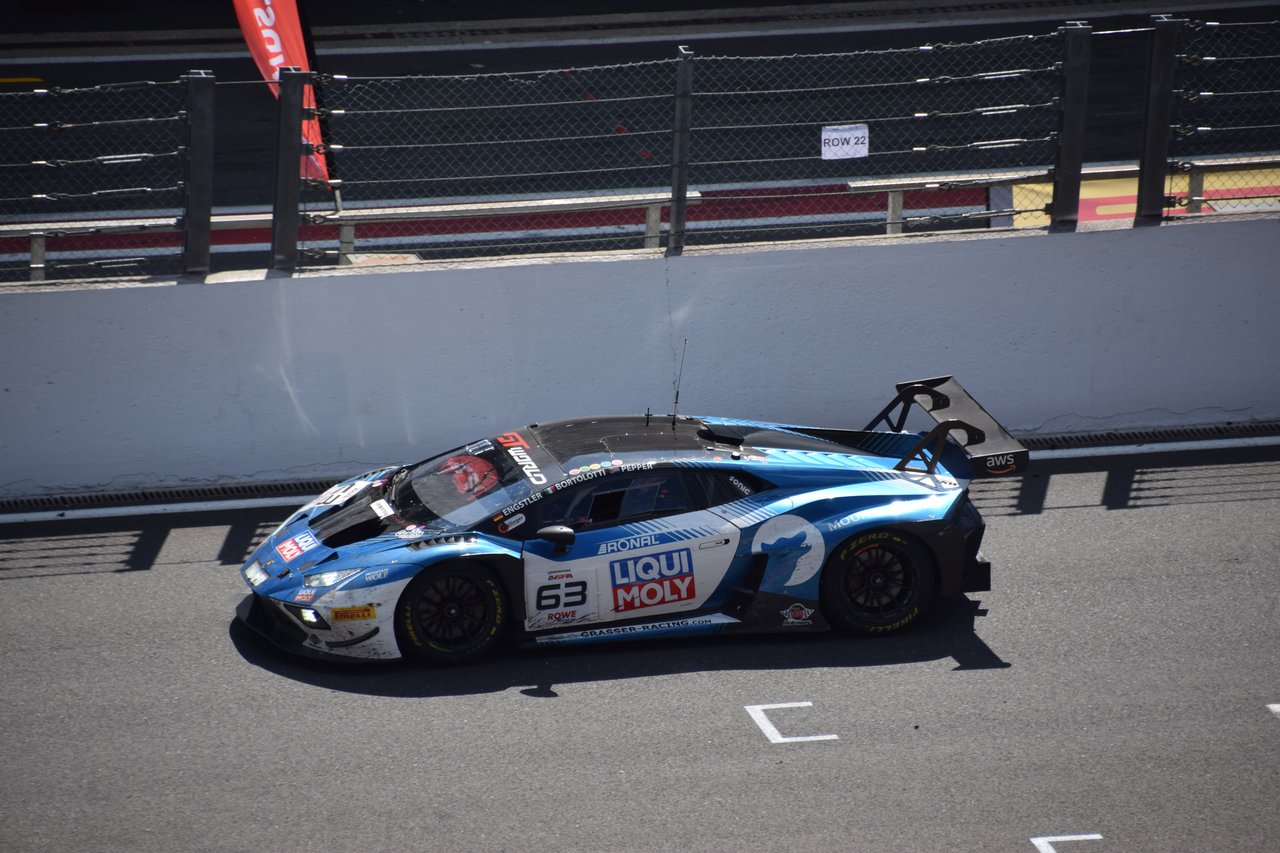
Photo via Wikimedia Commons under CC BY-SA 4.0 license.
The Last Pure-Bred Ten-Cylinder Gladiator: Anatomy of the Lamborghini Huracán GT3 EVO2
For over a decade, Sant’Agata Bolognese’s naturally aspirated V10 has served as the heartbeat of modern motorsport’s most visceral customer racing program. While the road-going Huracán bows out to make room for its hybrid successor, Squadra Corse ensured the V10's racing lineage would not fade quietly into the paddock twilight. Enter the Huracán GT3 EVO2—the final, most lethal evolution of a platform that has conquered the globe's most punishing endurance circuits, from the banking at Daytona to the unforgiving tarmac of the Nürburgring Nordschleife.
Developed directly by Lamborghini’s in-house motorsport division, the EVO2 inherits the aerodynamic breakthroughs and raw foundational DNA of the road-legal Huracán STO. Yet, beneath its carbon-fiber skin lies a purebred, FIA-compliant competition machine stripped of all electronic safety blankets save for motorsport-calibrated ABS and multi-stage traction control. At roughly €400,000 before spares and regional taxes, it represents the pinnacle of turn-key customer GT racing—an analog weapon built for privateer teams and professional drivers alike.
The Powertrain: The Untamed Song of the 5.2-Liter V10
In a motorsport landscape increasingly dominated by turbochargers and hybrid assist modules, the Huracán GT3 EVO2 stands as a defiant monument to linear throttle response and high-rpm theatre. While the road-going STO unleashes a wild 640 metric horsepower, the GT3 EVO2 is reined in by Balance of Performance (BoP) regulations to approximately 580 horsepower, delivered via a carbon-fiber intake restrictor system mandated by the FIA.
The engine itself is a masterpiece of internal combustion engineering. Displacing 5,204cc, the dry-sump, 90-degree V10 features titanium valves, forged aluminum pistons, and a high-compression ratio designed to spin past 8,000 rpm. For the EVO2 generation, Squadra Corse completely redesigned the intake system using ten individual throttle bodies operated by electronic actuators. This layout dramatically sharpens transient throttle response, allowing drivers to feather the rear tires with pinpoint precision at the apex of mid-speed corners.
Power is channeled rearward exclusively—no front driveshafts here—through a heavy-duty, six-speed sequential transmission supplied by Xtrac. Mounted transversely in the chassis, the gearbox features a lightened aluminum casing and a multi-plate sintered clutch designed for brutal standing starts and rapid-fire downshifts under heavy braking. A pneumatic paddle-shift system controls gear changes, accompanied by mechanical differential locking that can be adjusted via external ramps in the paddock.
Chassis Kinematics and Aerodynamic Mastery
The Huracán GT3 EVO2’s dominance on track stems not from sheer straight-line speed, but from its aerodynamic consistency and mechanical predictability. The aerodynamics package, engineered entirely in-house by Squadra Corse, draws direct inspiration from the road-legal STO. A massive carbon-fiber front splitter channels air underneath the flat bottom, while the iconic "snorkel" roof scoop feeds fresh air directly into the engine bay, replacing the side air intakes of earlier GT3 generations to optimize side-body airflow.
At the rear, a towering carbon-fiber wing is mounted on dedicated aluminum pylons, designed to provide adjustable downforce windows tailored for high-speed tracks like Monza or high-downforce bullrings like Brands Hatch. The rear diffuser works in tandem with the wing to anchor the rear axle, mitigating the traditional mid-engine tendency to snap oversteer on corner entry.
Underneath the composite skin lies an ultra-rigid aluminum-carbon hybrid spaceframe integrated with a welded multi-point steel roll cage that far exceeds FIA safety requirements. The suspension utilizes double wishbones front and rear, suspended by four-way adjustable motorsport dampers. Squadra Corse engineered revised kinematics to minimize tire degradation, ensuring that the Pirelli rubber maintains an optimal contact patch over the brutal curbing found at tracks like Spa-Francorchamps and Sebring. Braking is handled by ventilated steel discs clamped by monoblock calipers, paired with a quick-change endurance setup that allows mechanics to swap worn pads and rotors in mere minutes.
Technical Specifications
| Specification | Lamborghini Huracán GT3 EVO2 |
|---|---|
| Engine Type | 5.2-liter naturally aspirated 90° V10, dry sump |
| Max Power | ~580 hp (subject to FIA Balance of Performance regulations) |
| Valvetrain | Chain-driven DOHC, 4 valves per cylinder, titanium valves |
| Transmission | 6-speed sequential transverse Xtrac gearbox with pneumatic paddle shift |
| Drivetrain | Rear-wheel drive (RWD) with mechanical slip differential |
| Chassis | Aluminum-carbon composite spaceframe with integrated FIA roll cage |
| Suspension | Double wishbone front and rear, 4-way adjustable motorsport dampers |
| Braking System | Ventilated motorsport discs, multi-piston calipers, adjustable racing ABS |
| Wheels & Tires | Forged aluminum center-lock rims, Pirelli GT3 spec tires (Front: 300/680-18, Rear: 325/705-18) |
| Dry Weight | Approx. 1,230 kg (variable per BoP ballast) |
| Turn-Key Price | Approx. €400,000 (excluding taxes and optional spares packages) |
Behind the Wheel: On Track Dynamics
Drop yourself into the carbon-fiber bucket seat of the GT3 EVO2, flick the master ignition switch on the central console, and thumb the starter. The cabin immediately fills with a sharp, mechanical cacophony—the dry-sump pump whirring, injectors clicking, and the V10 settling into a lumpy, aggressive idle that rattles the driver’s helmet.
Out on the circuit, the car communicates through the steering wheel with uncompromising transparency. Turn-in is razor-sharp; the front tires bite hard against the tarmac the moment you release the brake pedal. Thanks to the revised engine mapping and individual throttle bodies, rolling back onto the power mid-corner is progressive and linear. There is no sudden turbo spike to unsettle the chassis mid-bend. Instead, the rear tires bite progressively as the revs climb toward the screaming redline.
The anti-lock braking system and traction control are fully adjustable via rotary dials on the steering wheel, allowing drivers to adapt on the fly as track temperatures rise and rubber builds up on the racing line. Over high-speed crests, the aerodynamic load keeps the car planted, inspiring the kind of confidence required to clip apexes at triple-digit speeds.
Market Positioning and Global Legacy
The Huracán GT3 EVO2 competes in one of the most fiercely contested categories in international motorsport: GT3. From the GT World Challenge Europe and America to the IMSA WeatherTech SportsCar Championship and the global LMGT3 class in the FIA World Endurance Championship, Lamborghini’s customer racing program has proven to be an industrial and competitive powerhouse.
Priced around €400,000 for a turn-key package, the EVO2 sits comfortably alongside rival machinery from Porsche (911 GT3 R), Ferrari (296 GT3), and BMW (M4 GT3). However, its mechanical accessibility, robust engine longevity, and unmatched exhaust note have made it a perennial favorite among gentleman drivers and elite professional teams alike.
Frequently Asked Questions
Can the Huracán GT3 EVO2 be converted for road use?
No. The GT3 EVO2 is a dedicated, purebred racing car built strictly for the track. It lacks emissions equipment, structural side-impact compliance for public roads, and standard lighting required for vehicle registration.
How does the EVO2 differ from the older Huracán GT3 EVO?
The EVO2 introduces significant aerodynamic upgrades derived from the Huracán STO—including the prominent roof air intake and carbon rear wing—along with a brand-new ten-throttle body system, revised roll-cage geometry, and enhanced brake caliper design for easier endurance servicing.
What is the typical running cost per kilometer?
While exact figures depend on the series and driving style, GT3 racing is an elite motorsport discipline. Engine overhauls are typically scheduled at high mileage intervals (often around 10,000 km), and tire, fuel, and consumable replacement costs place typical operational budgets well into six figures per competitive season.
Verdict
The Lamborghini Huracán GT3 EVO2 is a fitting swan song for one of the greatest eras in modern motorsport. By marrying the ferocious character of the naturally aspirated V10 with razor-sharp aerodynamics and bulletproof endurance engineering, Squadra Corse has crafted an instant classic. It may be the end of the road for the V10 in production cars, but on the race tracks of the world, the beast from Sant'Agata will roar on for years to come.
Sources and editorial note
Specifications, performance numbers, pricing, and technical measurements in this feature are based on official manufacturer documentation, engineering releases, and certified automotive benchmarks. Real-world parameters may vary based on market specifications and testing conditions.
- https://www.lamborghini.com/en-en/motorsport/motorsport-models/huracan-gt3-evo2
- https://www.gt-world-challenge-europe.com/news/2296/lamborghini-squadra-corse-presents-the-new-huracan-gt3-evo2-the-racing-version-of-huracan-sto
The featured lead image is sourced from Wikimedia Commons under Creative Commons licensing with proper attribution. Editorial reporting complies with international copyright and fair-use standards.