
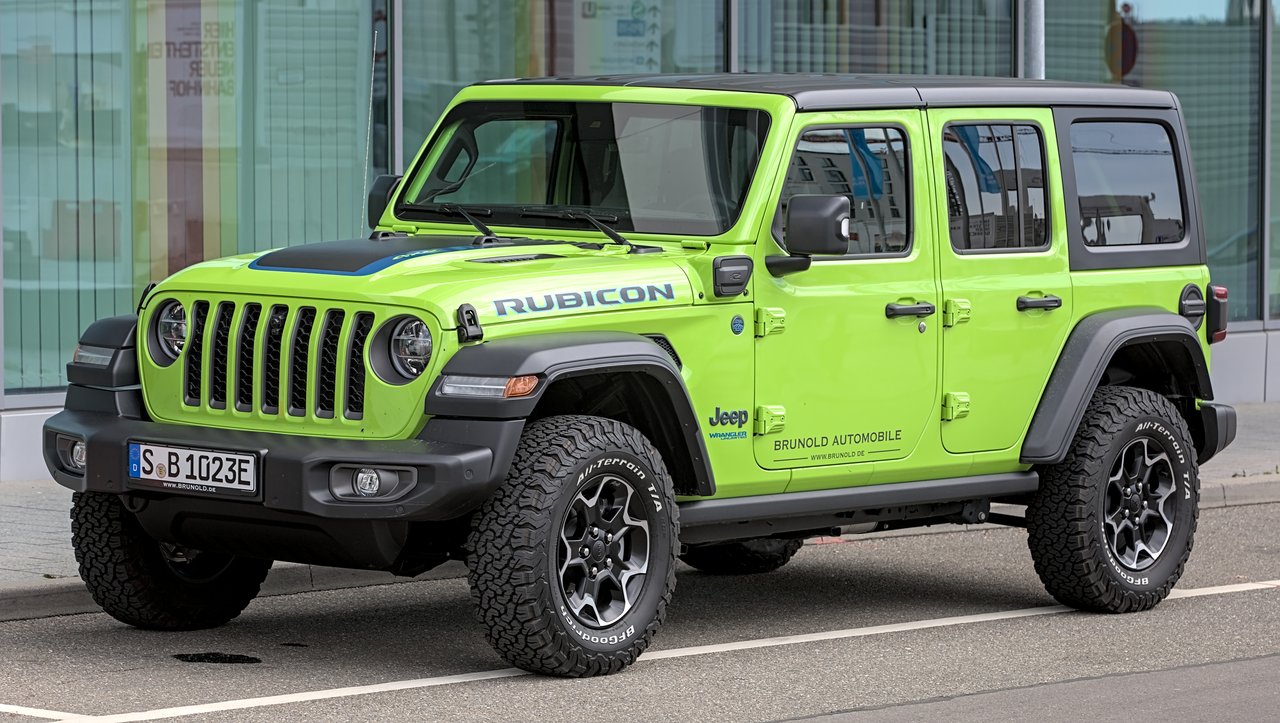
Photo via Wikimedia Commons under CC BY-SA 4.0 license.
Trail-Rated Electrons: Engineering the All-Electric Jeep Recon 4xe
By MasEko
For more than eight decades, Jeep's off-road authority was forged through greasy iron transfer cases, mechanical locking differentials, and the familiar grumble of internal combustion engines churning through rock and mud. The Jeep Recon 4xe arrives to upend that orthodoxy. Rather than a fragile crossover dressed in aggressive tire tread or an electrified compliance carriage, the Recon 4xe is a clean-sheet, battery-electric off-roader designed to prove that ditching petrol enhances, rather than compromises, pure trail capability.
The stakes are enormous. Diehard off-road traditionalists view battery electric vehicles with deep skepticism, citing thermal de-rating during sustained high-load ascents, underbody vulnerability, and the nightmare scenario of remote trail stranding. Jeep engineers tackled these doubts head-on with an audacious development target: create a production electric vehicle capable of crossing California's punishing 22-mile Rubicon Trail on a single charge and retaining enough energy to drive back to Lake Tahoe on tarmac.
STLA Large Platform: The Foundation of Rigidity
Underneath the upright, chiseled silhouette sits the Stellantis STLA Large platform. Unlike traditional body-on-frame architectures that rely on ladder rails with high-riding floorpans, the STLA Large EV-native architecture integrates a structural battery enclosure directly between high-strength hydroformed steel frame channels. This layout yields staggering torsional rigidity, which is vital when traversing cross-axle ruts where chassis flex can cause doors to jam or roof seals to creak.
The low center of gravity transforms vehicle dynamics. With several hundred kilograms of battery cells sitting below the axle centerlines, the Recon exhibits minimal body roll on asphalt while dramatically lowering the rollover angle when navigating steep off-camber terrain. Heavy-duty cast-aluminum subframes support the suspension assemblies, isolating drivetrain vibration while providing rigid mounting points for technical abuse.
Dual Electric Drive Modules: Precision Rock Crawling
Propulsion is handled by dual Electric Drive Modules (EDMs)—one positioned squarely between the front wheels and one across the rear. Each EDM packages a high-efficiency silicon-carbide inverter, a three-phase permanent-magnet synchronous motor, and a compact single-speed planetary gear reduction into a single aluminum casting.
Total system output is targeted at 600 horsepower and an immense 617 lb-ft of torque. The mechanical revelation, however, is how that torque reaches the dirt. In a conventional internal-combustion 4x4, extracting peak torque requires spinning the engine into its powerband against a slipping torque converter or relying on a 4.0:1 mechanical low-range transfer case. In the Recon 4xe, maximum torque is available at zero RPM.
Motor inverters meter current in fractions of a millisecond. When an obstacle demands an inch of forward creep over a wet granite boulder, there is no driveline windup, no lurching, and no clutch slip. The driver eases into the accelerator, and the motors deliver microscopic, metered rotational force with surgeon-like precision.
Selec-Terrain and True Electronic Locking Axles
Managing this electronic surge is Jeep’s proprietary Selec-Terrain traction management system. Drivers select from Auto, Sport, Snow, Sand/Mud, and Rock modes via a cockpit toggle. Rock mode alters the throttle mapping exponentially, softening the initial pedal stroke so jolts over rough ground do not cause erratic throttle inputs.
While many modern electric all-wheel-drive systems rely exclusively on brake-based torque vectoring—clamping the brake caliper on a spinning wheel to force torque across an open differential—Jeep recognized the limits of that approach. Hard trail driving quickly boils brake fluid and destroys brake pads. Instead, the Recon 4xe integrates genuine electronic locking differential technology directly into its axle drive units.
When the electronic lockers are engaged, the drive axles lock mechanically left-to-right. Power splits evenly across both wheels regardless of surface traction. If three wheels lose contact with the earth entirely, 100 percent of the available torque on that axle transfers mechanically to the single tire retaining grip, pulling the chassis through without hesitation.
Chassis Armor, Kinematics, and Open-Air Freedom
Placing a high-voltage lithium-ion pack under the floor in technical terrain requires substantial protection. Jeep encases the Recon’s battery cells inside an aluminum sub-structure shielded from rock strikes by full-coverage, high-strength steel skid plates. Structural steel rock sliders run along the rocker panels, engineered to hold the full weight of the vehicle when dropped onto sharp ledges. Cast-steel recovery hooks mount directly to structural frame nodes front and rear, ready for heavy winching extraction.
Suspension kinematics diverge from Wrangler tradition by adopting independent suspension front and rear. Long-travel multi-link setups allow respectable wheel articulation while eliminating the bump-steer and highway wandering inherent to solid front axles. Ground clearance approaches 11 inches on aggressive factory rubber.
Jeep preserved its signature open-air cabin design. The Recon features fully removable doors secured by simple hinge pins and quick-disconnect automotive wiring harnesses. The rear quarter glass unlatches with simple levers, while the Sky One-Touch power roof peels back at the touch of a button, opening the cabin to the elements in seconds without the storage headaches of heavy modular hardtops.
Digital Trailcraft: Uconnect 5 and Rubicon Certification
The Recon's 14.5-inch center touchscreen runs the latest Uconnect 5 infotainment system, heavily optimized for off-grid travel. It incorporates factory-integrated Trails Offroad guides, giving drivers access to detailed route overviews, difficulty ratings, and waypoint descriptions for legendary off-road tracks across the globe.
The screen provides live telemetry: pitch, roll, steering angle, altitude, motor temperatures, and battery thermal draw. Real-time energy forecasting monitors trail conditions, calculating state of charge based on continuous elevation changes and crawl speeds.
This tech pays off in real-world endurance. During testing across the Rubicon Trail, the Recon exploits regenerative braking on descents like Big Sluice and Cadillac Hill. By capturing gravitational potential energy and converting it back into electrical storage, the Recon offsets the energy consumed on technical hill climbs, achieving full trail crossing certification with enough charge in reserve to roll smoothly into town.
Jeep Recon 4xe Specifications
| Parameter | Technical Specification |
|---|---|
| Platform Architecture | Stellantis STLA Large (BEV-Native) |
| Powertrain Configuration | Dual Electric Drive Modules (Front & Rear EDMs) |
| Peak System Output | Estimated 600 hp (447 kW) |
| Peak System Torque | Estimated 617 lb-ft (836 Nm) |
| Battery Pack Capacity | Approx. 100 kWh usable capacity |
| 0–100 km/h Acceleration | Approx. 3.6 seconds (Sport Mode) |
| Ground Clearance | 10.8 inches (274 mm) |
| Approach / Departure Angles | 44.0° / 34.0° |
| Water Fording Depth | Up to 32.0 inches (812 mm) |
| Targeted On-Road Range | Approx. 280–300 miles (450–480 km) |
| Estimated Base Price | $62,000 – $75,000 USD (trim dependent) |
Market Positioning, Trims, and Global Availability
The Recon 4xe occupies a distinct niche in the electric 4x4 landscape. It does not replace the traditional ladder-frame Wrangler; instead, it bridges the gap between raw backcountry capability and refined daily road manners. It targets adventurers cross-shopping the Rivian R1S, the upcoming electric Land Rover Defender, and the four-motor Mercedes-Benz G 580 with EQ Technology.
Jeep will structure the lineup through familiar trim hierarchies: a standard Recon 4xe, a comfort-focused Overland or Sahara edition, and a range-topping, Trail-Rated Rubicon equivalent equipped with 33-inch all-terrain tires, full skid plate armor, and active electronic locking axles. North American production leads the rollout, with global export programs bringing the electric off-roader to Europe, Australia, and Middle Eastern markets shortly thereafter.
Frequently Asked Questions
How can the Recon 4xe rock-crawl without a traditional low-range transfer case?
A conventional low-range transfer case multiplies an internal-combustion engine's high-RPM torque to turn wheels slowly. The Recon's electric motors produce peak torque instantly at zero RPM. By coupling these motors with single-speed planetary gear reductions and precision inverter gating, the vehicle produces massive, controlled wheel torque at fractional speeds without mechanical multi-speed gearing.
Is the floor-mounted high-voltage battery vulnerable to punctures or water crossings?
No. The battery pack is structurally incorporated into the chassis, enclosed in an extruded aluminum housing, and further protected by full-length stamped high-strength steel skid plates. Sensitive electrical connectors, inverters, and cell modules are sealed to IP67-rated water-resistance standards, allowing the Recon 4xe to ford standing water up to 32 inches deep.
Can the Recon genuinely run the Rubicon Trail on a single charge and drive back?
Yes. Slow-speed rock crawling relies on high torque rather than high aerodynamic horsepower, which keeps sustained kilowatt-hour consumption lower than highway cruising. Additionally, severe downhill sections activate regenerative braking, which feeds energy back into the pack rather than cooking mechanical brake friction components.
Engineering Verdict: A New Off-Road Benchmark
The Jeep Recon 4xe demonstrates that electrification improves off-road control. By matching the instantaneous torque precision of electric drive modules with physical electronic locking differentials, robust underbody armor, and genuine open-air modularity, Jeep delivers an authentic backcountry machine. It silences internal-combustion skepticism through solid mechanical engineering, proving that zero emissions and extreme trail capability can coexist seamlessly.
Sources and editorial note
Specifications, performance numbers, pricing, and technical measurements in this feature are based on official manufacturer documentation, engineering releases, and certified automotive benchmarks. Real-world parameters may vary based on market specifications and testing conditions.
The featured lead image is sourced from Wikimedia Commons under Creative Commons licensing with proper attribution. Editorial reporting complies with international copyright and fair-use standards.