
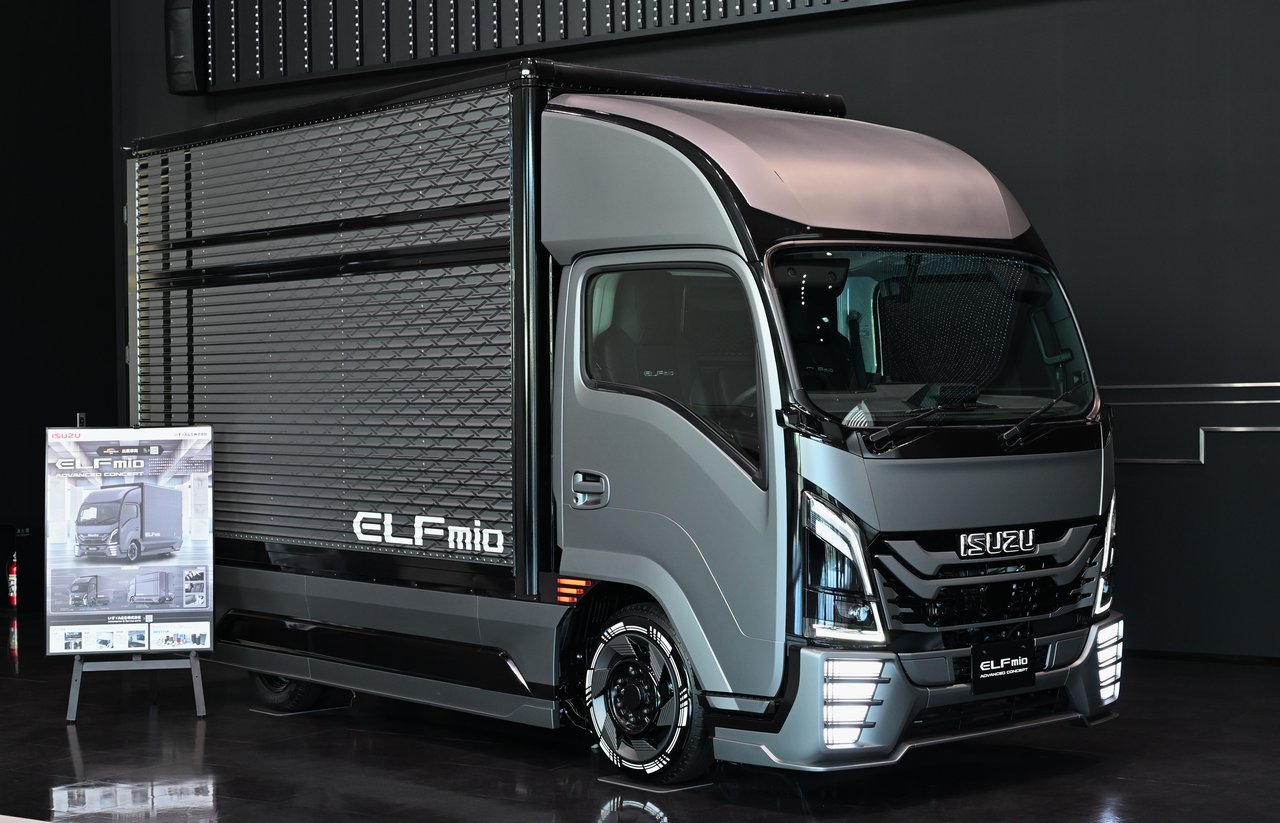
Photo via Wikimedia Commons under CC0 license.
Hydrogen Heavyweight: Inside the Isuzu-Toyota Fuel Cell ELF EV Partnership
For decades, the commercial vehicle sector has been locked in an ideological tug-of-war. Battery-electric platforms make absolute sense for urban parcel delivery, yet heavy urban rotation, intensive refrigeration, and multi-shift operations expose the chemical limitations of lithium-ion cells. Heavy payloads and round-the-clock uptime demand rapid energy replenishment that charging pedestals simply cannot match. Enter the heavyweights of Japanese commercial engineering: Isuzu and Toyota. By fusing Isuzu’s class-leading ELF EV architecture with Toyota’s third-generation hydrogen fuel cell stack, these two giants are preparing a direct assault on the commercial transport status quo, targeting mass production by fiscal year 2027.
This collaboration is not a token green-washing exercise; it is an industrial alignment born of pragmatism. Isuzu brings decades of chassis dominance and body-structure optimization, while Toyota injects billions of yen in fuel cell maturation. The goal is uncompromising: a zero-emission light-duty truck capable of enduring heavy refrigerated logistics cycles without the deadweight and downtime of massive battery packs.
The Hydrogen Architecture: Under the Cab
At the mechanical core of this joint venture lies a complete re-engineering of the standard battery-electric ELF platform. While the baseline ELF EV utilizes a floor-mounted traction battery, this fuel cell variant replaces that electrochemical deadweight with a high-pressure hydrogen storage array and Toyota’s latest modular fuel cell stack.
Toyota’s third-generation fuel cell system marks a massive evolutionary leap over the hardware currently powering the Mirai. Engineers have fundamentally redesigned the MEA (Membrane Electrode Assembly) and separator flow channels, boosting volumetric and gravimetric power density while slashing precious metal usage. The stack operates at a higher voltage threshold, which reduces thermal stress on the copper wiring harnesses and increases overall system efficiency during sustained high-load operations.
Hydrogen is stored in carbon-composite high-pressure tanks underslung within the chassis frame rails, shielded from cargo shifting and side-impact hazards. Feeding the stack is an intelligent air-management system that regulates humidity and oxygen delivery across varying altitude and temperature profiles. The fuel cell generates electricity on demand, feeding a compact buffer lithium-ion battery that handles peak transient loads—such as pulling away from a loading dock under full gross vehicle weight rating (GVWR)—and captures regenerative braking energy.
Chassis Kinematics and Refrigeration Integration
Logistics operators know that putting a fuel cell truck on the road requires more than just swapping out an internal combustion engine. Refrigerated transport (‘reefer’ trucks) places an immense electrical and mechanical draw on the vehicle. Traditional battery-electric reefer trucks suffer from severe range anxiety because the refrigeration compressor directly bleeds power from the main drive battery.
The Isuzu-Toyota alliance solves this by tapping the fuel cell’s high continuous power output. The system can easily provision high-voltage direct current to the transport refrigeration unit (TRU) without compromising the vehicle’s cruising range. To accommodate the weight of the fuel cell stack, power control units, and hydrogen tanks without sacrificing payload capacity, Isuzu implemented rigorous body-structure optimization. High-tensile steel reinforcements are strategically integrated into the ladder-frame chassis, while crossmembers have been re-profiled to save kilograms, offsetting the heavy ancillaries of the hydrogen system.
Suspension kinematics have also been tuned for the dual reality of empty running and max-payload distribution. Up front, independent double-wishbone architecture keeps steering geometry precise and reduces cab vibration over deteriorated urban tarmac. Out back, a heavy-duty live axle paired with progressive-rate leaf springs ensures that whether the box is packed with frozen meats or running empty back to the depot, wheel hop is minimized and cargo integrity remains uncompromised.
Technical Specification Sheet
| Specification | Isuzu-Toyota FCEV Light-Duty Truck |
|---|---|
| Platform Base | Isuzu ELF EV Architecture (Optimized) |
| Powertrain Type | Polymer Electrolyte Fuel Cell (PEFC) + Buffer Battery |
| Fuel Cell Generation | Toyota 3rd-Generation Modular System |
| Hydrogen Storage | High-pressure composite tanks (70 MPa) |
| Refueling Time | Approx. 3 to 5 minutes |
| Primary Application | High-utilization urban/regional refrigerated delivery |
| Payload Capacity | Optimized for standard light-duty commercial class (3.5T - 7.5T variants) |
| Target Production Start | Fiscal Year 2027 |
Market Positioning and Global Strategy
The light-duty commercial segment is fiercely competitive, dominated by diesel mainstays and emerging battery-electric interlopers. However, fleet managers running multi-shift delivery routes have been vocal about the Achilles' heel of pure battery power: multi-hour charging windows kill productivity. By targeting a refueling time of under five minutes, this Isuzu-Toyota truck directly addresses the core operational requirement of commercial logistics.
Cost reduction is the primary battleground. Toyota is aggressively driving down manufacturing costs through automated stack production and economies of scale shared with its passenger car hydrogen programs. Simultaneously, Isuzu is streamlining assembly procedures at its Japanese plants, leveraging shared component sourcing to bring the purchase price closer to parity with traditional diesel equivalents.
While initial rollout will focus heavily on the Japanese domestic market—where hydrogen refueling infrastructure is receiving state-level backing—global deployment into North America, Europe, and select Asian markets is baked into the commercial roadmap. These trucks will target major logistics fleets operating strict hub-and-spoke distribution networks where centralized hydrogen fueling depots can be established.
Frequently Asked Questions
How does this truck handle the heavy electrical load of a refrigeration unit?
Unlike battery-electric trucks that suffer reduced driving range when running auxiliary refrigeration compressors, the fuel cell system provides continuous auxiliary power directly from the hydrogen stack without draining the primary buffer battery. This ensures both constant cooling temperatures and full driving range.
Why choose fuel cells over traditional battery-electric setups for this specific truck?
For high-utilization fleets running 24/7 shifts, battery-electric vehicles require lengthy downtime for recharging. This hydrogen fuel cell truck can be refueled in 3 to 5 minutes—matching the routine of a standard diesel truck—while offering zero tailpipe emissions and avoiding the massive weight penalties of ultra-large lithium-ion battery packs.
How are Isuzu and Toyota lowering the cost of production by 2027?
Toyota is redesigning its third-generation fuel cell stack to use significantly less precious metal while boosting manufacturing automation. Isuzu is simultaneously applying body-structure optimization to the ELF platform, reducing structural component counts and weight to keep manufacturing overhead low and payload capacities high.
MasEko's Verdict
The convergence of Isuzu’s commercial vehicle pedigree and Toyota’s hydrogen engineering brilliance represents a pragmatic masterclass in zero-emission transport development. By refusing to shoehorn battery-electric tech into applications where chemistry simply fails, they have designed a tool specifically tailored to the brutal demands of refrigerated logistics. If they hit their cost-reduction targets ahead of the FY2027 production launch, this truck will not just be a viable alternative—it will become the gold standard for heavy-duty commercial uptime.
— MasEko, Senior Automotive Engineer & Motoring Journalist for Maseko Auto
Sources and editorial note
Specifications, performance numbers, pricing, and technical measurements in this feature are based on official manufacturer documentation, engineering releases, and certified automotive benchmarks. Real-world parameters may vary based on market specifications and testing conditions.
- https://global.toyota/en/newsroom/corporate/44232994.html
- https://iaa-transportation.com/en/newsroom/isuzu-toyota-japans-first-mass-produced-light-duty-fuel-cell-truck
The featured lead image is sourced from Wikimedia Commons under Creative Commons licensing with proper attribution. Editorial reporting complies with international copyright and fair-use standards.