
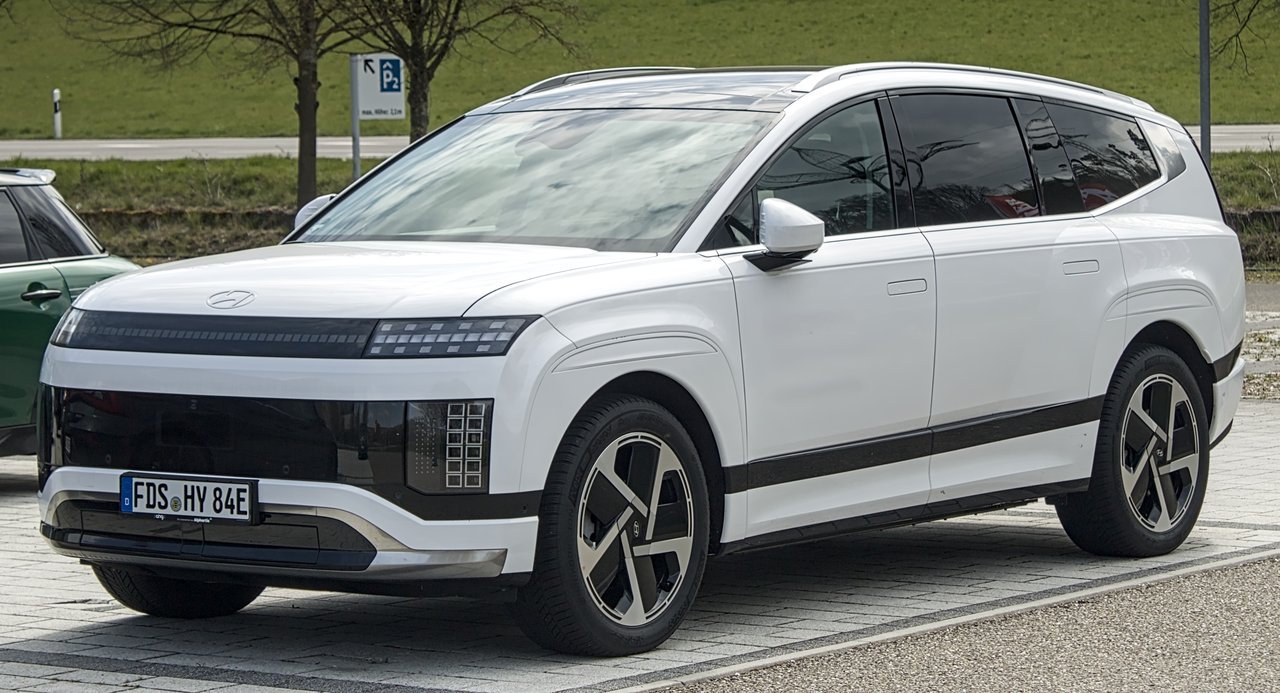
Photo via Wikimedia Commons under CC BY-SA 4.0 license.
The Dreadnought of the Metaplant: How the 2026 Hyundai IONIQ 9 Changes the Electric Family Transport Equation
For years, the electric three-row crossover segment has suffered from an existential crisis. Manufacturers have routinely taken enormous battery packs, wrapped them in bloated, slab-sided sheetmetal, and tuned the suspension either to rattle your teeth out over a pebble or wallow through corners like an oil tanker caught in a typhoon. The recipe was heavy, lazy, and utterly devoid of mechanical soul. Enter the 2026 Hyundai IONIQ 9—a machine assembled at Hyundai’s staggering new Georgia Metaplant that aims to dismantle these compromises entirely.
This is not merely another battery-electric people-mover. Built upon the proven flexibility of the Electric-Global Modular Platform (E-GMP), the IONIQ 9 represents Hyundai’s largest and most ambitious structural deployment of high-voltage architecture to date. It is a vehicle engineered with the quiet confidence of a brand that has spent the last half-decade eating the lunch of legacy automakers at their own game. Let us pop the metaphorical bonnet and examine the iron, silicon, and fluid dynamics that make this rolling behemoth tick.
Powertrain Architecture and High-Voltage Plumbing
Beneath the floorpan sits a monolithic 110.3 kWh lithium-ion battery pack, acting as the structural baseline across the entire trim hierarchy. Powering this vessel requires serious electrical muscle, and the IONIQ 9 delivers through a choice of three distinct output configurations depending on whether you opt for rear-wheel drive or dual-motor all-wheel drive.
The entry point utilizes a single permanent-magnet synchronous motor on the rear axle, while the dual-motor variants—culminating in the performance-oriented Performance AWD spec—push a stout 422 horsepower (314.6 kW) and instant-on torque through both ends. But numbers on a spec sheet mean little if the energy cannot be replenished efficiently. This is where E-GMP's crown jewel truly shines: its native 800-volt electrical architecture.
While most competitors still rely on legacy 400-volt systems that choke under sustained DC fast-charging, the IONIQ 9’s high-voltage spinal cord handles up to 350 kW without breaking a sweat. Plug it into a high-output DC ultra-charger, and the battery management system orchestrates a 10-to-80 percent state-of-charge migration in as little as 24 minutes. Furthermore, Hyundai has integrated native North American Charging Standard (NACS) hardware right out of the box, granting seamless access to the continent’s most robust supercharging infrastructure without awkward tethered adapters.
Chassis Dynamics and Kinematics
Moving a footprint of this magnitude requires a masterclass in chassis tuning. With a curb weight pushing past the three-ton threshold when fully loaded, sheer spring rates alone cannot tame body roll. Hyundai’s engineering team has deployed a sophisticated multi-link front and rear suspension geometry, coupled with selective damping and available self-leveling pneumatic springs designed to manage dynamic load transfer.
When charging into a tight mountain sweeper, the torque vectoring system uses brake-based yaw control and instantaneous motor slip-regulation to tuck the nose into the apex, masking the mass with clever electronic sleight-of-hand. It does not defy physics—nothing of this scale can—but it manages energy transference with a fluid composure that leaves rivals feeling clumsy. The steering rack is electrically assisted yet remarkably calibrated, offering progressive weight off-center that allows the driver to accurately place the front tires without second-guessing.
2026 Hyundai IONIQ 9 Specification Sheet
| Parameter | Specification |
|---|---|
| Battery Capacity | 110.3 kWh (Usable) |
| Max Power Output | Up to 422 hp (314.6 kW) Dual-Motor AWD |
| EPA-Estimated Range | Up to 335 miles (Long Range RWD) |
| Charging Architecture | 800-volt system (10-80% in ~24 mins at 350 kW) |
| Charging Standard | Native NACS Integration |
| Transmission | Single-speed reduction gear per drive unit |
| Production Facility | Hyundai Motor Group Metaplant America (Georgia, USA) |
| Starting MSRP | $58,955 (Excluding destination and tax incentives) |
Market Positioning and Global Strategy
Priced at a highly aggressive starting MSRP of $58,955 for the baseline configuration, the IONIQ 9 undercuts several key legacy competitors while offering superior standard hardware. It locks horns directly with the Kia EV9 (its corporate cousin), the Rivian R1S, and traditional internal-combustion heavyweights like the Ford Explorer and Kia Telluride.
By producing the vehicle on U.S. soil at the state-of-the-art Georgia metaplant, Hyundai has strategically insulated the supply chain while positioning the vehicle to capture lucrative regional manufacturing incentives. Trims range from the efficiency-focused Long Range RWD—capable of stretching a single charge up to an EPA-estimated 335 miles—to the fully-loaded, plush Calligraphy trim that turns the cabin into a rolling executive lounge.
Frequently Asked Questions (FAQ)
Does the IONIQ 9 require an adapter to use Tesla Superchargers?
No. Hyundai has baked native North American Charging Standard (NACS) hardware directly into the 2026 IONIQ 9. You can pull straight up to a compatible V3 or V4 Supercharger and plug in without fumbling with aftermarket dongles.
How does the 110.3 kWh battery manage thermal degradation during fast charging?
The E-GMP platform utilizes an advanced liquid-cooling circuit combined with intelligent battery pre-conditioning. When you input a DC fast charger as your destination in the native navigation, the car automatically warms or cools the pack to its optimal thermal window before you arrive, ensuring peak charging speeds and preserving long-term cell health.
Is the third row actually usable for adults on long road trips?
Thanks to the skateboard EV layout—which maximizes wheelbase dimensions and flattens the floorpan—the third row offers genuine knee and headroom. While tall adults might prefer the middle row for cross-country excursions, it is far from the cramped penalty-box seating found in traditional mid-size SUVs.
MasEko's Verdict
The 2026 Hyundai IONIQ 9 is a watershed moment for electric family transport. By pairing an unyielding 800-volt charging infrastructure with genuine dynamic polish and U.S.-based manufacturing, Hyundai has built a formidable machine. It respects the driver's need for mechanical efficiency while pampering passengers with space and technological integration. For families ready to make the leap into electrification without sacrificing utility or range, the dreadnought from Georgia is currently the benchmark to beat.
Sources and editorial note
Specifications, performance numbers, pricing, and technical measurements in this feature are based on official manufacturer documentation, engineering releases, and certified automotive benchmarks. Real-world parameters may vary based on market specifications and testing conditions.
- https://www.hyundainews.com/en-us/models/hyundai-ioniq_9-2026-ioniq_9
- https://www.hyundaiusa.com/us/en/vehicles/ioniq-9
The featured lead image is sourced from Wikimedia Commons under Creative Commons licensing with proper attribution. Editorial reporting complies with international copyright and fair-use standards.