
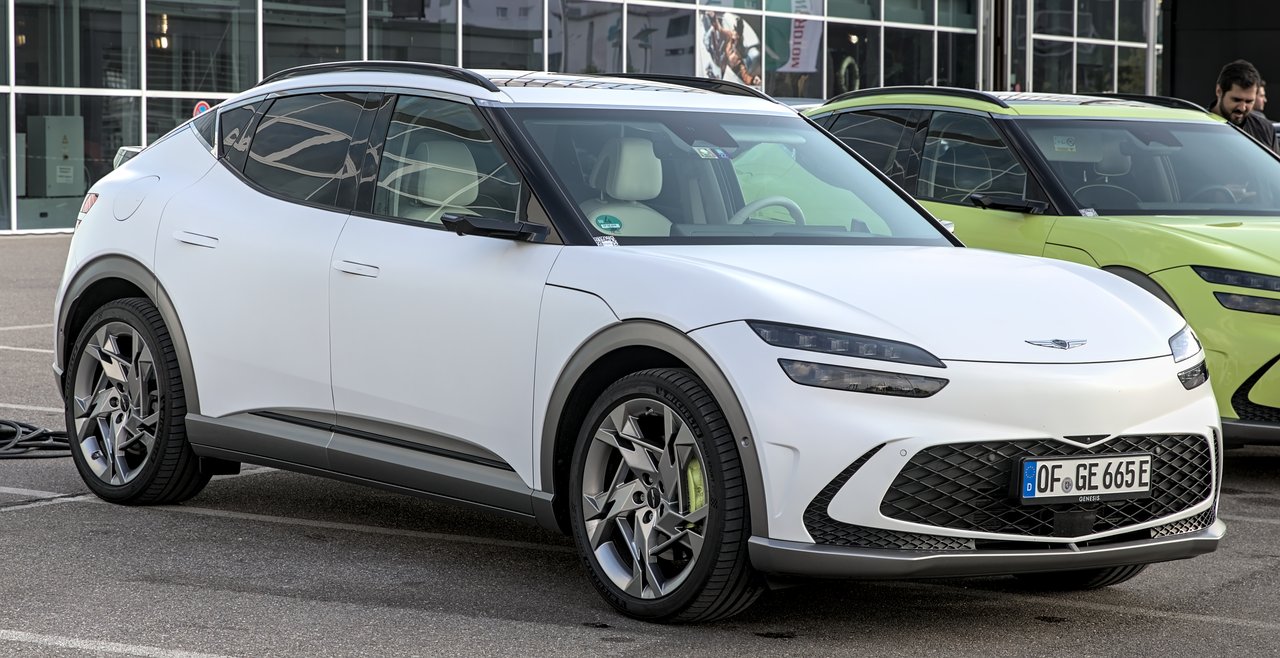
Photo via Wikimedia Commons under CC BY-SA 4.0 license.
Orange Heat: Genesis Unleashes Magma to Challenge Affalterbach and Garching
Genesis spent its first decade proving that South Korea could master vault-solid refinement, whisper-quiet cabins, and design-led executive luxury. It met Lexus on fit and finish, undercut the Germans on value, and established a distinct visual identity centered on twin-line light signatures and athletic proportions. Yet in the upper echelons of automotive prestige, luxury without a credible performance pedigree is an incomplete equation. The established European hegemony—BMW M, Mercedes-AMG, and Audi Sport—was built not merely on plush leather, but on the brutal crucible of the Nürburgring, Hockenheim, and Monza.
Enter Magma. Unveiled in vivid Magma Orange, this sub-brand program is not a superficial trim package or a cynical styling exercise. It is Genesis's calculated, fully engineered assault on the global performance hierarchy. Anchored by dynamic guidance from racing icon Jacky Ickx and accelerated by an official factory entry into the FIA World Endurance Championship (WEC), Magma signals the transition of Genesis from an elegant alternative into an unapologetic performance powerhouse.
The Triumvirate: GV60 Magma, G80 Special, and the GMR-001 Hypercar
The Magma strategy operates on three complementary fronts: real-world electric agility, limited-run combustion muscle, and top-tier prototype motorsport.
Leading the road-car charge is the GV60 Magma Concept, a performance electric crossover that is rapidly nearing showroom production. Underneath its muscular, widened bodywork sits Hyundai Motor Group's proven 800-volt Electric-Global Modular Platform (E-GMP). While it shares a mechanical baseline with its corporate sibling, the razor-sharp Hyundai Ioniq 5 N, the GV60 Magma trades unvarnished rally-car hooliganism for an ultra-high-speed gran-turismo ethos, delivering ferocious cornering loads alongside high-speed highway composure.
For internal combustion purists, Genesis created the G80 Magma Special. Built in strictly limited numbers initially targeted at Middle Eastern collectors, this widebody executive saloon ditches silent propulsion for a twin-turbocharged 3.5-liter V6 massaged to unleash heavy-artillery outputs. Lowered, widened by several inches over standard track widths, and fitted with functional carbon aero elements, the G80 Magma Special takes aim directly at the BMW M5 and Mercedes-AMG E 63.
The apex of the program is the Genesis GMR-001 Hypercar, an LMDh-spec endurance racer destined for the 2026 World Endurance Championship and IMSA WeatherTech SportsCar Championship. Developed under the Genesis Magma Racing banner, the prototype program guarantees that the dynamic tuning of future Genesis street cars will stem from genuine high-downforce aerodynamic modeling, energy-recovery algorithms, and endurance-tested thermal management developed at Le Mans and Daytona.
Powertrain and Thermal Architecture: The Pursuit of Repeatable Output
Electric performance vehicles face an immutable engineering adversary: thermal saturation. Generating 600 horsepower for a single quarter-mile sprint is trivial; sustaining peak power across a twenty-minute track session without motor derating or battery throttle-back demands serious thermal engineering.
The GV60 Magma integrates an 84.0-kWh nickel-manganese-cobalt (NMC) battery pack coupled to upgraded dual permanent-magnet synchronous motors (PMSM). Running through silicon-carbide (SiC) power modules, the system targets combined outputs exceeding 640 horsepower and upwards of 580 lb-ft of torque in momentary Boost modes. To safeguard this throughput, Genesis engineers revised the battery's internal cooling plate architecture, increasing coolant flow velocity through parallel micro-channels and enlarging the front low-temperature radiator core.
A multi-stage thermal conditioning system allows drivers to select bespoke thermal targets. In Track Mode, the cooling loops proactively drop battery core temperatures below nominal highway targets, creating a thermal buffer that absorbs the rapid heat spike generated by aggressive regenerative braking and full-throttle corner exits. Motor stators utilize direct oil-spray cooling, preventing localized hot spots in the copper hairpins during sustained high-rpm operation.
In the G80 Magma Special, combustion hardware takes center stage. The 3.5-liter 24-valve Lambda II V6 gains optimized turbocharger compressor wheels, a low-restriction water-to-air charge cooler, and revised electronic wastegate mapping. Exhaust gases exit through a free-flowing titanium exhaust system that allows the blown six to breathe freely at high rpm while generating a resonant, deep-throated soundtrack.
Chassis Dynamics, Kinematics, and Aero: The Jacky Ickx Influence
To ensure Magma models carve corners rather than merely disguise their mass, Genesis recruited six-time Le Mans champion Jacky Ickx as dynamic advisor. Ickx’s endurance philosophy permeates the chassis tuning: a fast car must build driver trust through linear responses, transparent slip angles, and zero nervous kickback at the limit.
The GV60 Magma sits markedly lower on revised suspension geometry. The front MacPherson struts incorporate forged aluminum knuckles with altered kingpin inclination to generate favorable negative camber gain under heavy lateral compression. At the rear, an independent five-link setup replaces compliant rubber subframe bushings with stiffened, pillow-ball spherical joints, eliminating rear-toe deflection under heavy trail-braking.
Electronic damping is governed by continuously variable active dampers wired to predictive road-scanning sensors. Roll stiffness has been increased via uprated anti-roll bars, yet the damping retains sufficient high-speed blow-off to prevent the chassis from deflecting off mid-corner curbing—a crucial attribute developed during punishing laps at the Nürburgring Nordschleife.
Aerodynamics play a dual mechanical and cooling role:
- Front Fascia: Three wide horizontal cooling slots feed the low-temperature radiator, while active aero canards channel high-pressure air around the front wheel wells to reduce turbulent wake.
- Widened Blister Fenders: Flared wheel arches accommodate wider Michelin Pilot Sport 4S rubber mounted on 21-inch flow-formed titanium-finish wheels, significantly widening the front and rear track dimensions for superior mechanical grip.
- Aero Wing and Venturi Diffuser: A raised, carbon-fiber rear wing works in concert with a deep underbody rear diffuser, generating clean downforce across the rear axle to stabilize the car during high-speed transitions without incurring excessive parasitic drag.
Deceleration is handled by an electro-hydraulic braking package utilizing 400 mm front iron discs clamped by rigid monobloc four-piston calipers. An advanced regenerative braking blend allows up to 0.6g of stopping power via electric motor drag alone, reserving the friction brakes for deep threshold stops and minimizing fade over hard sessions.
Genesis Magma Specifications Table
| Specification | Genesis GV60 Magma (Target Specs) | Genesis G80 Magma Special | Genesis GMR-001 LMDh Racer |
|---|---|---|---|
| Powertrain Type | Dual PMSM Electric (AWD) | 3.5L Twin-Turbo V6 (ICE) | Hybridized Race-Spec V6 / Spec MGU |
| Output (hp / kW) | 641 hp / 478 kW (Boost Mode) | 500+ hp / 373+ kW | 670 hp / 500 kW (Regulated Cap) |
| Torque | 568 lb-ft (770 Nm) | 440+ lb-ft (597+ Nm) | Regulated Balance of Performance |
| Transmission | Single-Speed Integrated Drive Axle | 8-Speed Sport Automatic | 7-Speed Sequential Transverse |
| 0-100 km/h (0-62 mph) | 3.4 seconds (estimated) | 3.8 seconds (estimated) | Classification Dependent |
| Chassis Setup | Electronically Controlled Damping + e-LSD | Lowered Track Springs + Stiffened Anti-Roll | Carbon Monocoque, Pushrod Inboard |
| Curb Weight | 4,750 lbs (est.) | 4,250 lbs (est.) | 2,270 lbs (1,030 kg minimum) |
| Market Availability | Global Production (Launch late 2025) | Middle East Limited Run (20 units) | FIA WEC / IMSA Competition (2026) |
On Track and Mountain Passes: Dynamic Realignment
Throw the GV60 Magma into a decreasing-radius sweeper, and the mechanical revisions immediately detach it from standard luxury crossovers. Turn-in is sharp, direct, and uncorrupted by torque steer, aided by the lowered roll center and widened track. The steering rack, re-valved for heavier resistance and higher fidelity, telegraphs the onset of front-tire scrub clearly through the rim.
Mid-corner balance is governed by the rear electronic limited-slip differential (e-LSD). In its aggressive sport calibrations, the system avoids front-axle push by routing torque across the rear axle to rotate the car naturally around its vertical axis. Stamp the throttle at corner exit, and the Magma hunkers down, deploying massive mechanical traction without digital stutter or ungraceful electronic intervention. It delivers an engaging, fluid handling profile that matches the dynamic precision of a Porsche Macan EV while retaining distinctive, Korean grand-touring character.
Market Positioning: Challenging the German Triumvirate
Genesis does not intend to match BMW M or Mercedes-AMG vehicle for vehicle across their sprawling portfolios. Instead, South Korea’s offensive is highly surgical. Magma targets performance buyers who have grown fatigued by the clinical, sometimes overly punishing setups of modern German sports sedans, or the exorbitant cost of maintenance associated with them.
With an anticipated starting price for the production GV60 Magma hovering around $80,000 to $85,000 in North America, Genesis sits strategically between the high-spec Hyundai Ioniq 5 N and the stratospheric price floor of the Porsche Taycan and Macan Turbo EV. It offers an exclusive, high-style alternative to the BMW i4 M50 and Tesla Model Y Performance, blending bespoke track dynamics with bespoke interior craftsmanship.
Frequently Asked Questions (FAQ)
Is Genesis Magma simply an appearance package like BMW M Sport or Audi S Line?
No. Magma is an authentic performance tier equivalent to full BMW M or Mercedes-AMG models. It introduces comprehensive mechanical modifications, including upgraded motor/engine outputs, specialized high-rate battery thermal cooling loops, stiffened structural suspension kinematics, electronic limited-slip differentials, and functional track aerodynamics.
How does the GV60 Magma differ dynamically from the Hyundai Ioniq 5 N?
While both vehicles leverage the high-performance 800V E-GMP layout, their chassis tunings diverge significantly. The Ioniq 5 N is engineered with an aggressive, sideways-biased rally character, featuring simulated gearshifts (N e-Shift) and drift optimizers. The GV60 Magma adopts an endurance grand-touring focus guided by Jacky Ickx, favoring higher high-speed downforce, lower interior NVH, linear transient response, and sustained high-speed stability across long track stints.
Why did Genesis establish an LMDh Hypercar program for Magma instead of entering GT3?
Entering the top-tier Hypercar class in the FIA World Endurance Championship and IMSA provides direct global exposure at premier events like the 24 Hours of Le Mans and 12 Hours of Sebring. Furthermore, LMDh regulations mandate hybrid powertrain integration and sophisticated aerodynamic development, yielding transferable engineering data directly applicable to high-performance road-going EVs and hybrids.
The Verdict
The Genesis Magma program marks the end of South Korea's conservative apprenticeship in the luxury segment. By blending dramatic aesthetic courage with rigorous thermal engineering, bespoke suspension kinematics, and a factory motorsport backbone, Genesis has crafted a performance sub-brand with genuine dynamic integrity. Affalterbach and Garching should take notice: Magma is not an experiment—it is a formidable, fire-breathing arrival.
Sources and editorial note
Specifications, performance numbers, pricing, and technical measurements in this feature are based on official manufacturer documentation, engineering releases, and certified automotive benchmarks. Real-world parameters may vary based on market specifications and testing conditions.
The featured lead image is sourced from Wikimedia Commons under Creative Commons licensing with proper attribution. Editorial reporting complies with international copyright and fair-use standards.