
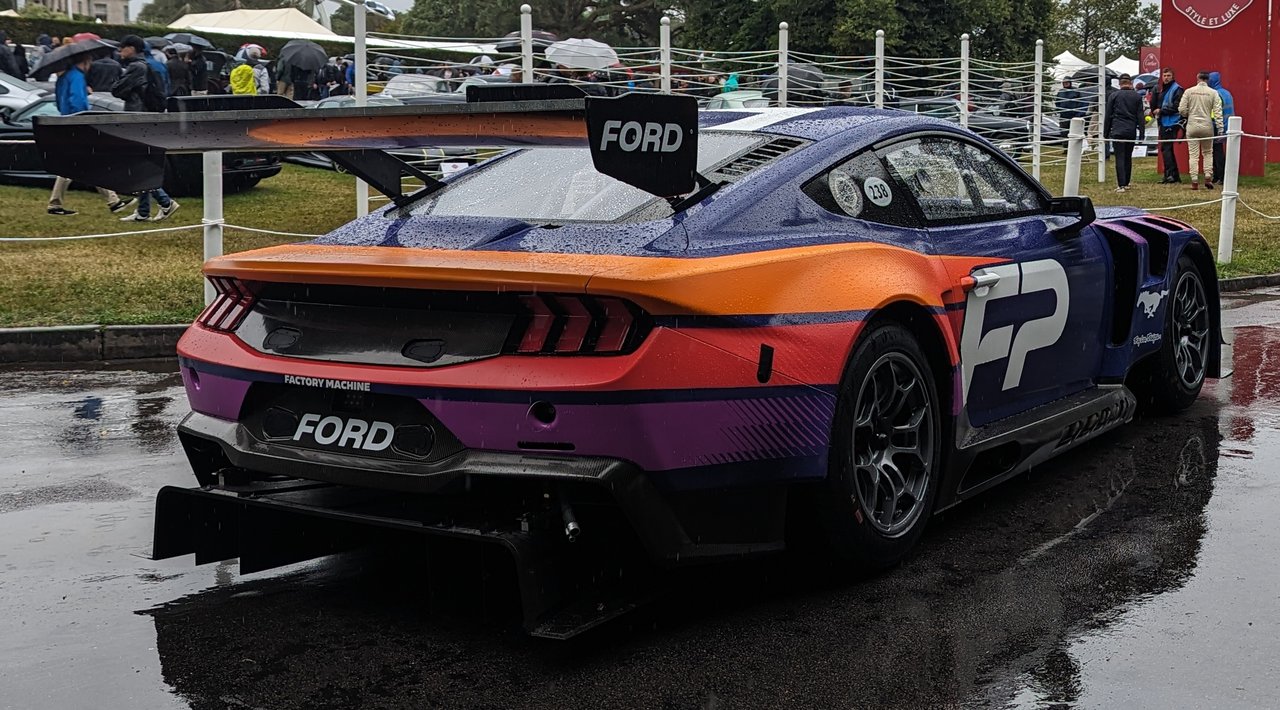
Photo via Wikimedia Commons under CC0 license.
Ford Mustang GT3: The Last Loud Argument for the Front-Engine V8
There is something gloriously stubborn about the Ford Mustang GT3. While Porsche, Ferrari, Aston Martin, and BMW have all converged on the same recipe for the FIA's GT3 class — mid-mounted engine, turbocharged, sophisticated, and increasingly anonymous — Ford walked the other way. They took the seventh-generation Mustang Dark Horse, dropped a big, breathless, naturally aspirated V8 up front, pointed the drive rearward, and handed the keys to Multimatic and M-Sport, two of the most formidable racecar constructors on the planet. The result is the only front-engine, rear-drive, atmospheric V8 on the GT3 grid, and it made its competition debut at the 2024 Rolex 24 at Daytona before crossing the Atlantic for Le Mans' new LMGT3 class that June.
This isn't a marketing exercise. Ford Performance wanted the Mustang racing against the world's best GT machinery in the world's best GT series — IMSA and the WEC — and they wanted it done properly. Multimatic handled the chassis engineering in Canada, M-Sport ran the WEC program from Cumbria, and Ford Performance orchestrated the whole campaign from Dearborn. The street-car halo acts are deliberate companions: the track-only Mustang Dark Horse R brings GT4-style racing to customer teams, while the road-legal, wildly expensive Mustang GTD translates genuine GT3 hardware — including a rear-mounted transaxle layout and active aero — into a number-plated car. But the GT3 racer is the flagship, the machine that carries the pony badge into battle.
Powertrain: No Turbos, No Hybrid, No Apologies
The heart of the Mustang GT3 is a race-specific evolution of the 5.0-litre Coyote V8, bored and stroked to 5.4 litres and built to Ford Performance's endurance specification. Forged internals, a revised crankshaft, dry-sump lubrication, and a race valvetrain let it rev with an urgency no road-going Mustang has ever managed. Power sits at around 550 hp in GT3 trim, though the figure breathes with the class's balance-of-performance air restrictor — the number moves as the ACO and IMSA tune the car against turbocharged rivals. Torque arrives in a broad, linear swell rather than the binary shove of a boost gauge, and the soundtrack is exactly what you'd hope: eight cylinders, no filters, howling through individual throttle bodies and a race exhaust that strips away every ounce of civility.
Behind the engine sits an Xtrac transaxle housing a six-speed sequential gearbox with straight-cut gears and a multi-plate racing clutch. The gearbox is shift-by-wire via steering-wheel paddles, and the oiling and cooling systems are engineered for the abuse of a 24-hour race. The transaxle layout is the key dynamic differentiator versus the road car: moving the gearbox to the rear axle transforms weight distribution, bringing the Mustang close to the ideal balance its mid-engine rivals achieve by architecture alone.
Air conditioning, FIA-spec fuel cell, comprehensive fire suppression, and aMotorsport-grade wiring loom round out a package built for the ACO's endurance crucible. Every component is homologated for the global GT3 rulebook, meaning the same fundamental car competes at Daytona, Sebring, Le Mans, and Spa.
Chassis and Dynamics: A Mustang That Actually Turns
Multimatic — the same outfit behind the GT Mk IV and the Bronco DR — started with the Mustang's fundamental architecture but replaced nearly everything that touches the road. The body-in-white was extensively reworked with a full FIA-specification steel roll cage, with suspension mounting points revised and a carbon-fibre decklid and bodywork panels keeping mass down. Curb weight is around 1,300 kg, a staggering 500 kg-plus lighter than the roadgoing Dark Horse.
Suspension is fully adjustable, unequal-length double wishbone at all four corners — a fundamental departure from the road car's struts. Multimatic-developed four-way adjustable dampers allow the engineers to tune low- and high-speed compression and rebound independently, which is precisely the level of control needed to manage a 1,300 kg car with a big V8 hanging over the front axle. Ride height, camber, caster, and anti-roll bars are all driver-adjustable within the parameters of each balance-of-performance window.
Braking comes from race-calibrated ventilated steel discs — the GT3 class forbids carbon-ceramics — clamped by six-piston front and four-piston rear monoblock calipers. The steering remains hydraulically assisted, an increasingly rare choice that gives the driver a genuine sense of front-tyre load in long, sustained corners where electric racks can go mute. On track, the GT3 Mustang is notable for its stability under braking — the front-engine layout and long wheelbase make it a remarkably planted car on corner entry — while the rear transaxle and wide rear tyres give it traction on corner exit that embarrasses some mid-engine rivals out of slow corners. It rewards smooth hands; drive it like a hooligan and the mass up front will let you know.
Specifications
| Specification | Ford Mustang GT3 |
|---|---|
| Engine | 5.4-litre naturally aspirated Coyote V8, dry sump |
| Power | Approx. 550 hp (BoP dependent) |
| Torque | Approx. 650 Nm (BoP dependent) |
| Transmission | Xtrac six-speed sequential transaxle, paddle shift |
| Layout | Front-engine, rear-wheel drive |
| Curb weight | Approx. 1,300 kg (BoP ballast dependent) |
| Suspension | Double wishbone, Multimatic 4-way adjustable dampers |
| Brakes | Ventilated steel discs, 6-piston front / 4-piston rear |
| Race debut | 2024 Rolex 24 at Daytona; 2024 24 Hours of Le Mans (LMGT3) |
| Championships | IMSA GTD Pro, IMSA GTD, FIA WEC LMGT3 |
| Price | Not sold to private customers; race program only (est. build cost $1M+) |
Market Position and Rivals
On the grid, the Mustang GT3 squares up against the Porsche 911 GT3 R, Ferrari 296 GT3, BMW M4 GT3, Mercedes-AMG GT3, Corvette Z06 GT3.R, and Aston Martin Vantage GT3. Only the Corvette shares its front-engine, rear-drive layout, making the Mustang part of a small, proud American minority. The GTD and Dark Horse R serve the customer and track-day markets, while the factory teams — Multimatic Motorsports in IMSA and M-Sport Ford in the WEC — carry the flag at the sharp end. As a customer proposition, comparable GT3 machinery typically sits in the $500,000–$800,000 bracket before spares, but Ford's GT3 is not for sale in that way; it is a factory weapon, and its street-legal emissary is the GTD, at roughly $325,000 before options.
Frequently Asked Questions
Is the Mustang GT3 based on the road car? Fundamentally, yes — but only skin deep. It shares the seventh-generation Mustang's silhouette and the Coyote V8's basic architecture, though the engine is bored to 5.4 litres and every dynamic component, from suspension to gearbox, is race-specific.
Can I buy one? No. Unlike some GT3 cars, the Mustang GT3 is not offered as a customer racer. The track-day equivalent is the Dark Horse R; the road-legal expression of the same engineering philosophy is the Mustang GTD.
Why naturally aspirated when rivals use turbos? Partly philosophy, partly pragmatism. A naturally aspirated V8 offers linear, predictable power delivery, proven endurance reliability, and a lower thermal load than forced induction — all assets in 24-hour racing. The sound doesn't hurt the showroom story either.
How does it compare to the Corvette Z06 GT3.R? They're kindred spirits: both are front-engine V8 GT3 cars from Detroit. The Corvette relies on the flat-plane-crank LT6's free-revving character, while the Mustang's cross-plane Coyote trades a little top-end snap for torque and tractability. On track, they are separated by balance-of-performance adjustments rather than philosophy.
Verdict
The Mustang GT3 matters because it refuses to conform. In an era where GT racing's engineering has homogenised toward mid-engine turbo sixes, Ford built a big, loud, front-engine V8 and proved it can win. That takes engineering nerve — the transaxle conversion, the Multimatic suspension, the endurance-spec Coyote — and it takes conviction about what a Mustang should be. Twenty years from now, when the grid is full of hybrid turbo saloon-based racers, the memory of a 5.4-litre V8 howling down the Mulsanne at 6,000 rpm with the rear axle squatting under throttle will be the thing we talk about. Ford built the Mustang the way it was always meant to be built: loud, physical, and racing where it counts.
Sources and editorial note
Specifications, performance numbers, pricing, and technical measurements in this feature are based on official manufacturer documentation, engineering releases, and certified automotive benchmarks. Real-world parameters may vary based on market specifications and testing conditions.
- https://www.multimaticmotorsports.com/wp-content/uploads/2024/08/2024_08_05-Mustang-GT3-Overview.pdf
- https://en.wikipedia.org/wiki/Ford_Mustang_GT3
The featured lead image is sourced from Wikimedia Commons under Creative Commons licensing with proper attribution. Editorial reporting complies with international copyright and fair-use standards.