
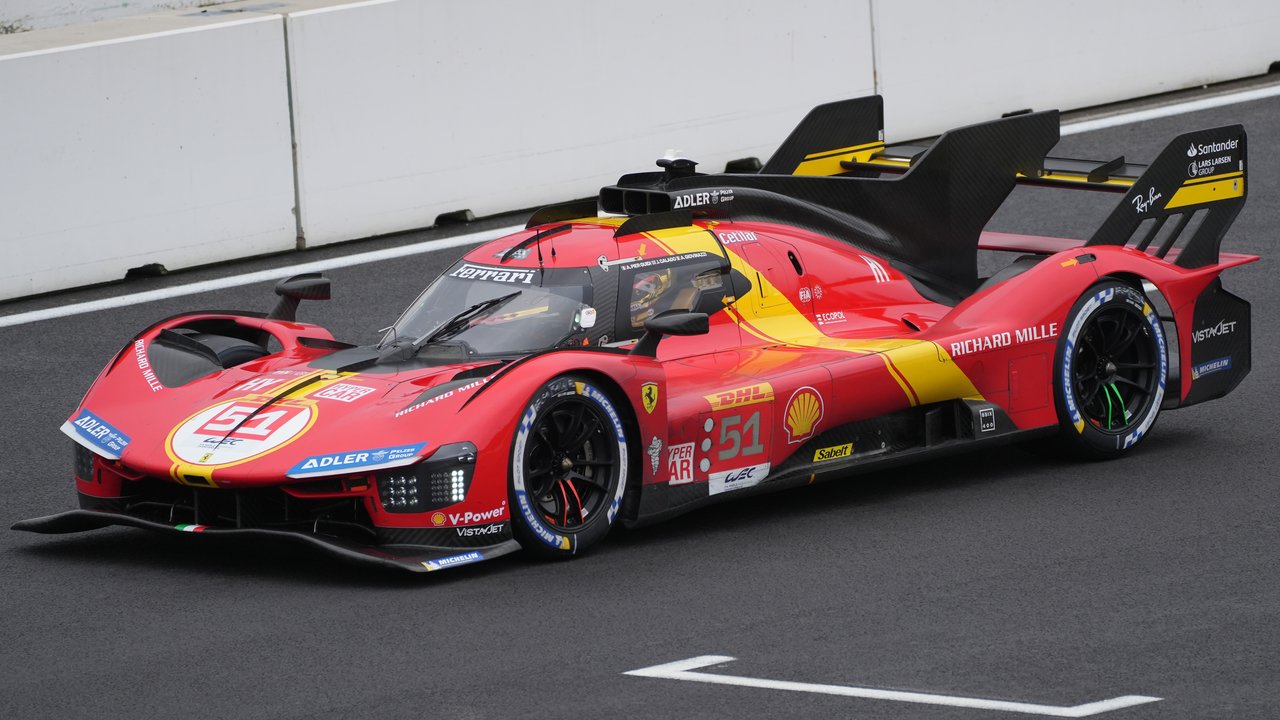
Photo via Wikimedia Commons under CC BY-SA 4.0 license.
Ferrari F80: The Le Mans Bloodline and Maranello’s New Hypercar Paradigm
Every decade or so, Maranello resets the benchmark for road-going speed. The lineage is sacred: the homologated fury of the 288 GTO, the raw composite minimalism of the F40, the Formula 1-derived V12 howl of the F50, the carbon-tubbed architectural mastery of the Enzo, and the hybrid-assisted vanguard of the LaFerrari. Now arrives the F80, and with it, an ideological earthquake. Ferrari has shelved the naturally aspirated V12 for its apex hypercar, replacing it with a 3.0-liter twin-turbocharged V6 mated to a tri-motor hybrid network.
For purists accustomed to the atmospheric operatics of 12 cylinders, the cylinder count reads like heresy. But Ferrari’s engineering department, led by Enrico Galliera and Gianmaria Fulgenzi, does not trade in nostalgia; it trades in lap times and silverware. The F80 is not an evolution of the 296 GTB, nor is it a boardroom compromise. It is a direct mechanical descendant of the 499P prototype that secured back-to-back overall victories at the 24 Hours of Le Mans in 2023 and 2024. Maranello has wagered its halo reputation on absolute technical supremacy over romanticism.
Powertrain Deep-Dive: 300 CV Per Liter and F1 Electrification
At the core of the F80 sits the F163CF, a dry-sump, 120-degree hot-V six-cylinder engine displacing 2,992 cc. Generating 900 CV (888 bhp) on combustion alone at 8,750 rpm, the internal combustion engine (ICE) achieves a specific output of 300 CV per liter—a figure that eclipses any road-legal combustion unit ever built in Maranello. The engine revs cleanly to a 9,000 rpm limiter, with dynamic transient overrev permitted to 9,200 rpm.
To withstand combustion chamber peak pressures approaching 260 bar, Ferrari re-engineered the crankcase using motorsport-grade aluminum alloys, reinforced the main bearings, and adopted DLC-coated titanium connecting rods. The fuel injection system operates at 350 bar, utilizing centrally mounted injectors with pre-chamber combustion concepts drawn directly from Scuderia Ferrari’s Formula 1 power units.
Eliminating turbo lag entirely are twin electrically assisted turbochargers (e-turbos). An axial-flux electric motor is sandwiched on the shaft between the exhaust turbine and the billet compressor wheel. Operating on the car’s 800V architecture, these MGU-H units can instantly spin the compressor to target boost pressures before exhaust gases build, or harvest waste thermal energy under sustained wide-open throttle to feed the high-voltage battery.
The electric powertrain adds another 300 CV (296 bhp) through three bespoke, in-house-developed electric motors:
- Front Axle (e-4WD): Two independent axial-flux motors driving the front wheels, delivering 140 CV (103 kW) each. Together with their integrated silicon carbide (SiC) inverters, the entire front axle assembly weighs a featherweight 61.5 kg and enables continuous torque vectoring across the front axle.
- Rear Axle (MGU-K): A dual-rotor axial-flux motor mounted alongside the eight-speed dual-clutch transmission. It contributes up to 95 CV (70 kW) during dynamic boost phases and recovers up to 70 kW of kinetic energy under deceleration.
- Energy Storage: A 2.28 kWh, 800V lithium-ion battery pack mounted low behind the seats. Employing cell-to-pack construction, it discharges up to 242 kW of continuous peak power.
Total system output stands at 1,200 CV (1,184 bhp), channeled through all four wheels. Acceleration is immediate, linear, and utterly devoid of inertia.
Active Aerodynamics and 1,050 kg of Ground Effect
Generating 1,050 kg of downforce at 250 km/h (155 mph) without turning the vehicle into a high-drag parachute required fundamental rethinking of underbody management. Chief design officer Flavio Manzoni worked in lockstep with aerodynamicists to carve the carbon-fiber shell around an extreme venturi envelope.
The front end adopts a triplane wing configuration, channeling high-pressure air through an F1-derived S-Duct to bleed pressure off the front axle while feeding cooling air to the 800V radiators. At the rear, an enormous 1.8-meter diffuser stretches from behind the passenger cell to the trailing edge of the bumper, raked at an aggressive expansion angle. For the diffuser to function, the transmission casing had to be tilted upward by 1.3 degrees.
Active aero management is handled by a motorized rear wing that alters both height and angle of attack. In High Downforce (HD) mode, it produces massive vertical load while working cooperatively with an underbody active flap system. In Low Drag (LD) mode, the wing flattens into the rear deck profile, dropping the drag coefficient significantly for ultra-high-speed runs.
Chassis Kinematics: The End of the Anti-Roll Bar
Aerodynamic downforce of over a ton creates severe suspension setup compromises. Historically, managing that vertical load required punishingly stiff springs, degrading mechanical grip over uneven surfaces. Ferrari bypassed this by ditching mechanical anti-roll bars entirely, outfitting the F80 with a 48V active suspension system developed alongside Multimatic.
Each corner features a 48V electric motor actuator tied directly to a spool-valve damper. The system applies individual vertical forces at each corner within milliseconds, actively resisting roll in corners, pitch under heavy braking, and heave at triple-digit speeds. By decoupling ride frequency from roll stiffness, the suspension keeps the aerodynamic floor within a millimeter-precise ride height window regardless of track curbs or braking compressions.
Stopping power relies on Brembo’s CCM-R Plus technology, which weaves long carbon fibers into a three-dimensional matrix before applying a silicon carbide friction coating. These discs withstand double the thermal shock of conventional carbon-ceramics, clamped by bespoke six-piston monobloc calipers up front.
Ferrari F80 Specifications
| Parameter | Specification |
|---|---|
| Internal Combustion Engine | 3.0-liter (2,992 cc) 120° twin-turbo V6, dry sump (F163CF) |
| ICE Output | 900 CV (888 bhp) @ 8,750 rpm, 850 Nm @ 5,550 rpm |
| Electric Drive | Tri-motor (2 front e-axle, 1 rear MGU-K), 800V architecture |
| Hybrid Output | 300 CV (296 bhp) peak electric assist |
| Total Combined Output | 1,200 CV (1,184 hp / 883 kW) |
| Transmission | 8-speed dual-clutch transmission (F1 DCT) |
| Drivetrain | Electric all-wheel drive (e-4WD) with dynamic torque vectoring |
| 0–100 km/h (0–62 mph) | 2.15 seconds |
| 0–200 km/h (0–124 mph) | 5.75 seconds |
| Top Speed | 350 km/h (217 mph) electronically limited |
| Dry Weight | 1,525 kg (3,362 lbs) |
| Aerodynamic Downforce | 1,050 kg @ 250 km/h (460 kg front / 590 kg rear) |
| Dimensions (L x W x H) | 4,840 mm x 2,060 mm x 1,138 mm (Wheelbase: 2,665 mm) |
| Base Price | €3.6 million ($3.9 million USD / £3.1 million GBP) |
| Production Run | 799 units globally |
Dynamic Behavior: Track Exorcism
Ferrari rates the F80’s Fiorano lap time at 1:15.30. To contextualize that: it is over two seconds quicker than the SF90 XX Stradale and four seconds faster than the LaFerrari. It is a pace that edges into dedicated GT3 machinery territory while running on Michelin Pilot Sport Cup 2 R street tires.
From behind the wheel, the asymmetrical "1+" cabin dictates the driving experience. The passenger seat is set back slightly and trimmed in black to visually disappear, making the cockpit feel like a single-seater prototype. Turn-in response is violent; the active 48V suspension holds the car dead-flat through corner entry, while the front e-axle pulls the nose inside the apex with zero understeer. Roll transition simply does not exist.
Power delivery out of slow hairpins is relentless. Where a twin-turbo engine typically exhibits a momentary pressure lag, the F80’s e-turbos preload the intake tract while the front axle claws the asphalt. The soundtrack lacks the stratospheric, metallic scream of the Enzo’s V12, but it trades it for a guttural, Le Mans-grade bark layered with sharp wastegate chirps and intense mechanical whine.
Market Positioning and Key Rivals
Ferrari will manufacture exactly 799 examples of the F80 between late 2025 and 2027. Despite a pre-tax base price of €3.6 million, the entire production run sold out before the car’s public unveiling.
Its primary adversary is the McLaren W1, which takes a divergent philosophical path: a 4.0-liter twin-turbo flat-plane V8 pushing 1,275 PS exclusively through the rear wheels. While the W1 targets raw power-to-weight and traditional rear-driven handling, the F80 counters with all-weather all-wheel-drive traction, front-axle torque distribution, and a direct link to top-tier endurance racing. Meanwhile, Aston Martin’s Valkyrie remains the high-rpm naturally aspirated purist benchmark, albeit without the usable packaging, thermal reliability, or cutting-edge digital integration of the Italian entry.
Frequently Asked Questions
Why did Ferrari drop the V12 in favor of a V6 for its flagship hypercar?
Packaging, mass distribution, and racing relevance drove the decision. The 120-degree V6 lowers the center of gravity, permits an enormous 1.8-meter rear underfloor diffuser that would be physically impossible with a long V12 block, and establishes a direct transfer of technology from the 499P Le Mans-winning prototype and Formula 1 program. Generating 300 CV per liter, the V6 represents Ferrari's most advanced internal combustion engineering to date.
Can the Ferrari F80 be driven in an electric-only mode?
No. Ferrari deliberately omitted a dedicated EV-only mode (eDrive). The 2.28 kWh battery and tri-motor hybrid system are calibrated strictly for performance enhancement, torque-fill, and energy regeneration. The combustion engine runs continuously in all primary drive modes (Hybrid, Performance, and Qualify).
How does the 48V active suspension replace traditional anti-roll bars?
The system uses four independent 48V electric actuators connected to Multimatic spool-valve dampers. These actuators apply real-time upward or downward vertical force at each individual wheel hub. By calculating pitch, yaw, and lateral acceleration thousands of times per second, the actuators actively counteract body roll and dive through brute electrical force, negating the need for a mechanical torsion bar linking the wheels.
The MasEko Verdict
The Ferrari F80 represents an uncompromising pivot toward competition-driven efficiency. By abandoning the V12, Maranello risked alienating its traditional collector base, but the car’s mechanical architecture justifies the gamble. Between its e-turbocharged Le Mans combustion core, lightning-fast active suspension, and staggering 1,050 kg of downforce, the F80 does not merely modernize the hypercar rulebook—it tears it up and rewrites it in carbon fiber.
Sources and editorial note
Specifications, performance numbers, pricing, and technical measurements in this feature are based on official manufacturer documentation, engineering releases, and certified automotive benchmarks. Real-world parameters may vary based on market specifications and testing conditions.
The featured lead image is sourced from Wikimedia Commons under Creative Commons licensing with proper attribution. Editorial reporting complies with international copyright and fair-use standards.