
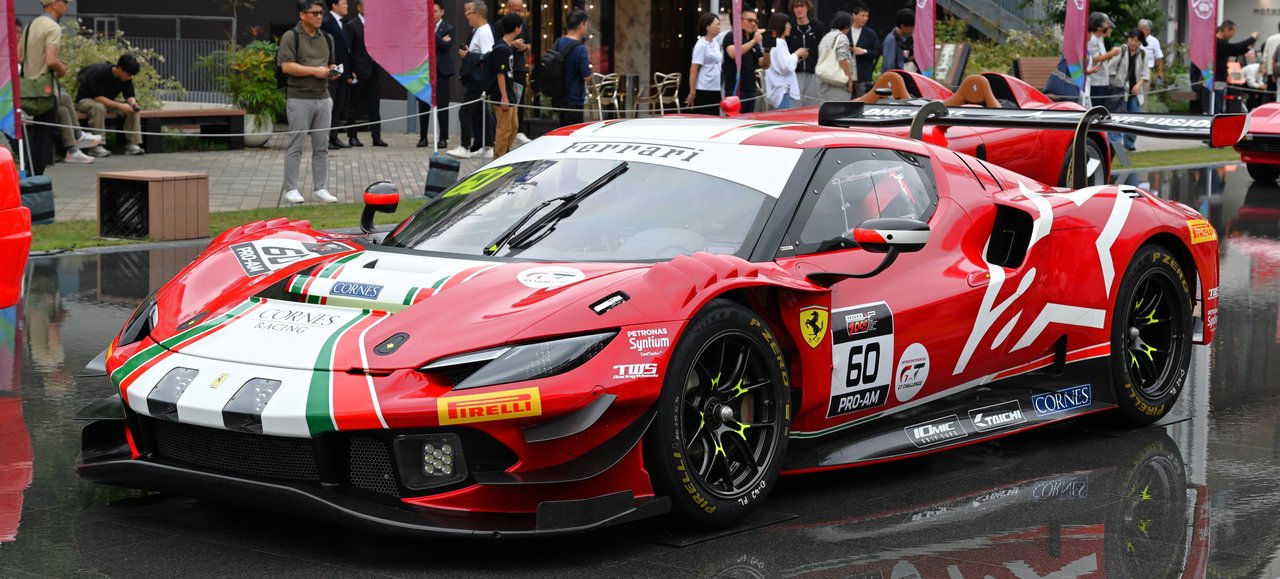
Photo via Wikimedia Commons under CC0 license.
Ferrari 296 GT3: The Turbocharged Reckoning That Won Daytona
There's a particular kind of racing symmetry that defines Ferrari's most consequential machines. In 2023, when the Prancing Horse's freshly minted 296 GT3 crossed the finish line at the Rolex 24 at Daytona, it wasn't simply claiming another GT3 victory. It was announcing, with unmistakable clarity, that Maranello had engineered a competition platform so fundamentally capable that it could dominate on debut—a feat that demanded more than just horsepower and heritage. It demanded a complete rethinking of how a mid-engine Ferrari tackles the rigours of modern international motorsport.
The 296 GT3 represents a radical departure from its predecessor, the 488 GT3. Where the road-going 296 GTB hedges its bets with a plug-in hybrid system—a concession to emissions regulations and luxury-market realities—the race car strips away that complexity entirely. Ferrari's engineers made a deliberate choice: go pure internal combustion, and go turbocharged. The result is a purpose-built, 600-horsepower twin-turbo V6 that breathes more freely and produces more torque (712 Nm) than the engine it replaced. This is race engineering uncompromised by road-car constraints, and it shows.
The Engine: Twin Turbocharging Done Right
At the heart of the 296 GT3 sits a 2992 cc twin-turbocharged V6—a purposeful step down in displacement from the 488 GT3's 3.9-liter V8, yet more powerful. This isn't downsizing for downsizing's sake; it's engineering philosophy. Twin turbochargers positioned low in the engine bay optimize packaging and weight distribution while delivering boost response that feels immediate rather than delayed. Ferrari calibrated the turbo strategy specifically for racing: aggressive anti-lag systems ensure that throttle application is sharp, and the boost curve is tailored to deliver maximum mid-range thrust where track pace is actually won.
The V6 configuration itself—borrowed from the road car but substantially modified for competition—allows Ferrari to exploit the inherent advantages of a shorter powerplant. Engine bay airflow improves. Packaging becomes more efficient. Weight sits lower and further aft than a traditional V8 would allow. The engineers then focused on mechanical resilience: forged internals, race-grade fuel injection, and a dry-sump lubrication system rated for sustained high-G cornering at full throttle. The result? A mill that delivers 600 hp and 712 Nm without the complexity of hybrid architecture, without the weight penalty of battery packs, and without the packaging compromises that road-car engineering demands.
Power delivery to the wheels flows through a sequential six-speed gearbox—a race item, not a road component—with quick, cable-actuated shifts that fire off in milliseconds. The final drive is a Torsen differential with adjustable locking characteristics, allowing engineers to dial in how much slip bias the rear axle allows under acceleration and cornering. This is the hardware of serious racing.
Chassis Architecture: Silhouette Racing Taken Seriously
The 296 GT3 is a proper silhouette racer, meaning it retains the overall proportions and visual character of the 296 GTB while being, underneath, something far more extreme. Ferrari built the chassis around the road car's mid-engine layout—a fundamental advantage when it comes to weight distribution and handling balance. But the race car's development diverged completely from there.
The aluminium monocoque is stiffened with additional bracing and reinforcement points calculated specifically for the loads generated by race-pace cornering and the aero forces of a full competition body kit. Suspension geometry was retuned from the ground up: double-wishbones front and rear, but with spring rates, damper curves, and anti-roll bar stiffness calibrated for slick tires and track-only performance. Ride height is dramatically lower than the road car. Camber and toe curves are optimized for the high slip angles generated during aggressive cornering.
Braking comes courtesy of a six-piston carbon-ceramic setup sourced from Brembo, with brake balance and modulation programmable via onboard electronics. The brake ducting has been substantially revised to cope with the repeated thermal cycling of endurance racing, where six-hour stints demand cooling efficiency that road-car systems simply cannot match.
What's striking about the 296 GT3's chassis behaviour is how it mirrors the turbocharged engine philosophy: it's engineered for precision and control at race pace, with no compromise for comfort or versatility. At 1,200 kg dry weight—before series-mandated BoP (Balance of Performance) ballast—the car carries exceptional power density. That lightness translates directly to track responsiveness and braking performance.
Aerodynamics and Balance
The 296 GT3's silhouette bodywork isn't merely cosmetic. The front fascia channels cooling air through enlarged intakes, while the hood vents are positioned to extract heat from the engine bay. The rear wing is a substantial affair—a GT3 wing bracket sits proud of the rear deck, generating downforce across the speed range while the underbody has been meticulously shaped for low-pressure efficiency. These aren't afterthoughts; they're the result of hundreds of computational fluid dynamics simulations and track validation.
Downforce distribution is tuned to maintain mid-corner stability while allowing the rear to remain responsive under hard braking and trail-braking. The mid-engine layout aids this inherently: the centre of pressure sits closer to the centre of gravity than it would on a front-engine design, which means the aero forces feel more linear and controllable.
Competition Pedigree: Born to Win
The 296 GT3's debut at the 2023 Rolex 24 at Daytona wasn't a tentative first outing. AF Corse's number 51 entry, piloted by Alessandro Pier Guidi, James Calado, and Côme Ledoyen, won outright in the GTD Pro class—a statement that Maranello's engineers had nailed the fundamentals. Since then, the car has competed extensively in LMGT3 (FIA World Endurance Championship), IMSA GTD Pro, and GT World Challenge series globally, racking up podiums and race victories that underscore its underlying competitiveness.
In 2024, Ferrari released the 296 GT3 Evo, a mid-cycle update that refined the package further: revised aerodynamics for improved stability and downforce consistency, updated suspension geometry based on three years of racing data, and engine tuning that squeezed additional performance from the twin-turbo V6. The Evo represents what happens when a manufacturer listens to driver feedback and racing engineers in the field.
Specification Sheet
| Specification | 296 GT3 / Evo |
|---|---|
| Engine Type | Twin-turbocharged V6 |
| Displacement | 2,992 cc |
| Power Output | 600 hp @ 7,500 rpm |
| Torque | 712 Nm @ 4,500 rpm |
| Transmission | Sequential 6-speed, cable-actuated |
| Differential | Torsen with adjustable locking |
| Dry Weight | ~1,200 kg (before BoP ballast) |
| Power-to-Weight Ratio | ~500 hp/tonne (baseline) |
| 0–100 km/h | ~3.2 seconds (estimated, racing conditions) |
| Suspension | Double-wishbone front and rear, adjustable dampers |
| Brakes | Six-piston carbon-ceramic (front and rear) |
| Tires | Pirelli racing slicks (series-specified) |
| Fuel Tank | 90 liters |
| Overall Length | ~4,630 mm |
| Overall Width | ~1,950 mm (with mirrors) |
| Overall Height | ~1,290 mm |
Market Positioning and Global Racing Series
The 296 GT3 competes in a crowded but competitive GT3 landscape. Its rivals include the Porsche 992 GT3 R, the Lamborghini Revuelto GT3, the BMW M4 GT3, and the Mercedes-AMG GT3. Each brings distinct engineering philosophies and strengths. The Porsche is supremely balanced and predictable. The BMW is a technologically dense bruiser. The 296 GT3, though, stands out for the coherence of its engineering: everything—the turbocharged engine, the mid-engine layout, the aero package, the suspension tuning—works in concert without compromise.
Globally, the car races under multiple series governance. In the FIA World Endurance Championship (WEC), it competes in LMGT3, competing against the Porsche 992 GT3 R, the BMW M4 GT3, and others in six-hour and 24-hour endurance events. In North America, it dominates IMSA GTD Pro, the premier professional GT3 class, where teams field factory-backed entries. GT World Challenge, both in the Americas and Europe, provides additional racing platforms for customer teams and privateer entries.
Pricing for a 296 GT3 customer entry hovers around €500,000–€600,000 depending on specification and supplier, though direct Ferrari quotes vary. This positions it competitively against other factory-backed GT3 machinery; it's not a bargain, but it's priced fairly within a category where top-tier racing hardware commands premium fees.
Driving Dynamics: What the Data Really Tells
On circuit, the 296 GT3 reveals itself as a car engineered for precision. The mid-engine layout delivers near-perfect weight distribution, which manifests as predictable mid-corner balance and confidence-inspiring turn-in. The turbocharged engine provides linear power delivery across the rev range—no dramatic spike, no lag hunting, just accessible, controllable performance that rewards smooth inputs.
What separates truly great racing machinery from merely competent machinery is how it rewards aggression without punishing it. The 296 GT3 sits in that category. Push it hard into a fast corner, and it responds with progressive grip and adjustability. The rear end is planted without feeling locked down; there's nuance available to the driver. Throttle application mid-corner feels natural—the power delivery is metered enough that you're not fighting wheelspin or sudden attitude changes, yet potent enough to drive the car to the exit. Braking is confidence-inspiring; the carbon-ceramic system offers excellent modulation, and the mid-engine weight distribution means nose-heavy understeer during hard deceleration is minimal.
In high-fuel-load endurance running, the 296 GT3 maintains that balance surprisingly well. Weight transfer during long fuel stints changes the handling slightly—the car gets a touch more ponderous mid-corner—but the fundamental character remains accessible. This is the hallmark of intelligent suspension engineering: the platform is tuned to handle varying loading conditions without requiring constant re-calibration from the driver.
Frequently Asked Questions
Q: How does the 296 GT3 compare to the 488 GT3 it replaced?
A: The 296 GT3 is more powerful (600 hp vs. 488 GT3's 710 hp at lower revs, but comparable power per displacement), lighter, and features a twin-turbo V6 instead of a naturally aspirated V8. The mid-engine packaging is more efficient, and the elimination of hybrid complexity allows for a cleaner, more focused race engineering approach. It's a generational step forward in terms of power delivery responsiveness and handling balance.
Q: Why turbocharged instead of naturally aspirated?
A: Turbocharging allows Ferrari to meet racing regulations' displacement caps while achieving higher power outputs with better fuel efficiency—critical in endurance racing where fuel consumption directly impacts race strategy. Turbos also provide design flexibility; the engineers can tune boost delivery for racing conditions rather than making compromises for road-car street manners.
Q: Is a 296 GT3 available for customer purchase?
A: Yes. Ferrari sells customer versions to privateers and professional teams through authorized racing partners. Pricing ranges from €500,000–€600,000 depending on specification. However, these are competition-only vehicles; they're not road-legal and aren't intended for anything other than circuit racing or track days at racing venues.
Q: How does BoP (Balance of Performance) affect the 296 GT3?
A: Series organizers apply BoP adjustments across all GT3 machinery to maintain competitive balance. For the 296 GT3, this typically includes added weight ballast (10–15 kg in some seasons) and potential fuel-flow restrictions, depending on the car's current competitiveness. It's part of the ecosystem of modern GT3 racing; no car escapes it if it's winning.
Conclusion: The Coherent Machine
The 296 GT3 wins not because Ferrari threw unlimited budget and resources at a single problem, but because the team engineered a coherent whole. The turbocharged V6 isn't simply powerful; it's responsive and efficient. The mid-engine layout doesn't just sound traditional; it delivers tangible advantages in weight distribution and packaging. The aero package is functional, not decorative. The suspension is tuned for real-world racing demands, not compromise.
That debut victory at Daytona in 2023 wasn't luck. It was the inevitable result of a manufacturer's racing program functioning exactly as intended. The 296 GT3 Evo, released later, proved that Ferrari understood what worked and where refinement was possible. Today, across LMGT3, IMSA GTD Pro, and GT World Challenge series globally, the 296 GT3 remains among the most competitive machines in GT3 racing. It's not the fastest in every corner or the quickest in a straight line; instead, it's the most complete—a purpose-built race car that rewards smooth technique and punishes mistakes minimally. In professional motorsport, that coherence is everything.
Sources and editorial note
Specifications, performance numbers, pricing, and technical measurements in this feature are based on official manufacturer documentation, engineering releases, and certified automotive benchmarks. Real-world parameters may vary based on market specifications and testing conditions.
- https://www.ferrari.com/en-EN/competizioni-gt/296-gt3
- https://sportscar365.com/industry/ferrari-takes-wraps-off-296-gt3-car/
The featured lead image is sourced from Wikimedia Commons under Creative Commons licensing with proper attribution. Editorial reporting complies with international copyright and fair-use standards.