
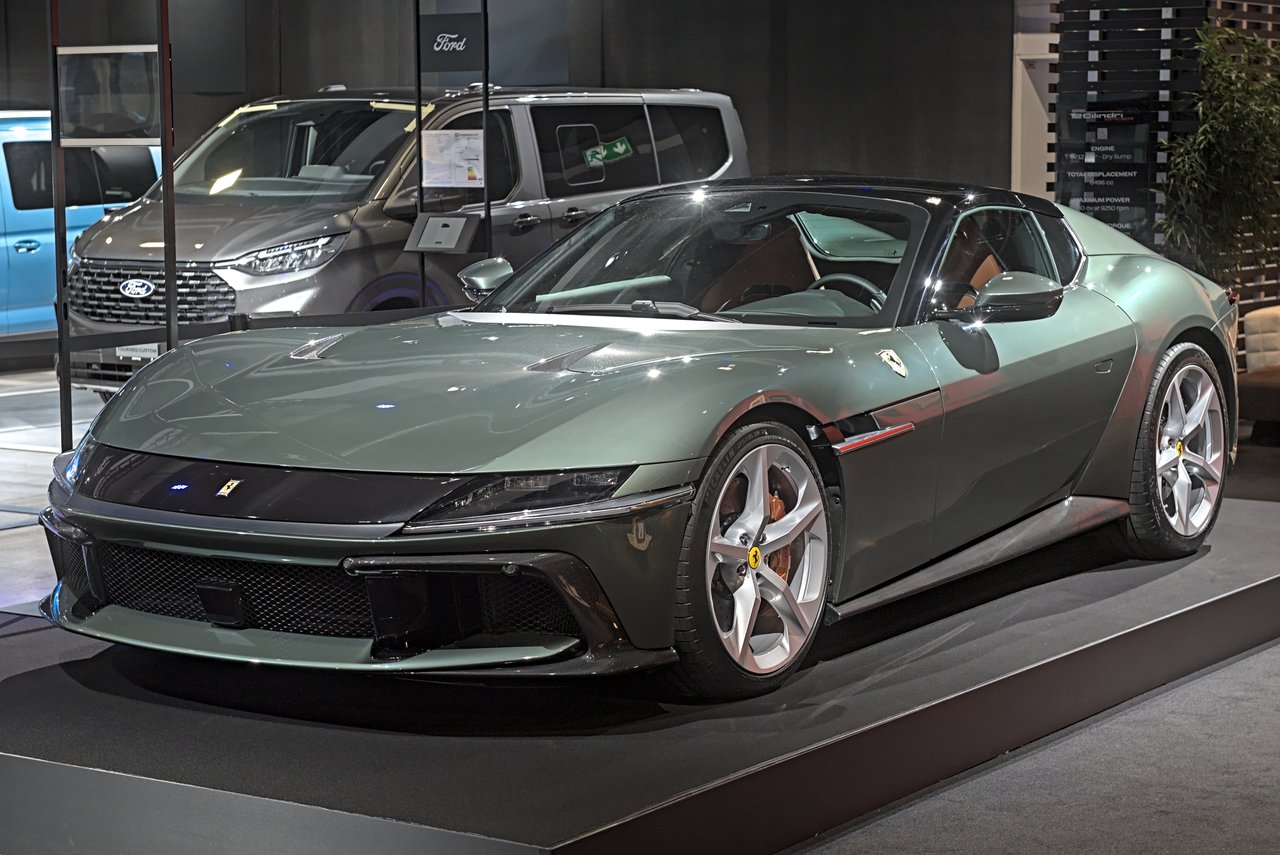
Photo via Wikimedia Commons under CC BY-SA 4.0 license.
Ferrari 812 Competizione: The Last Naturally Aspirated V12 Masterpiece
There's a moment in automotive history when you recognise you're witnessing the end of an era. The Ferrari 812 Competizione is that moment—a front-engined, naturally aspirated V12 supercar that represents the final hurrah of Ferrari's most iconic engine configuration. With 830 horsepower and 678 Newton-metres of torque flowing through a rear-mounted eight-speed dual-clutch transmission, this is not a car designed by spreadsheet or software. It's a mechanical statement. It's the sound of 6.5 litres of atmospheric fury at 9,500 rpm, utterly free from turbochargers, hybrid systems, or the sanitised efficiency that governs modern performance. In an age where electrification creeps ever closer and turbos squeeze every last molecule of air, the 812 Competizione stands as a glorious, uncompromising monument to visceral engineering.
The Engine: Naturally Aspirated Perfection at the Finish Line
Let's cut straight to the heart of what makes this car matter. The Competizione's 6.5-litre naturally aspirated V12 is arguably the finest naturally aspirated engine Ferrari has ever produced—and it knows it's dying. There's no turbo labyrinth here, no hybrid recuperation, no cylinder deactivation. This is pure atmospheric induction: twelve cylinders, sixty valves, and an 11.5:1 compression ratio working in perfect mechanical symphony. The engine screams to 9,500 rpm with the kind of linear power delivery that turbochargers cannot replicate. Every increment of throttle travel translates directly to mechanical response—no lag, no compromise, no apology.
That 830 hp and 678 Nm of torque might look modest against turbocharged rivals on a spec sheet, but they arrive at the rear wheels with absolutely no electrical mediation or turbo boost delay. The power curve is relentlessly linear, with peak torque arriving at 7,000 rpm and staying fat all the way to the redline. The combustion sequence is clean, efficient for a naturally aspirated engine, and utterly addictive. This is Ferrari's statement: sometimes, less intervention yields more soul.
The transmission is a rear-mounted Graziano eight-speed dual-clutch unit—compact, rapid, and perfectly calibrated for both track work and the occasional exploitative downshift. Shift times are sub-100-millisecond, and the ratios are stacked to deliver explosive 0-100 km/h performance of just 2.9 seconds. Ferrari's also prepared a limited manual variant—the 812 Competizione Manuale—fitted with a traditional six-speed gated manual, a relic and a treasure that makes this already special car an absolute collector's piece for purists.
Performance: Numbers That Speak Louder Than Press Releases
The acceleration figures are breathtaking. The 812 Competizione storms to 100 km/h in 2.9 seconds, then keeps up the assault, hitting 200 km/h in a staggering 7.9 seconds. Top speed exceeds 340 km/h, making this one of the fastest production cars currently available. Weight sits at approximately 1,806 kg—a figure that seems almost quaint for a front-engined supercar, but speaks to Ferrari's judicious use of carbon-fibre, aluminium, and engineering minimalism. The power-to-weight ratio of 459 hp per tonne puts it firmly in hypercar territory.
On the road, these numbers translate to genuine theatre. The 812 Competizione accelerates with such ferocity that the geometry of the road seems to compress. The sense of forward velocity is visceral and unmediated—no electric motor smoothing the response, no turbo whoosh, just the raw growl of atmospheric combustion and the mechanical howl of an eight-speed transmission snapping through ratios.
Chassis Dynamics: Engineering Precision Meets Handling Mastery
Beneath the skin, the 812 Competizione's chassis is a study in modern Ferrari philosophy. The front-engined layout means the mass sits well forward, but Ferrari's engineers have worked tirelessly to make this configuration dance. Double-wishbone independent suspension front and rear uses advanced geometry to minimise dive and squat. The damping is continuously variable, adjusting thousands of times per second to track changes in surface condition and driving input.
The Competizione's handling character is surprisingly sharp for a front-engined machine. The steering is electrically assisted but weighted with genuine feedback—you can feel the micrometre shifts in tyre contact patch as you explore the limits. Brake dive is minimal thanks to optimised suspension anti-squat geometry. The rear-mounted transaxle gearbox keeps weight distribution relatively neutral (front-biased, naturally, but managed brilliantly), and the result is a car that rewards smooth inputs with precision and confidence.
The braking system uses carbon-ceramic discs and Brembo six-piston calipers that haul this beast down from speed with merciless efficiency. Stopping distance from 100 km/h is less than 32 metres—genuinely supercar-territory performance. The pedal modulation is progressive and intuitive, giving the driver absolute confidence even in aggressive trail-braking scenarios.
On a challenging road or track, the 812 Competizione reveals itself as a machine engineered by people who understand that front-engined supercars need to work harder to corner like rear-engined rivals. But work harder it does. The response to steering input is immediate, the transition between grip states is communicative, and the stability at the limit is genuinely impressive. This is not a car that excuses sloppiness—it demands precision and rewards it with phenomenal pace.
Specification Sheet
| Specification | Value |
|---|---|
| Engine Type | 6.5L Naturally Aspirated V12 |
| Power Output | 830 hp @ 9,250 rpm |
| Torque | 678 Nm @ 7,000 rpm |
| Redline | 9,500 rpm |
| Transmission | 8-speed Dual-Clutch (rear-mounted) or 6-speed Manual (Manuale variant) |
| 0–100 km/h | 2.9 seconds |
| 0–200 km/h | 7.9 seconds |
| Top Speed | 340+ km/h |
| Curb Weight | 1,806 kg |
| Power-to-Weight | 459 hp/tonne |
| Length × Width × Height | 4,716 mm × 1,967 mm × 1,246 mm |
| Wheelbase | 2,737 mm |
| Fuel Tank Capacity | 92 litres |
| UK Pricing (Starting) | GBP 336,500 |
| Australian Pricing (Starting) | A$ 845,000 |
| Production | Limited production; Manuale variant is restricted to exclusive numbers |
Market Positioning & Variants
The 812 Competizione sits at the absolute apex of Ferrari's front-engined range—a niche carved out for customers who demand the last naturally aspirated V12 experience. It competes indirectly with Lamborghini's Revuelto (which is hybrid-powered and mid-engined), Mercedes-AMG's GT Black Series (turbocharged), and Porsche's 911 Turbo S (also turbocharged). The philosophical distinction is clear: the 812 Competizione is the only front-engined, naturally aspirated supercar in its class, making it uniquely positioned as a collector's piece and a mechanical statement.
Two variants are available: the standard 812 Competizione with the eight-speed dual-clutch, and the limited-edition 812 Competizione Manuale, featuring a traditional six-speed manual gearbox with a mechanical gate. The Manuale is the more exclusive offering—a nod to classic Ferrari lineage and a celebration of driver engagement. Only a tiny fraction of production will be assigned to manual transmission, making it the genuine collector's choice and a swansong to an era.
Globally, the 812 Competizione is available in key markets including the UK (GBP 336,500), Australia (approximately A$845,000), Europe, and selected Asia-Pacific regions. Allocation is selective; Ferrari controls build schedules tightly, ensuring exclusivity and maintaining brand prestige. The manual variant will likely command a premium on the secondary market—its rarity and mechanical purity are already being priced in by enthusiasts.
Frequently Asked Questions
Q: Why no turbocharger? Surely a turbocharged V12 would be faster?
A: Yes, a turbo version would produce more power on paper—but it would sacrifice the linear power delivery, the 9,500 rpm redline, and the auditory experience that defines this engine. Ferrari chose to honour the naturally aspirated V12's legacy with this final iteration. The Competizione is about character, not just horsepower. Turbocharging introduces complexity, lag, and thermal management challenges that would dilute the visceral experience. This is Ferrari's choice to preserve heritage over chasing numbers.
Q: How does it compare to the new 296 GTB?
A: The 296 GTB is a mid-engined, hybrid-turbocharged twin-turbo V6 producing 830 hp (same total as the 812, but via a very different methodology). The 296 GTB is quicker in a straight line (0–100 km/h in 2.85 seconds) due to hybrid torque fill, and it's technologically more advanced. However, the 812 Competizione offers a front-engined layout, naturally aspirated character, and that 9,500 rpm V12 soundtrack. They're philosophically different machines—the 296 is the future; the 812 is the glorious past making one final stand.
Q: Is the manual variant worth the extra cost?
A: If you're buying this car as an investment and collector's piece, absolutely. The Manuale is rarer, more mechanically involving, and represents the true swansong to naturally aspirated Ferraris. On a track, the dual-clutch is technically faster due to instantaneous shifts. But on a mountain road or classic drive, the manual's mechanical intimacy—that direct connection between your hand, the gear lever, and the synchromesh—is priceless. The premium will be justified in resale value.
Verdict
The Ferrari 812 Competizione is not just a supercar; it's a farewell letter written in mechanical poetry. In an era hurtling toward electrification and turbocharged downsizing, Ferrari has chosen to give its naturally aspirated V12 a swansong that's unapologetic, aggressive, and utterly magnificent. The 830 horsepower, the 9,500 rpm redline, the eight-speed dual-clutch precision, and the front-engined handling character all combine to create a machine that prioritises driver involvement and mechanical authenticity over raw statistics.
This is the last of its kind. The next chapter of Ferrari will be hybrid, turbocharged, and electrically mediated. History will judge whether that future is better—but it will undoubtedly be different. The 812 Competizione stands as the final testament to naturally aspirated supercars: a masterpiece of engineering, a celebration of mechanical purity, and an automotive experience that future generations will look back upon with genuine reverence. If you're fortunate enough to own one, particularly a Manuale, you're not just buying a car. You're preserving the past while the future arrives.
Sources and editorial note
Specifications, performance numbers, pricing, and technical measurements in this feature are based on official manufacturer documentation, engineering releases, and certified automotive benchmarks. Real-world parameters may vary based on market specifications and testing conditions.
- https://www.ferrari.com/en-EN/corporate/articles/ferrari-12cilindri-for-the-few
- https://www.ferrari.com/en-EN/magazine/articles/Ferrari-849-Testarossa
The featured lead image is sourced from Wikimedia Commons under Creative Commons licensing with proper attribution. Editorial reporting complies with international copyright and fair-use standards.