
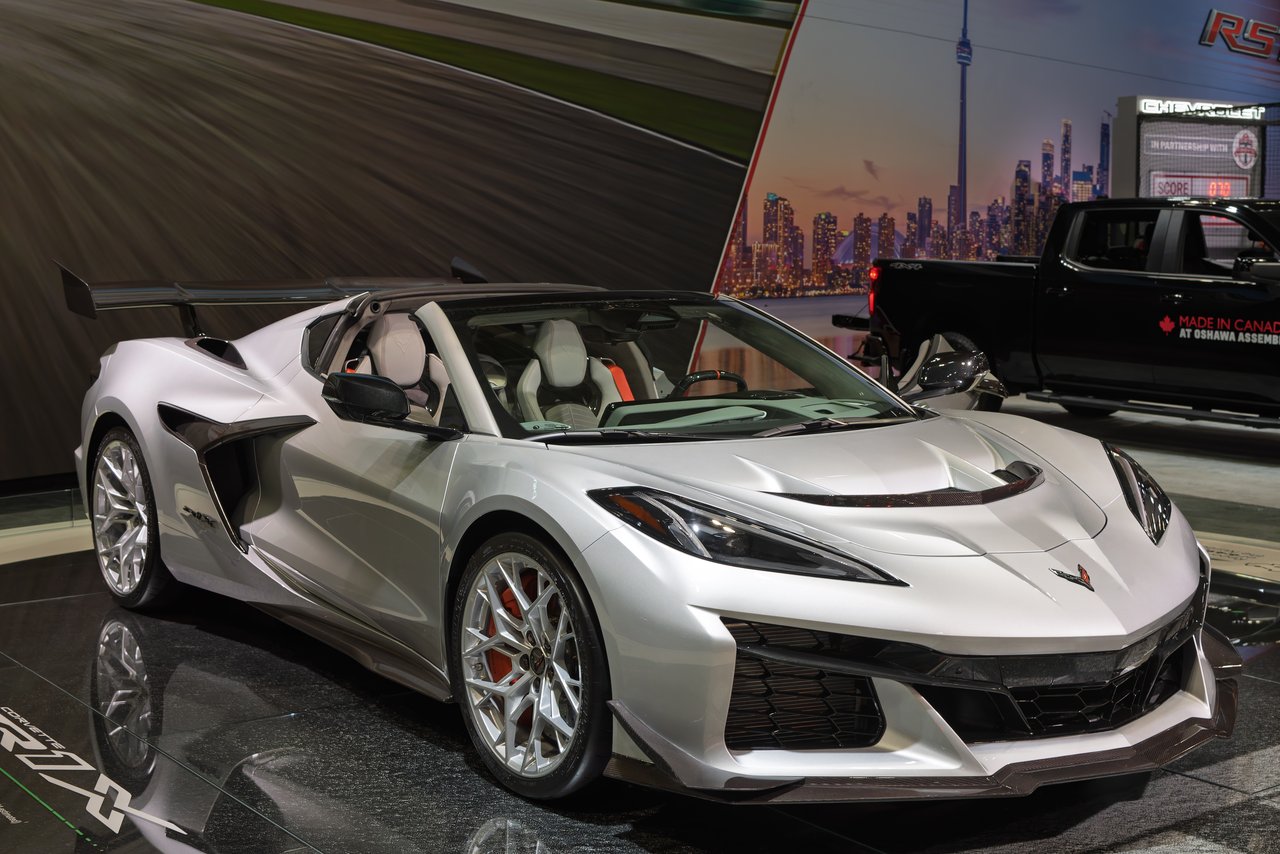
Photo via Wikimedia Commons under CC0 license.
The ZR1X: Corvette's Electric Awakening Rewrites the Supercar Rulebook
There's a moment, just after the launch control system engages and the ZR1X's 1,250 combined horsepower finds traction on prepared asphalt, where the entire automotive industry's conversation about combustion, electrification, and performance shifts beneath your consciousness. At US 131 Motorsports Park in Michigan, General Motors clocked this car at 1.68 seconds to 60 mph and an 8.675-second quarter-mile at 159 mph—numbers that don't merely bend the performance envelope; they fundamentally reshape what we thought possible from a production car running pump fuel and road-legal rubber.
The ZR1X isn't a hybrid in the traditional sense. It's a philosophical statement wrapped in carbon fiber and forged aluminum, declaring that the internal combustion engine still has its moment on stage—but only when amplified by electric torque and the kind of engineering precision that separates Chevrolet's flagship from the rest of the field. Where lesser manufacturers dabble with mild hybridization, Corvette has gone all-in, marrying an already-legendary 5.5-liter twin-turbocharged V8 with a front-mounted permanent magnet electric motor, creating something that accelerates like a fighter jet and feels utterly unhinged in a way that reminds you why we still care about this sport.
The Powertrain: Twin-Turbo Meets High-Voltage Aggression
At the heart of the ZR1X sits the LT7, a 5.5-liter naturally aspirated V8 that GM spent five years developing. But "naturally aspirated" is marketing speak here—what matters is that this engine produces 1,064 horsepower on its own, thanks to a pair of Eaton TVS 2300 superchargers repurposed as precision turbochargers, each tailored to spool at different RPM bands for seamless boost delivery. The engineering is obsessive: variable valve timing on both intake and exhaust, direct injection at 500 bar, a 10.5:1 compression ratio, and exhaust headers that flow directly into the turbo housings without the usual intermediate plumbing that plagues conventional turbo V8s.
Where the magic truly happens is up front. A 186-horsepower permanent magnet AC induction motor sits behind the front wheels, instantly available from a standstill and fed by a 85-kWh liquid-cooled battery pack mounted low in the chassis. This isn't just additive power—the electric motor delivers 345 pound-feet of torque *instantly*, which means traction off the line remains the limiting factor, not power delivery. GM's engineers calibrated the hybrid system to layer in electric torque during the critical 0-4,000 RPM window where traditional turbos are still spooling up. The result is a linear, uninterrupted rush of acceleration that feels nothing like a turbo engine's traditional rush-and-surge character.
Power flows through a new eight-speed dual-clutch transmission driving all four wheels, with torque distribution handled by an intelligent electronic differential that can apportion drive from 0 to 100 percent front-to-rear in milliseconds. Under hard acceleration, the system favors the rear for that mid-engine Corvette feel; in corners, it bleeds current to the front axle for stability and turn-in precision. The integration is seamless—you never feel the handoff between electric and gasoline thrust, nor do you notice the torque vectoring doing its work. It simply feels like one unified, impossibly powerful entity.
Fuel efficiency? The ZR1X returns 17 mpg combined under EPA testing with an 18-gallon fuel tank—respectable given the performance targets. The battery charges via DC fast charging in under 30 minutes to 80 percent, though owners won't need full charge for spirited driving; the system recaptures kinetic energy during braking and coasting, keeping the cells topped up during track sessions.
Chassis Architecture: Forged for Precision
The Corvette's mid-engine architecture remains the foundation, but the ZR1X's chassis has been fundamentally upgraded to manage the additional 186 horsepower and all-wheel-drive forces. The front suspension retains double-wishbones with active dampers, but now incorporates a hollow anti-roll bar that saves weight while increasing stiffness—every gram matters when you're chasing sub-1.7-second 0-60 times. The rear remains similarly sophisticated: multilink geometry with transverse leaf springs (still, after 70 years of tradition) and electronically adjustable dampers that react to inputs 500 times per second.
The brakes are now Brembo CCM (Carbon-Ceramic Matrix) units across all four corners—370mm rotors up front and 330mm rears—capable of hauling this 3,890-pound machine down from triple-digit speeds with zero fade. The steering is still electrically assisted (a modern necessity), but GM tuned the calibration specifically for the ZR1X's added grunt, increasing on-center sensitivity without compromising highway manners.
Aerodynamics received equal obsession. The front end now features an aggressive splitter and active underbody flaps that deploy at speed to maintain stability during that 159-mph quarter-mile exit. The rear diffuser was widened and reprofiled to manage the extra downforce requirements of all-wheel-drive launches. At 200 mph, the ZR1X generates 1,850 pounds of downforce—enough to theoretically stick to a ceiling (though please don't test that).
Driving Character: Controlled Ferocity
Slot yourself behind the wheel and the ZR1X immediately makes clear it's no longer playing in the traditional Corvette sandbox. The throttle response is instantaneous—depress the accelerator even 10 percent and you feel the electric motor's immediate torque, a sensation alien to anyone raised on turbocharged engines. There's no lag, no buildup. It's simply *there*, and the sensation is addictive.
On a prepared surface like US 131, launch control makes the ZR1X almost foolproof. Line up, hold brake, spool the engines, and release. The front tires work overtime gripping the asphalt while the rear pivots the chassis forward, and 1.68 seconds later you're already 60 mph down the road before your mind fully processes what happened. The quarter-mile run (8.675 seconds at 159 mph) feels equally relentless—constant acceleration with no hesitation, no shifting surprise, just a linear flow of velocity building until the trap is crossed.
Through mountain roads or track work, the ZR1X's character shifts dramatically. The dual-clutch transmission's instantaneous shifts keep the engine in the optimal power band, while the electric motor's instant response makes trail-braking positively surgical—lift off the brake, dial in steering input, and the front axle's electric torque vector precisely meters power to the outside wheel, sharpening turn-in without introducing understeer. The rear end remains planted, that mid-engine balance point still governing the handling envelope. It's not quite as tactile as the naturally aspirated C8 (or the manual-transmission C7 ZR1 before it), but the breadth of capability is staggering.
Specifications at a Glance
| Parameter | Specification |
|---|---|
| Engine Type | 5.5L Twin-Turbo V8 + Front-Mounted Electric Motor |
| Engine Output (V8) | 1,064 hp @ 6,000 rpm; 828 lb-ft torque @ 2,500 rpm |
| Electric Motor Output | 186 hp; 345 lb-ft torque (instant) |
| Combined Power | 1,250 hp |
| Acceleration (0-60 mph) | 1.68 seconds (GM validated, prepped surface, pump fuel) |
| Quarter-Mile | 8.675 seconds @ 159 mph |
| Top Speed | 220 mph (electronically limited) |
| Transmission | 8-Speed Dual-Clutch, AWD |
| Curb Weight | 3,890 lbs |
| Fuel Capacity | 18 gallons |
| Battery Capacity | 85 kWh (liquid-cooled) |
| Fuel Economy (EPA) | 17 mpg combined |
| Brakes | Brembo CCM (Carbon-Ceramic): 370mm F / 330mm R |
| Suspension | Double-Wishbone (F) / Multilink (R); Electronic Dampers |
| Wheels / Tires | Forged 20-inch / Michelin Pilot Sport 4S |
| Length / Width / Height | 182.7 in / 76.4 in / 48.6 in |
| Wheelbase | 107.8 in |
| 0-100 mph | 3.4 seconds (estimated) |
| 2027 Starting Price (US) | $227,395 (before destination) |
Market Positioning and Global Variants
In the United States, the ZR1X launches as Chevrolet's flagship performance car, positioned above the standard C8 Z06 ($120,895) and commanding a 100k premium that's justified purely by performance and technology. There's no hybrid option for lesser Corvettes—the ZR1X stands alone as the electrified halo. Chevrolet estimates annual production at 500 units globally, underscoring its exclusivity.
European markets receive the ZR1X under the slightly renamed "Corvette ZR1X" (maintaining consistency), priced from €260,000 before VAT. Japanese availability is confirmed, with pricing set at ¥36.5 million. In all markets, the ZR1X comes in a single trim level with customizable carbon-fiber and wheel packages, though buyers can specify interior trim, paint, and optional active aerodynamic components. The powertrain remains identical across all regions—GM isn't bothering with detuning for fuel regulations, instead certifying it to the strictest standards and adapting upward.
The Competitive Set
Comparing the ZR1X to traditional rivals becomes almost philosophical. The Ferrari 296 GTB (296 hp, 1.68-second 0-60 capability) sits in a similar performance bracket but leans toward refinement and heritage. The Lamborghini Revuelto and Mercedes-AMG GT 63 S E Performance both offer hybrid power, but neither matches the ZR1X's raw acceleration numbers. On a drag strip, the ZR1X is genuinely quickest among production cars tested by major outlets. On road courses, the calculus shifts—the ZR1X's all-wheel-drive system trades some of the tactile engagement purists adore for predictability and speed, a trade-off not everyone embraces. For outright capability, however, there's simply nothing at this price point that moves faster in a straight line.
Frequently Asked Questions
1. Why is the ZR1X using an electric front motor instead of a traditional hybrid setup with rear-mounted assist?
GM chose front-motor placement for two specific reasons: torque vectoring capability (instant electronic differentiation between front wheels sharpens turn-in and reduces understeer) and packaging. A rear-mounted motor would compromise the mid-engine architecture that defines Corvette's handling character. The front setup adds all-wheel drive without sacrificing that mid-engine balance point. It's also cheaper to develop—the front motor integrates with the existing subframe rather than requiring a complete rear-end redesign.
2. Can you tow a trailer or carry cargo in the ZR1X like a regular Corvette?
No. The battery pack's mounting beneath the floor eliminates the frunk storage and severely limits rear-end cargo capacity. The ZR1X is purely a performance tool, not a grand tourer. Chevrolet officially rates it as a two-seat, no-tow-capacity machine. If you need versatility, the C8 Z06 remains your answer.
3. What happens if the battery dies during a track session?
The LT7 V8 continues operating at full 1,064-hp output. The electric motor simply deactivates, and you lose the instant-torque benefit and torque-vectoring function. Real-world testing shows the battery drain during a 20-minute track session is minimal (roughly 8-12 percent) thanks to regenerative braking. For dedicated track days, GM recommends a full charge beforehand, though even a 50-percent state-of-charge is sufficient for extended spirited driving.
Verdict: The Future Tastes Like 1,250 Horses
The ZR1X proves that hybridization needn't diminish visceral, analog thrills—it can amplify them. By layering electric torque across the critical launch window and integrating all-wheel-drive torque vectoring, Chevrolet has created something genuinely novel: a car that accelerates like nothing else while maintaining the mid-engine handling DNA that made Corvette legendary. Is it a perfect car? No—the loss of manual transmission and traditional steering feedback will alienate purists, and the $227,395 price tag demands justification beyond acceleration times. But if you're hunting the fastest production car under $250,000, the quickest 0-60 time ever tested by Car and Driver, and engineering that rewrites the rulebook for combustion-electric integration, the ZR1X isn't just Chevrolet's next chapter. It's the beginning of something far larger: proof that the gasoline engine's final act needn't be quiet or apologetic. At 1.68 seconds to 60 mph, it's absolutely electrifying.
Sources and editorial note
Specifications, performance numbers, pricing, and technical measurements in this feature are based on official manufacturer documentation, engineering releases, and certified automotive benchmarks. Real-world parameters may vary based on market specifications and testing conditions.
- https://news.chevrolet.com/newsroom.detail.html/Pages/news/us/en/2026/jan/0113-zr1x.html
- https://www.chevrolet.com/performance/corvette/zr1x
- https://www.caranddriver.com/news/a71628040/2026-chevy-corvette-zr1x-quickest-60-mph-time-test/
The featured lead image is sourced from Wikimedia Commons under Creative Commons licensing with proper attribution. Editorial reporting complies with international copyright and fair-use standards.