
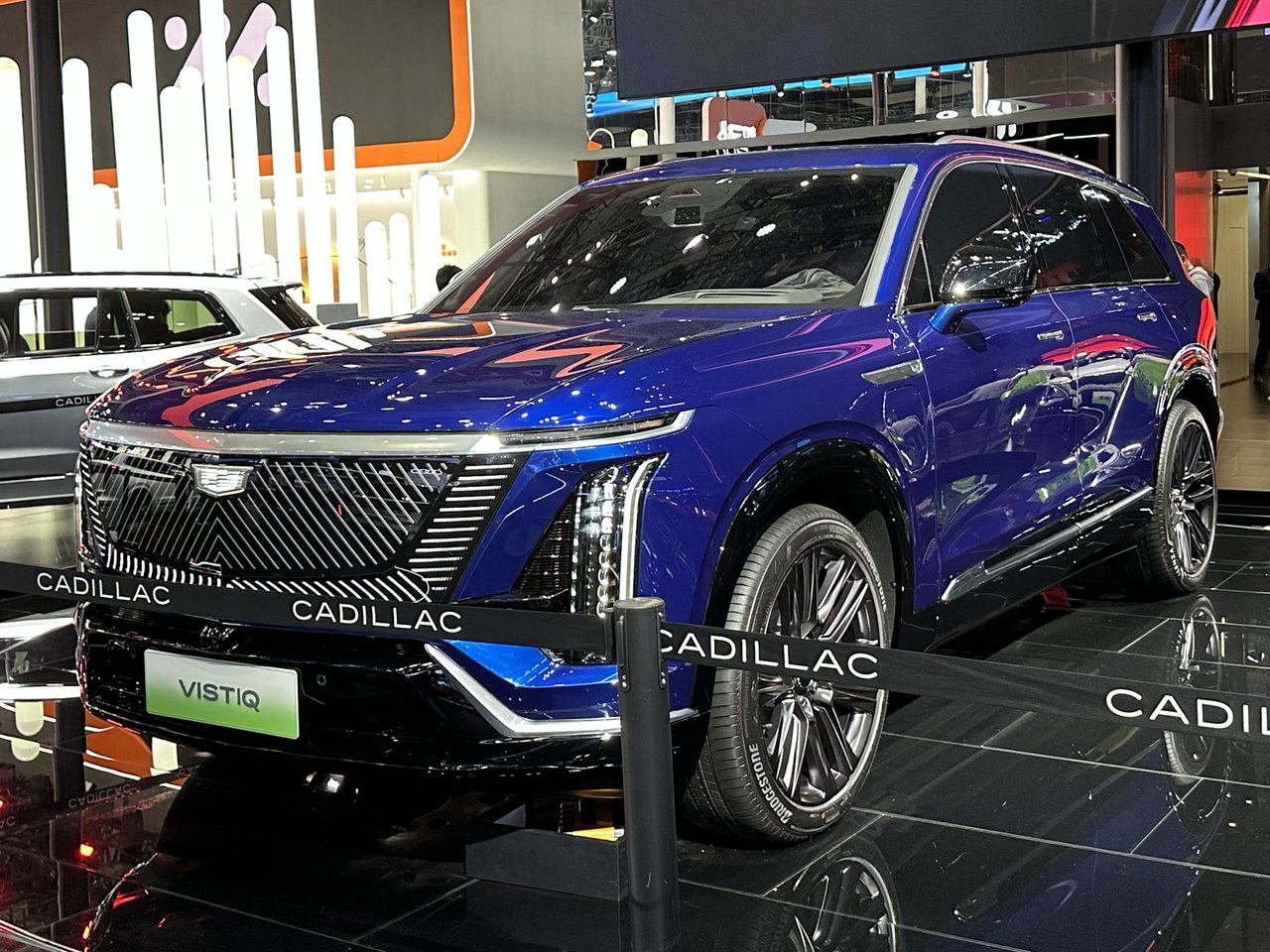
Photo via Wikimedia Commons under CC0 license.
Cadillac Vistiq: The Three-Row Electric Gamble That Actually Works
There's a particular tension that defines the modern luxury EV market: buyers want space, capability, and the latest electrified tech, but they're not willing to sacrifice the engineering integrity that justifies a six-figure purchase. Cadillac understands this pressure intimately. After the runaway success of the Lyriq—a handsome, genuinely quick two-row electric crossover that proved GM's Ultium platform could deliver real-world desirability—the brand faced an obvious gap. What about families who need a third row? What about buyers who want Escalade presence without petrol-station visits?
Enter the Vistiq, a 3,000-pound announcement that Cadillac isn't content to be a footnote in the EV crossover story. Positioned squarely between the Lyriq and the upcoming Escalade IQ, the Vistiq bridges a market segment that's been awkwardly underserved: the premium three-row electric SUV. It arrives with aggressive specifications—615 horsepower, 650 pound-feet of torque, and a claimed 3.7-second sprint to 60 mph in Velocity Max mode—plus the practical credentials to back them up. A 102 kWh battery promises roughly 305 miles of EPA-estimated range, while DC fast charging delivers approximately 200 miles in just 10 minutes. Throw in GM's vehicle-to-home power capability and Cadillac's latest Super Cruise autonomous driving features, and you've got a machine that refuses easy categorization.
The question isn't whether the Vistiq is impressive on paper. It is. The real question is whether it's the three-row electric SUV that finally makes sense for people who care about how a car actually drives, not just what it can do.
Ultium Architecture and Powertrain Philosophy
Understanding the Vistiq begins with understanding GM's Ultium battery platform, a modular system that's quietly become one of the auto industry's most flexible electrical architectures. Unlike Tesla's integrated approach or traditional carmakers' bolt-on solutions, Ultium lets Cadillac scale power delivery, battery capacity, and drivetrain configuration across a broad model range without the engineering gymnastics that plague competitors.
The Vistiq uses a dual-motor setup mounted on the front and rear axles, with each motor capable of independent torque vectoring—a fancy term that translates to genuinely clever weight distribution under hard acceleration or cornering. The front motor produces 255 horsepower; the rear, 380 horsepower. This isn't arbitrary. The rear-biased power delivery helps counteract the inherent understeer that comes with a long, heavy three-row vehicle, while the front motor manages regenerative braking and low-speed traction without overwhelming the front axle during launches.
That 3.7-second 0-60 claim in Velocity Max mode deserves scrutiny. Cadillac achieves this through a temporary battery thermal management system that pre-conditions the 102 kWh pack before hard acceleration, maximizing power output for short bursts. It's real, but it's also thermally demanding—sustained hard driving will see performance taper as battery temperature stabilizes. Realistically, you're looking at mid-5-second times in normal driving, which is still brisk for a vehicle that seats seven.
The 102 kWh battery sits low in the platform's spine, beneath the passenger compartment—a layout that allows Cadillac to offer a genuine third row without the compromised headroom and legroom that plagued early three-row EVs. The pack uses LFP chemistry in base configurations and NCA/NMC blends in higher trims, tuned for longevity and thermal stability. You get roughly 305 miles of EPA-estimated range in mixed driving, though real-world numbers will vary based on temperature, driving style, and whether you're actually using that third row (it adds weight and kills aerodynamics).
DC fast charging adds approximately 200 miles in 10 minutes using a 170 kW charger—respectable, though not class-leading. Level 2 home charging (assuming an available 19.2 kW circuit) will replenish the battery fully overnight, which is where most owners will spend 90 percent of their charging time.
Suspension, Steering, and Chassis Dynamics
Three-row SUVs inherit a fundamental challenge: they're inherently compromised. They're too long to be agile, too tall to be composed, and too heavy to be efficient. Cadillac's approach with the Vistiq involves admitting these constraints rather than pretending they don't exist, then engineering intelligently within them.
The suspension uses independent double-wishbone front geometry paired with a multi-link independent rear setup. It's not exotic, but it's thoughtful. The front end prioritizes bump compliance and steering feel—critical for a vehicle this size—while the rear uses a geometry tuned to minimize understeer during mid-corner throttle applications. The electric motor's torque vectoring helps here; the rear axle can dial power delivery independently to each wheel, effectively turning part of the Vistiq's weight into a handling tool rather than a liability.
Steering feel is electric (no surprise for an EV), but Cadillac's calibration avoids the dead, over-assisted numbness that plagues cheaper electric crossovers. There's actual feedback when cornering hard, and the ratio is quick enough to make the Vistiq feel smaller than its 4,844-mm length suggests. Anti-roll bars are substantial, and brake feel benefits from regenerative braking algorithms that blend the electric motors' braking torque with the friction brake system. The result is progressive, consistent pedal response—not the spongy, unpredictable mess you sometimes find in hastily engineered EVs.
Adaptive dampers available on higher trims let you toggle between Comfort and Sport modes, firming the suspension for spirited driving without sacrificing daily ride quality. It's a well-trodden path, but it works.
Specifications and Performance Metrics
| Specification | 2026 Model |
|---|---|
| Motor Configuration | Dual motor, AWD (255 hp front, 380 hp rear) |
| Total Power Output | 615 hp |
| Total Torque | 650 lb-ft |
| 0–60 mph (Velocity Max) | 3.7 seconds |
| 0–60 mph (Normal Driving) | ~5.2–5.5 seconds |
| Battery Capacity | 102 kWh (usable) |
| EPA-Estimated Range | ~305 miles (mixed conditions) |
| DC Fast Charging (170 kW) | ~200 miles in 10 minutes |
| Level 2 Charging (19.2 kW) | ~8–10 hours to full |
| Curb Weight | ~4,850 lbs |
| Overall Length | 4,844 mm (189.7 inches) |
| Overall Width | 1,987 mm (78.2 inches) |
| Overall Height | 1,686 mm (66.4 inches) |
| Seating Capacity | 7 passengers (3-2-2 configuration) |
| Cargo Space (All Seats Up) | ~14.6 cubic feet |
| Cargo Space (Third Row Folded) | ~44.8 cubic feet |
| Cargo Space (Rows 2–3 Folded) | ~92.5 cubic feet |
| Base Price (2026) | $77,395 |
| Base Price (2027) | $77,500 |
| Transmission | Single-speed reducer |
| Differential | Electronic torque vectoring (independent rear motor control) |
| Key Features | Super Cruise, AKG Studio audio, vehicle-to-home (V2H) capability, Velocity Max mode |
Interior, Technology, and Premium Ambitions
Cadillac's Vistiq doesn't pretend to be minimalist. The cabin wraps occupants in soft-touch materials, available wood trim, and genuine leather seating. The AKG Studio audio system—a 19-speaker setup tuned by the Harman subsidiary—delivers surprising clarity, especially given the inherent acoustic challenges of a large, resonant SUV. Head-up display, wireless phone charging, and a 17-inch infotainment touchscreen with wireless Apple CarPlay and Android Auto are baseline expectations at this price point, and Cadillac meets them cleanly.
Super Cruise, GM's hands-off highway autonomy system, deserves its own mention. Unlike Tesla's Autopilot or BMW's Driving Assistant Pro, Super Cruise genuinely allows extended wheel-off driving on mapped highways—no steering wheel monitoring gimmicks. It works, and it works well, though coverage remains geographically limited compared to older technologies. This is genuinely useful tech for long road trips, and it adds meaningful value over competitors who still require constant steering wheel input.
Vehicle-to-home power represents Cadillac's hedge on the energy future. Using a bidirectional charger (not included; you'll pay extra), the Vistiq can back up a home or feed power back to the grid during demand response events. It's forward-thinking and practical, especially if you live in regions with unstable power grids or time-of-use electricity pricing.
Market Positioning, Trim Levels, and Global Availability
The 2026 Vistiq launches with three trim levels: Elegance, Premium, and Ultra. Elegance starts at $77,395 and includes dual motors, all-wheel drive, the 102 kWh battery, and core tech features. Premium adds adaptive dampers, upgraded leather, and enhanced audio. Ultra tops the range with every available feature, adaptive suspension tuning, and premium paint options, reaching approximately $94,000.
The 2027 model sees a slight price bump to $77,500 for the base model, in line with industry trends. Real-world transaction prices, incentives, and EV tax credits will vary by region and timeframe—federal credits remain available for US buyers, though phase-out schedules for premium EVs are tightening.
Globally, the Vistiq remains a North American-focused product. Cadillac has committed to an EV-only future in premium markets, but inventory priorities favor domestic demand. Chinese versions, adapted for local markets with potentially different powertrains or battery options, may appear under the Cadillac or GM banner, though this hasn't been officially confirmed. European availability remains uncertain, as the Vistiq's size and federal emissions regulatory framework make it a tougher sell than smaller, lighter electric crossovers.
Key rivals include the Tesla Model X (faster, less space, premium pricing), the BMW iX xDrive50 (more refined, smaller cargo area, comparable pricing), and the Mercedes EQE SUV (similar positioning, different market focus). The Genesis GV90 Electrified represents direct competition in terms of luxury positioning and feature set, though it's not yet widely available in North America. For families prioritizing space and EV practicality over performance theater, the Vistiq's positioning makes genuine sense.
Frequently Asked Questions
Q: Does the Vistiq have towing capacity, and can it handle a trailer?
A: Cadillac hasn't published official towing specifications for the Vistiq yet. Given the Lyriq's 3,500-pound capacity and the Vistiq's lower aerodynamics profile and heavier curb weight, expect towing capability in the 3,500- to 4,500-pound range once official testing concludes. Towing significantly impacts range—plan for 30–40 percent reduction when pulling a loaded trailer.
Q: What's the warranty coverage, and how does battery longevity stack up?
A: Cadillac offers an 8-year/100,000-mile warranty on the battery pack, in line with competitors. Real-world degradation is modest—expect 2–5 percent capacity loss over five years under normal conditions. GM's battery chemistry prioritizes cycle life over peak energy density, meaning the Vistiq's pack should outlast the vehicle's useful life in most cases.
Q: How does winter driving affect range, and what cold-weather features are available?
A: Winter reduces range by 20–35 percent, depending on temperature extremes and driving style. The Vistiq includes preconditioning—you can warm the cabin and battery before departure while plugged in, maximizing range when leaving home. Heated steering wheel, heated seats in all rows, and a heat pump climate control system (available on Premium and Ultra trims) mitigate the worst of winter's efficiency penalty.
Final Verdict
The Cadillac Vistiq arrives at exactly the right moment in the EV market's evolution. It's not a technologically revolutionary machine—its architecture is modular, proven, and shared across a dozen other GM products. But that's precisely its strength. By refusing to over-engineer or chase bleeding-edge novelty, Cadillac has built a three-row electric SUV that actually works as a premium family conveyance. It's quick enough to be engaging, spacious enough to justify its size, and pragmatic enough that ownership doesn't feel like signing up for a corporate beta test.
Is it the fastest three-row SUV? No—the Tesla Model X clears it. Is it the most luxurious? The Mercedes and BMW make credible arguments otherwise. But for the buyer who wants genuine three-row space, legitimate EV performance, hands-off highway autonomy, and the assurance that Cadillac's engineering priorities align with their own, the Vistiq makes a compelling case. It's not revolutionary. It's simply very, very good. And in a market drowning in hype, that matters.
Sources and editorial note
Specifications, performance numbers, pricing, and technical measurements in this feature are based on official manufacturer documentation, engineering releases, and certified automotive benchmarks. Real-world parameters may vary based on market specifications and testing conditions.
- https://news.gm.com/home.detail.html/Pages/topic/us/en/2025/may/0512-2026-Cadillac-VISTIQ-high-tech-luxury-electric-baby-Escalade.html
- https://www.cadillac.com/electric/vistiq
The featured lead image is sourced from Wikimedia Commons under Creative Commons licensing with proper attribution. Editorial reporting complies with international copyright and fair-use standards.