
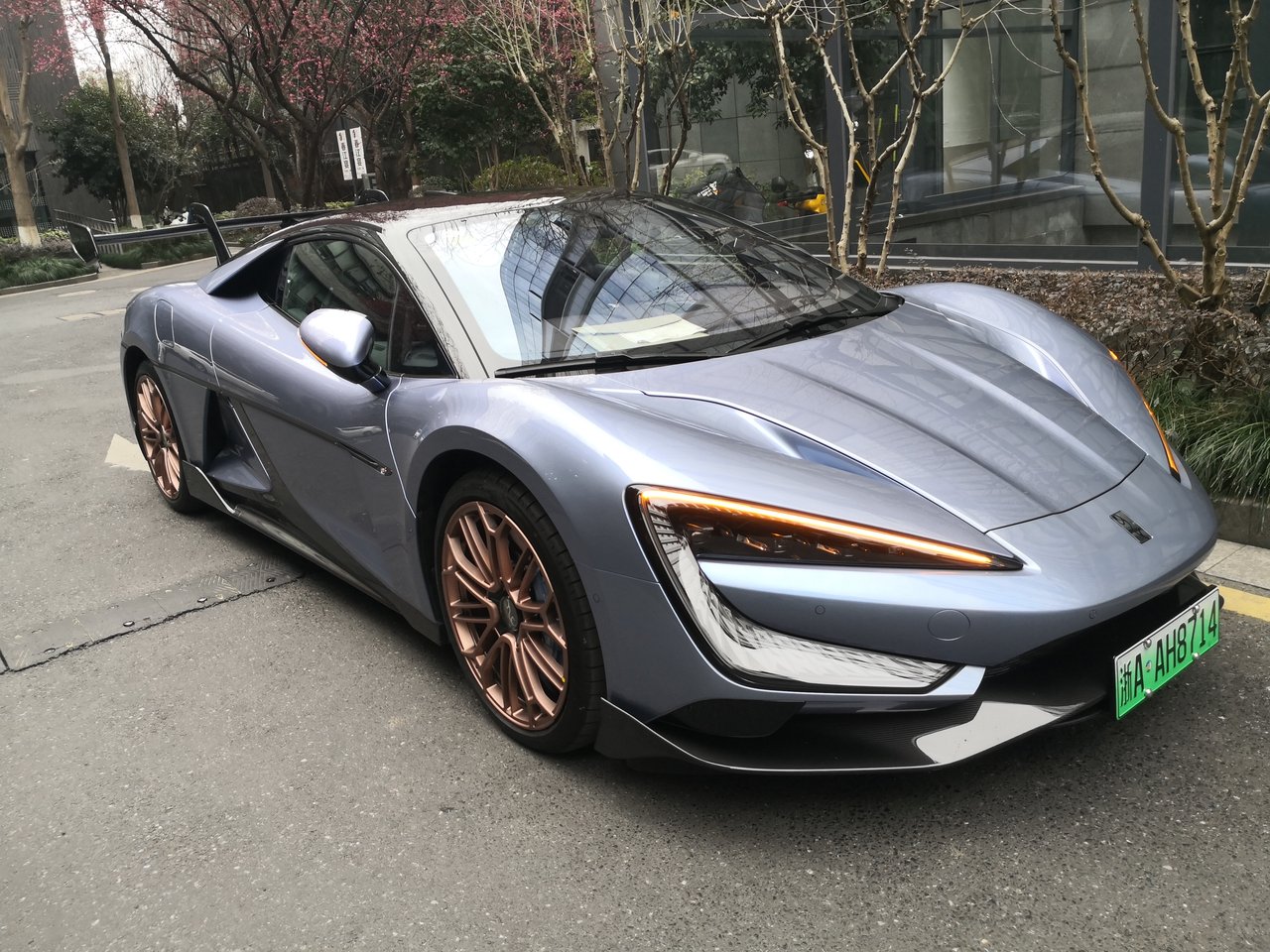
Photo via Wikimedia Commons under CC0 license.
The 1,287-Horsepower Disruption: BYD Yangwang U9
For more than seven decades, the high-performance hierarchy remained predictable. If you wanted benchmark chassis control, you looked to Weissach. If you craved powertrain theater and bespoke carbon composites, you bought ticket stubs to Maranello or Sant'Agata. That European monopoly on top-tier performance just hit a structural wall. The BYD Yangwang U9 is not a design study or a low-volume boutique kit car; it is a full-scale assault on the exotic car establishment, backed by China’s most vertically integrated industrial titan.
Priced at 1.68 million RMB (roughly $233,000 USD), the U9 targets hypercar benchmarks at a fraction of boutique European costs. Delivering 1,287 horsepower through four independent electric motors and riding on an active electro-hydraulic suspension that can literally launch the car off the pavement, the U9 signals a new reality: the bleeding edge of vehicle dynamics and software-defined powertrain calibration is no longer exclusive to Europe.
Powertrain Deep-Dive: The e4 Quad-Motor Architecture
At the mechanical core of the Yangwang U9 lies BYD’s proprietary e4 platform—known natively as YiSiFang. Rather than mounting two large electric drive units on the axles and modulating traction via draggy mechanical differentials or friction brakes, BYD packaged four independent permanent magnet synchronous motors (PMSM). Each corner motor produces 240 kW (322 hp) and 420 Nm (310 lb-ft) of torque, spinning up to an impressive 21,000 RPM. Total output registers at 960 kW (1,287 hp) and a pavement-ripping 1,680 Nm (1,239 lb-ft).
Each motor couples to its corresponding wheel via an integrated, ultra-compact single-speed reduction gearbox. Controlling these motors requires enormous electrical efficiency and computational speed. BYD implemented silicon-carbide (SiC) power electronics throughout the inverters, operating at an efficiency rating of 99.5 percent. Because each wheel operates as an independent kinematic actuator, torque distribution response times drop below five milliseconds.
In practice, mechanical torque vectoring is dead. If the front-inside wheel hits a patch of standing water during high-G lateral loading, the e4 ECU does not wait for a differential clutch pack to clamp or an open diff to route slip. It drops torque at that specific corner to zero, or briefly commands negative torque (regenerative braking), while feeding positive torque to the loaded outside rubber. This creates instantaneous yaw moments, bending the car into the apex and eliminating the low-speed push inherent to heavy, all-wheel-drive platforms. The sprint from 0 to 100 km/h evaporates in 2.36 seconds, with the standing quarter-mile dispatched in 9.78 seconds.
Chassis Kinematics: DiSus-X Active Suspension
Social media fixated on the party tricks: the U9 hopping completely off the ground, doing programmed dances, and rocking to synthesized beats. Dismissing this as marketing spectacle misses the engineering breakthrough underneath. That system is DiSus-X (YunNian-X), an 800-volt, fully active electro-hydraulic body control system operating at speeds that make conventional adaptive damping look prehistoric.
DiSus-X replaces traditional anti-roll bars with four active corner modules. Each corner integrates a high-power dual-valve hydraulic actuator tied into a central dual-motor hydraulic pump system running off the 800V bus. The system provides up to 36 kW of hydraulic lifting power, generating lift velocities of up to 500 mm/s with a total stroke adjustment range of 75 mm. Each actuator can exert more than one ton of instantaneous vertical force.
This allows complete decoupling of roll, pitch, and heave. Under maximum longitudinal braking, conventional cars rely on stiff front spring rates and aggressive anti-dive suspension geometry (angled control arm pivots) to fight forward weight transfer, which compromises bump absorption. DiSus-X simply pumps hydraulic fluid into the front actuators while scavenging from the rear, keeping the carbon tub completely level. Roll under lateral loads exceeding 1.2G is eliminated without running bone-jarring spring rates.
Crucially, DiSus-X provides high-speed redundancy. If a front tire suffers a sudden high-speed blowout, the system senses the loss of hub height and tire pressure in milliseconds. It instantly raises the suspension strut on the blown corner, stiffens the opposing diagonal damper, and redistributes vehicle weight across the three intact wheels. The U9 can safely brake and pull over at highway speeds without the naked wheel rim grinding into the pavement or dragging the front splitter.
Structural Carbon Tub and the 80 kWh Blade Battery
Containing this violence requires exceptional structural stiffness. The U9 passenger cell uses a monocoque super-carbon cabin tub developed in-house. BYD quotes a torsional rigidity of 54,425 Nm per degree. Cast aluminum front and rear subframes bolt directly to the composite tub, carrying forged aluminum double-wishbone suspension assemblies at all four corners.
Mounted flat beneath the floor is an 80 kWh Lithium Iron Phosphate (LFP) Blade Battery pack utilizing Cell-to-Body (CTB) integration. By integrating the battery pack casing as a stressed member of the lower chassis, BYD optimized torsional rigidity and vertical packaging. LFP chemistry offers inherent thermal runaway resistance compared to nickel-manganese-cobalt (NMC) chemistries, allowing prolonged high-current discharge cycles on track without immediate thermal de-rating.
The penalty is mass: the battery pack contributes significantly to the car’s substantial 2,475 kg (5,456 lb) curb weight. To offset charging bottlenecks during track outings, BYD engineered dual-gun DC ultra-fast charging. The U9 features charging ports on both rear quarter panels. Plugged into two independent fast chargers simultaneously, the vehicle draws a combined peak of 500 kW, recouping 30 to 80 percent state of charge in 10 minutes.
BYD Yangwang U9 Technical Specifications
| Parameter | Specification |
|---|---|
| Powertrain Architecture | e4 Platform: 4x Independent Permanent Magnet Synchronous Motors |
| Total System Power | 960 kW / 1,287 hp (1,306 PS) |
| Total System Torque | 1,680 Nm (1,239 lb-ft) |
| Transmission | 4x Single-Speed Independent Reduction Gearboxes |
| Acceleration (0–100 km/h) | 2.36 seconds |
| Standing 1/4 Mile | 9.78 seconds |
| Top Speed | 309 km/h (Official) / 375.12 km/h (ATP Papenburg High-Speed Test) |
| Battery Capacity & Chemistry | 80 kWh LFP Blade Battery (Cell-to-Body integration) |
| Maximum Charging Rate | 500 kW (Dual-plug simultaneous DC fast charging) |
| Chassis Construction | Carbon fiber monocoque tub with aluminum subframes |
| Suspension System | DiSus-X Intelligent Full Active Body Control (Electro-Hydraulic) |
| Brakes | Carbon-ceramic drilled rotors, 6-piston monobloc front calipers |
| Curb Weight | 2,475 kg (5,456 lbs) |
| Dimensions (L x W x H) | 4,966 mm x 2,029 mm x 1,295 mm |
| Wheelbase | 2,900 mm |
| Base Price | 1,680,000 RMB (~$233,000 USD) |
Track Dynamics: Defying Mass on the Limit
Flinging 2.5 tonnes down a technical ribbon of tarmac should reveal severe dynamic compromises, yet the U9 breaks textbook expectations. Turn-in response is immediate. The steering rack feels hyper-direct, but the real work happens at the contact patches. As you pitch the car into a fast sweeper, DiSus-X stiffens the outside struts while the e4 computers calculate slip angles and apply inverse drag on the inside wheels. The sensation is not organic analog feedback like a Porsche 911 GT3 RS; it is the feeling of absolute, computationally enforced grip.
Transitioning through chicanes, body roll is virtually zero. You brace for the delayed weight transfer typical of heavy performance EVs, but the electro-hydraulic actuators arrest lateral inertia before the body can list onto the tire sidewalls. Carbon-ceramic stoppers bite hard, complemented by regenerative braking capable of returning up to 1.2G of clean deceleration before friction pads even clamp the rotors.
The limitation remains tire heat. While the active aero package—headlined by an aggressive rear diffuser, active air vents, and an optional track-spec carbon rear wing—generates real high-speed stability, those massive 325-section rear tires work overtime to manage 1,680 Nm of torque against 2,475 kilograms. After three flat-out laps on a demanding circuit, managing tire pressures becomes the primary concern. Straight-line punch never wanes; during private high-speed testing at ATP Papenburg in Germany, an uncorked U9 recorded a verified top speed of 375.12 km/h.
Market Positioning and Rivals
The Yangwang U9 exists in an unprecedented commercial bracket. It offers power outputs matching the Rimac Nevera ($2.2 million) and Pininfarina Battista ($2.5 million), but BYD sells it for $233,000. In terms of price, its direct rivals are the Porsche Taycan Turbo GT ($230,000) and the Chevrolet Corvette ZR1 ($180,000+ est.), neither of which offer a carbon monocoque or quad-motor layout.
Ferrari’s SF90 Stradale commands more than double the price, pairs an internal combustion V8 with complex hybrid electric motors, and cannot match the digital agility of four independent drive units. The U9 launched exclusively in mainland China through dedicated Yangwang flagship showrooms, with select allocations trickling into the Middle East and European evaluation hubs as BYD studies homologation for broader global markets.
Frequently Asked Questions
Why did BYD build the suspension to make the car jump off the ground?
The "jump" function is an extreme demonstration of actuator force and reaction speed. Launching a 2.5-tonne vehicle into the air requires generating over one ton of vertical thrust per corner in less than a second. While jumping is an auto-show novelty, that same speed and high-pressure hydraulic capacity allows DiSus-X to neutralize body roll, squat, and dive instantly under racing loads, as well as clear large road obstacles at speed.
Why use an LFP Blade Battery instead of lighter NMC cells?
While Nickel-Manganese-Cobalt (NMC) cells yield superior gravimetric energy density, Lithium Iron Phosphate (LFP) provides superior thermal resilience, cycle life, and puncture safety. In a 1,287-hp performance application, repetitive high-C-rate discharge creates extreme heat. The Blade battery architecture tolerates elevated thermal thresholds without degrading, allowing continuous high-speed runs while doubling as a stiff structural chassis component via Cell-to-Body packaging.
How does the three-wheel limp-home capability function?
Conventional vehicles drag their undercarriage or spin out when a tire disintegrates because the suspension corner collapses. DiSus-X detects the blowout instantly, commands the damaged corner’s hydraulic ram to lift the hub by up to 75 mm, and increases damping resistance at the opposing rear and front struts. Simultaneously, the e4 powertrain kills drive to that wheel and redistributes torque across the remaining three corners, allowing stable braking and directional control.
The Verdict: A New Engineering Baseline
Purists will lament the curb weight, the quiet hum of electric drive units, and the lack of an analog gearbox. Those complaints miss the point. The BYD Yangwang U9 is a triumphant engineering tour de force. By deploying independent quad-motor torque vectoring, an innovative dual-plug 500 kW charging infrastructure, and a fully active 800-volt hydraulic suspension, BYD accomplished what many legacy marques declared impossible: building an ultra-fast, dynamically coherent electric supercar from a blank sheet of paper, at a price that undermines every legacy competitor.
Sources and editorial note
Specifications, performance numbers, pricing, and technical measurements in this feature are based on official manufacturer documentation, engineering releases, and certified automotive benchmarks. Real-world parameters may vary based on market specifications and testing conditions.
The featured lead image is sourced from Wikimedia Commons under Creative Commons licensing with proper attribution. Editorial reporting complies with international copyright and fair-use standards.