
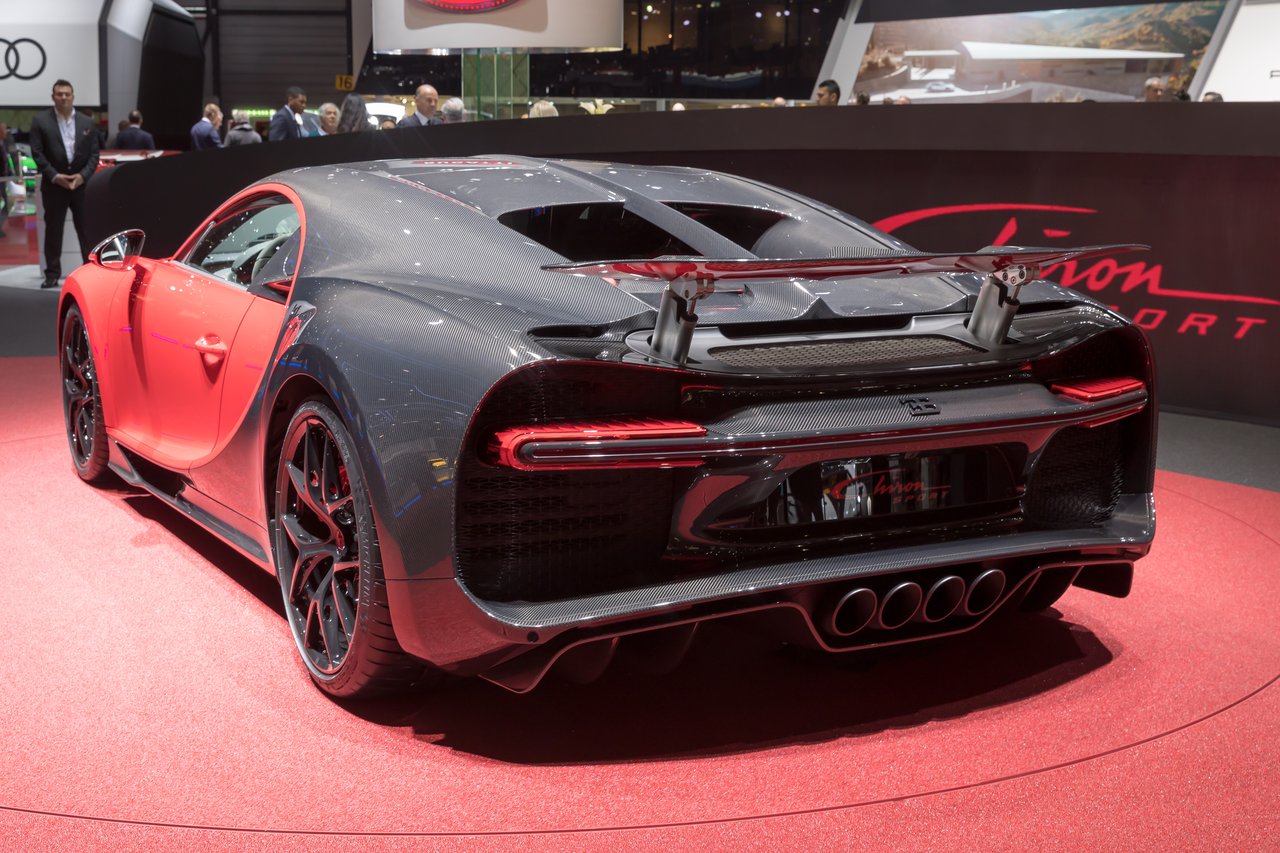
Photo via Wikimedia Commons under CC BY-SA 4.0 license.
Breaking the 300-MPH Barrier: Inside the Bugatti Chiron Super Sport 300+
Automotive history is rarely forged in increments; it is shattered in violent, physics-defying leaps. On August 2, 2019, at Volkswagen’s high-speed testing facility in Ehra-Lessien, Bugatti did the unthinkable. Veteran Le Mans winner Andy Wallace strapped himself into a heavily modified, long-tail derivative of the Chiron and punched the throttle down the facility’s 8.7-kilometer (5.4-mile) straight. When the data telemetry finally settled, the numbers read 490.484 km/h—equivalent to 304.773 mph. For the first time in the history of the automobile, a production-based hypercar had eclipsed the mythical 300-mph threshold, a milestone once thought decades away.
Yet, the aftermath of that scorching run sparked fierce debates in pit lanes and enthusiast forums worldwide. Was a one-way run a true record? Why did Bugatti eschew the traditional two-way average mandated by governing bodies? Beyond the boardroom politics and technical nuances lies a masterclass in high-speed fluid dynamics and metallurgical endurance. This is the engineering autopsy of the car that redefined the limits of terrestrial velocity.
The Powerhouse: 1,600 PS of Quad-Turbo Ferocity
At the mechanical core of the Chiron Super Sport 300+ beats Bugatti’s legendary 8.0-liter W16 engine. For this application, Molsheim’s engineers extracted an astonishing 1,600 metric horsepower (1,577 mechanical hp)—a 100-PS jump over the standard Chiron. Achieving this output without turning the engine into a hand grenade required a complete overhaul of the forced-induction architecture and thermal management systems.
The quad-turbocharger setup utilizes larger, more efficient compressor wheels. At lower revs, the sequential turbocharging system operates with two primary units spooling to eliminate lag, while the secondary pair awakens at 3,800 rpm to flood the combustion chambers with dense, intercooled air. To keep intake temperatures in check, the dual water-air intercooler system pumps 37,000 liters of coolant through the engine per hour.
Torque is rated at a monstrous 1,600 Nm (1,180 lb-ft), flat-lined from 2,000 to 7,000 rpm. Transferring this rotational force to the asphalt requires a heavily reinforced seven-speed dual-clutch transmission coupled to a permanent all-wheel-drive system. Every gear ratio and final drive component was scrutinized to handle the immense load without fracturing under the torsional strain of sustained high-speed acceleration.
Aero and Chassis: Bending the Wind at 500 km/h
Aero-drag increases exponentially once you push past 400 km/h. At 490 km/h, the air ceases to act as a gas and begins to behave like a viscous fluid, attempting to tear body panels away and flip the car over. Bugatti’s aerodynamics team, led by Frank Heyl, completely re-engineered the rear half of the Chiron to create the 'Longtail' profile.
The rear overhang was extended by approximately 25 centimeters (nearly 10 inches), allowing the boundary layer of air to attach more smoothly to the bodywork before detaching cleanly. This drastically reduces the wake turbulence and overall drag coefficient. The iconic rear wing was completely deleted, replaced by a fixed aerodynamic setup integrated directly into the rear fascia, while a heavily revised rear diffuser works in tandem with an optimized ride-height strategy to manage underbody pressure.
Equally critical were the tires. Bugatti partnered with Michelin to develop bespoke Pilot Sport Cup 2 rubber. Before leaving the factory, every single tire is individually X-rayed at high speed to detect microscopic structural imperfections. These tires were rated to withstand speeds up to 500 km/h, enduring centrifugal forces that cause the tread blocks to experience loads equivalent to thousands of times their own weight.
The One-Way Run vs. The Two-Way Ratified Record
When Bugatti announced the 304.773 mph run, purists immediately pointed out a caveat: it was a single-direction run. Guinness World Records and standard sanctioning bodies historically require a two-way average—driving down the straight in opposite directions within an hour to cancel out wind speed, gradient, and atmospheric variance.
Bugatti defended the methodology with practical pragmatism. Ehra-Lessien features a single long straight with a massive banked left-hand sweeper at either end. Entering those banking corners at speeds exceeding 400 km/h places catastrophic loads on the suspension and tires. Furthermore, running against the prevailing wind direction on a single-lane track introduced safety variables that the team deemed unnecessary once the engineering milestone was proven. While it may not hold the official Guinness crown for a two-way production average, the telemetry is undisputed: a car originating from a production line broke the 300-mph barrier.
Bugatti Chiron Super Sport 300+ Specifications
| Metric | Specification |
|---|---|
| Engine Type | 8.0-litre Quad-Turbocharged W16 |
| Maximum Power | 1,600 PS (1,577 hp) |
| Peak Torque | 1,600 Nm (1,180 lb-ft) from 2,000–7,000 rpm |
| Transmission | 7-Speed Dual-Clutch (Ricardo), AWD |
| 0–100 km/h (0–62 mph) | 2.4 seconds |
| Top Speed (Achieved) | 490.484 km/h (304.773 mph) |
| Top Speed (Customer Limit) | Electronically capped at 440 km/h (273 mph) |
| Curb Weight | Approx. 1,995 kg (4,400 lbs) |
| Production Run | 30 units worldwide |
| Base Price | €3.5 million (~$3.9 million USD) |
Global Availability and Market Positioning
Following the record-breaking run, Bugatti announced a limited production run of 30 customer cars, officially designated as the Chiron Super Sport 300+. Priced at roughly €3.5 million (approx. $3.9 million USD) before options, all 30 allocations were spoken for almost immediately among Bugatti’s elite clientele.
Aesthetically, the customer cars pay direct homage to the record-breaking prototype: exposed jet black carbon fiber bodywork cut vertically by twin racing stripes in Jet Orange, with lightweight magnesium wheels and an engine cover rendered in dark titanium. However, for liability and safety reasons, customer cars are delivered with the top speed electronically governed to 440 km/h (273 mph)—still terrifyingly fast, but leaving the ultimate 304-mph envelope exclusively to the factory-unlocked prototype.
Frequently Asked Questions
Can customer Chiron Super Sport 300+ cars actually reach 304 mph?
In theory, yes, the underlying mechanical hardware, aerodynamics, and powertrain are identical. In practice, customer cars leave the factory with a software limiter capping them at 440 km/h (273 mph). Owners wishing to unlock the full 300+ mph potential must coordinate with Bugatti technicians, who inspect the vehicle and prepare the track environment.
Why did Bugatti use Ehra-Lessien instead of Bonneville Salt Flats?
Bonneville offers vast open space, but its salt surface has high rolling resistance, low traction, and surface undulations that upset high-speed stability. Ehra-Lessien features a perfectly smooth, perfectly flat 8.7-kilometer asphalt straight with high-speed banked corners, offering ideal, repeatable safety and aerodynamic conditions.
How do the Michelin tires survive speeds near 500 km/h?
The tires are constructed with reinforced carcass plies and specialized rubber compounds designed to handle extreme thermal degradation. Every single tire produced for the Super Sport 300+ undergoes rigorous laser and X-ray testing to ensure zero structural defects before being mounted on the car.
MasEko’s Verdict
The Bugatti Chiron Super Sport 300+ is much more than a marketing exercise or a vanity project for the ultra-wealthy. It is a monument to internal combustion engineering in an era transitioning toward electrification. Pushing a heavy, luxury-laden grand tourer past 304 mph requires overcoming a wall of atmospheric physics that defeats almost everything else on wheels. Bugatti didn't just break a record on August 2, 2019; they planted a permanent flag at the absolute summit of mechanical speed.
Sources and editorial note
Specifications, performance numbers, pricing, and technical measurements in this feature are based on official manufacturer documentation, engineering releases, and certified automotive benchmarks. Real-world parameters may vary based on market specifications and testing conditions.
- https://bugatti.com/models/chiron-models/chiron-super-sport-300
- https://newsroom.bugatti.com/en/press-releases/first-bugatti-chiron-super-sport-300-ready-for-launch
The featured lead image is sourced from Wikimedia Commons under Creative Commons licensing with proper attribution. Editorial reporting complies with international copyright and fair-use standards.