
Photo via Wikimedia Commons under CC BY-SA 4.0 license.
Neue Klasse and the Soul of Munich: Previewing BMW's 1,300-Horsepower Electric Revolution
In 1962, Bayerische Motoren Werke hovered on the brink of financial collapse and an ignominious buyout by Daimler-Benz. The salvation came in the form of the original Neue Klasse—the 1500 sedan—a crisp, agile, four-door machine that single-handedly established the compact executive sports sedan blueprint. It gave birth to the 2002, laid the groundwork for the E30, and anchored BMW's identity as the purveyor of the ultimate driving machine for the next six decades.
Today, Munich stands at an equally fraught crossroads. Adapting flexible, compromise-laden combustion platforms like CLAR for battery-electric propulsion kept Munich competitive through the first phase of electrification, but the ceiling of that strategy has arrived. Enter the second Neue Klasse architecture. Arriving in 2026 with a clean-sheet 3-Series-sized sedan (internally designated NA0 and widely dubbed the i3), alongside a subsequent quad-motor electric M3 halo (ZA0), this architecture is not merely an electric compliance exercise. It is a fundamental ground-up reinvention of vehicle dynamics, energy storage, and onboard computing.
Gen6 Cylindrical Cells and 800V Architecture: The Hardware Leap
The engineering centerpiece of the Neue Klasse platform is BMW's sixth-generation eDrive technology. Munich has abandoned the prismatic cell format championed across the i4 and iX in favor of large-format cylindrical cells, mirroring the form factor popularized by Tesla but executing it with distinct structural and chemical nuances.
Developed with partners including CATL and EVE Energy, Gen6 utilizes two distinct cell heights with a uniform 46mm diameter: 4695 (95mm tall) for low-slung sedans like the i3, and 46120 (120mm tall) for higher-riding SAV crossovers like the next-generation iX3. Chemistry shifts dramatically toward higher energy density: the cathode increases nickel content while reducing cobalt, paired with a silicon-dominant anode. The result is a 20 percent increase in volumetric energy density over Gen5 prismatic units and a projected 30 percent jump in real-world range, enabling the most aerodynamic i3 configurations to surpass 800 kilometers (nearly 500 miles) on the WLTP cycle.
Crucially, Neue Klasse integrates these cells directly into the chassis using a pack-to-open-body design. Rather than slotting an isolated modular battery enclosure beneath the floorpans—which compounds mass and steals vertical cabin space—the upper cover of the battery pack serves as the vehicle floor. This structural integration raises torsional rigidity by double-digit percentages while keeping the overall vehicle profile low enough to preserve the classic 3-Series silhouette.
Charging infrastructure parity finally arrives via an 800-volt electrical architecture. Moving from 400V to 800V slashes resistance losses and allows the platform to accept sustained DC fast-charging rates exceeding 270 kW, with peak bursts touching 300 kW. On a high-output 350 kW charger, the Gen6 pack recovers 300 kilometers of range in 10 minutes flat, trimming the standard 10-to-80 percent charging window by over 30 percent compared to current BMW EVs.
"Heart of Joy": Rewiring the Digital Synapses
Modern performance vehicles typically suffer from digital bloat, utilizing dozens of distributed electronic control units (ECUs) exchanging fragmented data over congested CAN and FlexRay networks. In an aggressive dynamic maneuver, this distributed latency—sometimes measured in tens of milliseconds—creates a disjointed dialogue between steering input, brake-by-wire pressure, inverter output, and differential locking.
BMW's countermeasure is an in-house developed super-integrated domain controller codenamed Heart of Joy. This single central processing brain consolidates powertrain management, dynamic stability control, torque vectoring, and chassis kinematics into one computational hub. Running proprietary real-time algorithms with processing cycle times under one millisecond, Heart of Joy coordinates wheel torque directly at the inverter gate drivers.
Wheel slip is no longer mediated by an external ABS module clamping a rotor after traction breaks; the Heart of Joy modulates electrical current at the motor shaft before the tire carcass even finishes deflecting. The operational result is seamless slip control, near-instantaneous lateral response, and regenerative braking deceleration capable of pulling up to 0.6g without engaging the hydraulic friction pads.
The Quad-Motor M3: 1,341 Horsepower and Infinitely Variable Yaw
If the standard i3 models showcase efficiency, the upcoming electric M3 prototype is an unhinged engineering statement. BMW M's engineering division in Garching has been actively track-testing a modified widebody development mule equipped with four individual, permanently excited synchronous motors (PMSM)—one per wheel—managed by the Heart of Joy processor.
Total system potential exceeds 1,000 kW, or 1,341 brake horsepower. Because each wheel operates independently of mechanical drive axles or central differential units, the car gains access to true four-wheel torque vectoring with limitless adjustability. During turn-in on a mountain pass, the inside rear motor instantly commands regenerative braking while the outside rear motor deploys full positive torque, generating immediate, yaw-inducing mechanical rotation without dragging a brake pad.
Purists fearing the sanitized, understeering demeanor of generic all-wheel-drive EVs need not despair. BMW's dynamics engineers have baked aggressive rear-axle bias into the primary drive map. The front axle operates primarily as an auxiliary recovery and balance tool; during mid-corner throttle application, the front motors decouple entirely, allowing the driver to pivot the chassis on throttle angle alone, exactly as you would in an E46 or E92 M3.
Chassis Kinematics and the Panoramic Cockpit
Suspending this hardware is an aluminum-intensive double-wishbone front axle paired with a five-link rear configuration. BMW engineers have tuned the front steering geometry with significant positive caster trail, mechanically anchoring high-speed tracking while transmitting genuine tire-scrub loads through the variable-ratio electronic power steering rack.
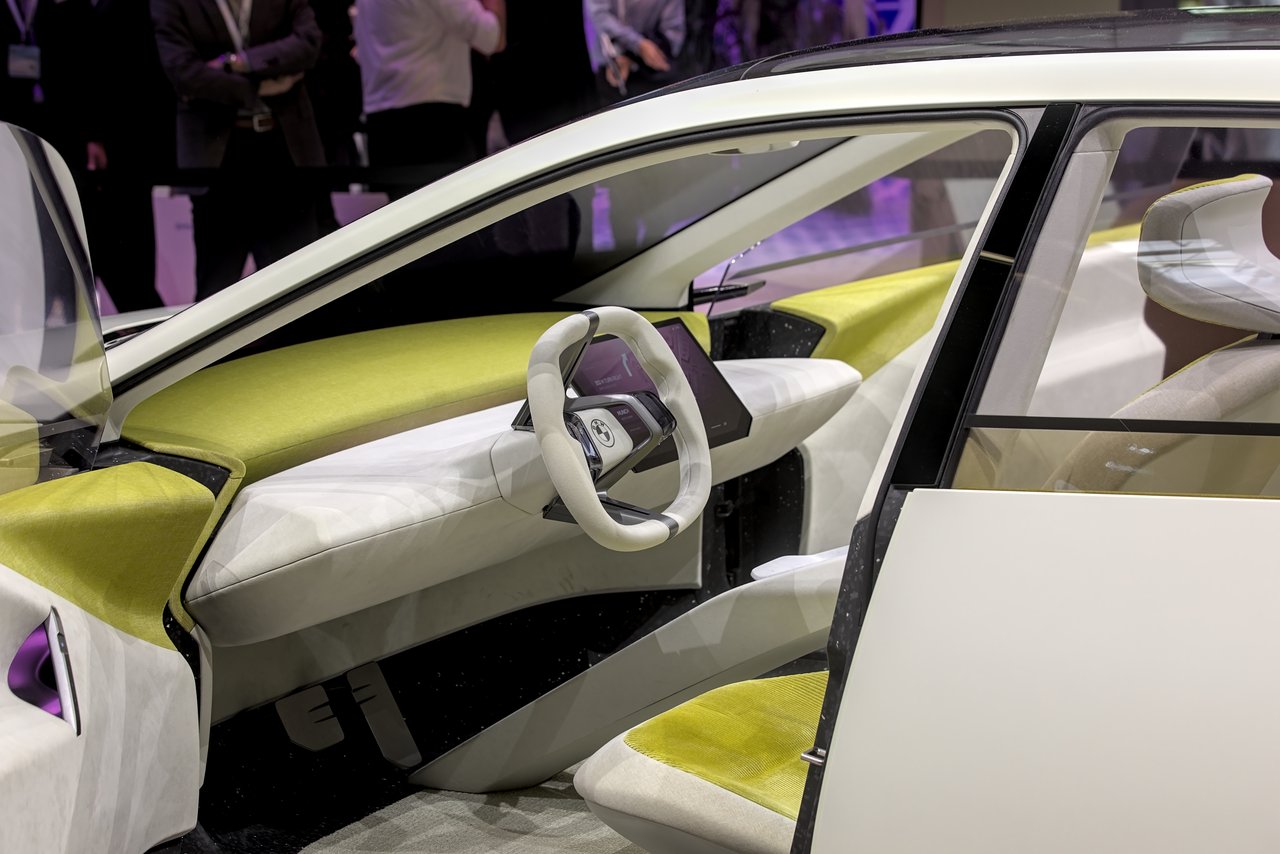
Inside, Neue Klasse eliminates the traditional gauge binnacle and oversized floating tablet clusters. The cockpit is dominated by BMW Panoramic Vision, a high-density projection system running along the entire base of the windshield from A-pillar to A-pillar. Information displays on a dark-coated lower band, focused at optical infinity so the driver's eyes never need to refocus between tarmac and instrumentation. Essential performance data sits directly in the driver's primary sightline, while infotainment and battery telemetrics shift toward the passenger side.
Technical Specifications: Neue Klasse i3 & i3 M Preview
| Parameter | BMW i3 eDrive40 (RWD) | BMW i3 M50 xDrive (AWD) | BMW i3 M Quad-Motor (Target) |
|---|---|---|---|
| Powertrain Layout | Single rear PMSM | Dual-motor (Front/Rear PMSM) | Quad-motor (Independently driven wheels) |
| Peak Power Output | 340 hp (250 kW) | 536 hp (400 kW) | 1,341 hp (1,000 kW) |
| Peak Torque | 430 Nm (317 lb-ft) | 795 Nm (586 lb-ft) | 1,400+ Nm (1,032+ lb-ft) |
| Battery Capacity (Gross/Net) | 85 kWh / 81 kWh | 105 kWh / 100 kWh | 110 kWh / 105 kWh (High-discharge) |
| Cell Chemistry / Architecture | Gen6 Cylindrical 4695 / 800V | Gen6 Cylindrical 4695 / 800V | Gen6 Cylindrical (High-C-rate) / 800V |
| 0–100 km/h (0–62 mph) | 5.2 seconds | 3.4 seconds | < 2.2 seconds |
| Top Speed | 210 km/h (130 mph) | 250 km/h (155 mph) | 300+ km/h (186+ mph) |
| Estimated Curb Weight | 1,920 kg (4,232 lbs) | 2,080 kg (4,585 lbs) | 2,150 kg (4,740 lbs) |
| Target Wheelbase / Length | 2,890 mm / 4,720 mm | 2,890 mm / 4,720 mm | 2,910 mm / 4,750 mm |
| Base Price (Estimated USD/EUR) | $56,000 / €58,000 | $72,000 / €75,000 | $125,000 / €130,000 |
Market Positioning and Global Availability
The Neue Klasse sedan launches production in late 2025 at BMW's new fossil-free Debrecen facility in Hungary, followed rapidly by production at the historic Munich home plant in 2026. Global availability will begin in the first half of 2026 for European and North American markets, with extended-wheelbase variants earmarked for Shenyang, China.
The standard i3 variants will directly challenge the Tesla Model 3 Performance and the upcoming electric Mercedes-Benz C-Class. Meanwhile, the quad-motor M3 EV enters a rarefied, hyper-technical bracket, squaring off against high-performance variants of the Porsche Taycan, the Lotus Emeya, and anticipated electric performance machinery from Audi Sport.
Frequently Asked Questions
Will this electric Neue Klasse replace the combustion 3-Series entirely?
No. BMW plans a dual-track strategy through the end of the decade. While the Neue Klasse NA0 platform underpins the fully electric i3, an updated iteration of the current CLAR architecture will continue to host hybridized turbocharged four- and six-cylinder internal combustion engines (G50 generation). Buyers can choose their powertrain without abandoning the 3-Series footprint.
Can an electric M car deliver authentic driver feedback without a mechanical gearbox?
BMW M CEO Frank van Meel has confirmed that the quad-motor M3 prototype utilizes acoustic and haptic shift simulation, similar to the system found in Hyundai's Ioniq 5 N, but paired with real physical wheel control. By manipulating motor torque down to the microsecond, the powertrain can physically mimic the power-interruption sensations, engine braking resistance, and gear-step torque profiles of an eight-speed dual-clutch transmission.
How does the structural battery design affect repairability after an accident?
Because the pack-to-open-body integration treats the battery cover as the cabin floor, structural side impacts require careful mitigation. BMW has engineered high-yield extruded aluminum side sills with dedicated crash-box zones outside the cell matrix. Moderate lateral impacts damage the sacrificial exterior rocker assemblies without deforming the cell retention enclosure, allowing structural repair without total pack replacement.
The MasEko Verdict: Engineering the Electric Driver's Car
Electrification has leveled the straight-line acceleration playing field; any mass-market dual-motor EV can run down a decade-old supercar at a stoplight. In doing so, it threatened to render BMW's traditional engineering virtues irrelevant. The Neue Klasse is Munich's answer, shifting the fight away from raw horsepower toward computational latency, chassis kinematics, and integrated packaging.
By pairing structural 4695 cylindrical cells and an ultra-fast 800V backbone with the microsecond reflexes of the Heart of Joy controller, BMW is not simply electrifying the 3-Series. It is creating a dynamic baseline where torque vectoring can out-think a mechanical limited-slip differential while slashing physical weight penalties. If the production versions validate what the development mules promise on track, the Neue Klasse will prove that the driver's car does not die with internal combustion—it merely gets faster reflexes.
Sources and editorial note
Specifications, performance numbers, pricing, and technical measurements in this feature are based on official manufacturer documentation, engineering releases, and certified automotive benchmarks. Real-world parameters may vary based on market specifications and testing conditions.
The featured lead image is sourced from Wikimedia Commons under Creative Commons licensing with proper attribution. Editorial reporting complies with international copyright and fair-use standards.