
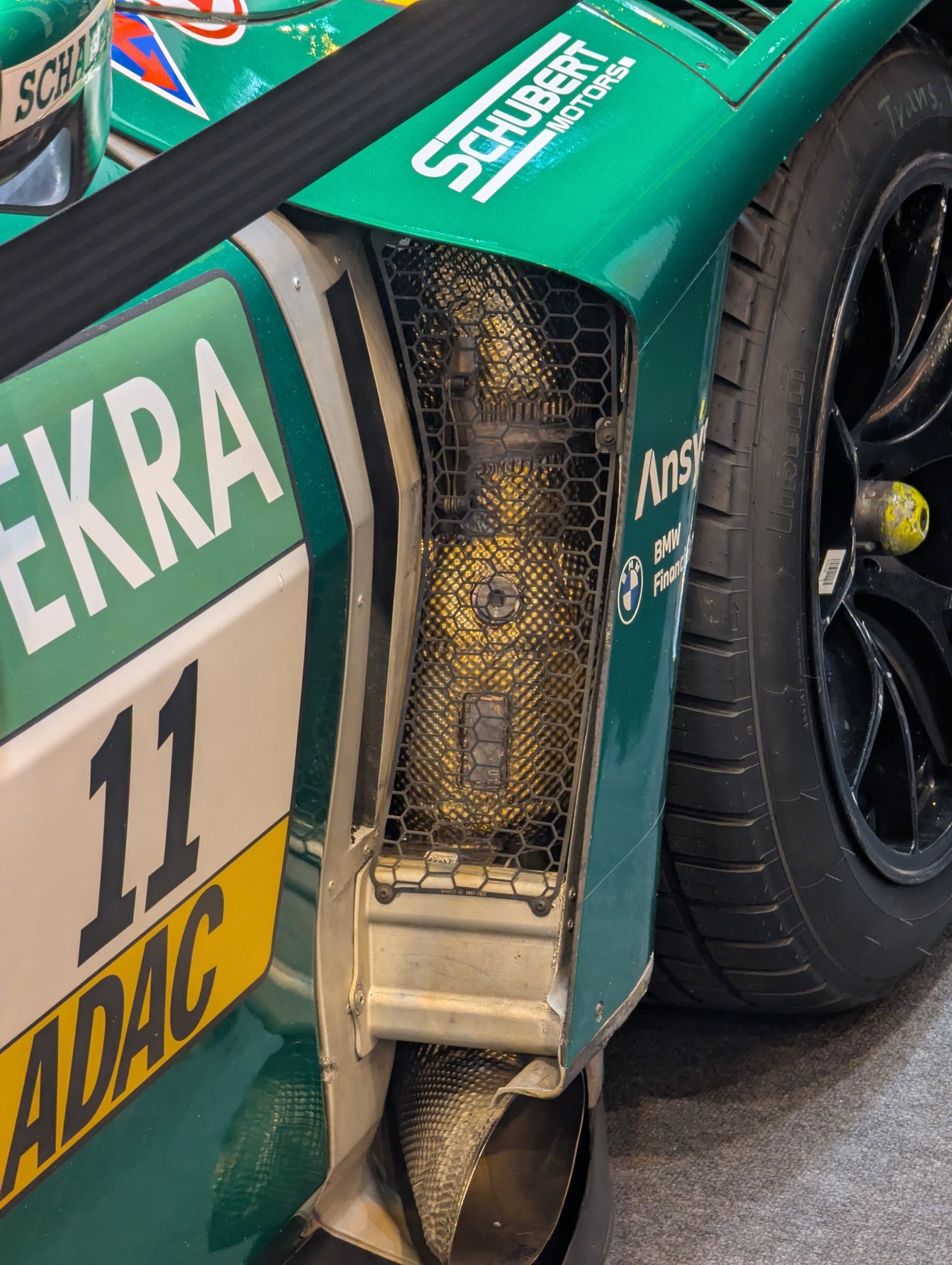
Photo via Wikimedia Commons under CC BY 4.0 license.
BMW M4 GT3 EVO: The Nürburgring's New Prescription for Customer Racing
In May 2024, BMW rolled into the Nürburgring with a machine that embodied one of motorsport's most honest truths: perfection is the enemy of progress. The M4 GT3 EVO didn't arrive to shatter lap records or rewrite the rulebook. Instead, it came to fix what worked, refine what didn't, and remind customer racing teams that sometimes the most valuable evolution isn't measured in horsepower or tenths of a second—it's measured in reliability, drivability, and the margin between finishing first and finishing broke.
Three years into the current GT3 regulation era, BMW's engineers understood their assignment: make a car that wins, sure, but make it one that teams actually want to live with across a full season. The EVO update represents that philosophy in sheet metal and suspension geometry. It's a master class in iterative refinement, and it's why the M4 GT3 EVO matters as much in the paddock as it does on the road back to the pits.
The Engine: Controlled Fury in a Familiar Package
At the heart of the M4 GT3 EVO sits a 3.0-litre twin-turbocharged straight-six that traces its bloodline directly to the road-going S58 found in the M3 and M4 Competition models. That shared parentage tells you everything about BMW's engineering philosophy: proven architecture, pushed to the absolute edge of what GT3 Balance of Performance regulations allow.
The racing version produces up to 590 horsepower and 700 Nm of torque, though teams typically run it in different configurations depending on series, circuit, and fuel specifications. The P58 engine (BMW's internal designation) uses a compact twin-scroll turbocharger architecture that minimizes lag while keeping the entire power unit compact enough to fit within the M4's existing beltline. Fuel injection is direct and metered with millisecond precision; ignition timing and boost pressure are constantly adapted by the engine control unit to maximize power delivery while protecting component longevity.
What makes this engine special isn't raw displacement or turbo size—it's the engineering maturity underneath. BMW spent years with the S58 in customer hands, gathering real-world reliability data, stress-test results, and failure-mode analysis. The racing version inherits that institutional knowledge. Oil cooling lines are optimized for sustained high-temperature running. Piston crowns are shaped to resist detonation. Valve lift and timing profiles squeeze the last drop of combustion efficiency out of every firing cycle. For customer teams running multiple rounds across Europe, Asia, and North America, that reliability translates to fewer engine grenades at critical moments and lower overhaul costs at season's end.
Transmission and Power Delivery: Sequential Precision
The M4 GT3 EVO uses a sequential six-speed gearbox purpose-built for circuit racing. Shifts happen electronically through paddle actuators, with a shift time hovering around 150 milliseconds—fast enough to keep momentum through technical sections, consistent enough to feel predictable under braking into a tight corner. The gearing is fixed once the car arrives at an event; there's no adjusting ratios on the fly, which simplifies logistics but demands thoughtful pre-event simulation and data analysis.
The differential is a limited-slip unit with adjustable locking percentage, allowing teams to dial in how aggressively the rear axle locks under acceleration. Crank the lock percentage up, and you get snappier corner-exit traction at the cost of potential understeer if the front end runs out of grip first. Back it off, and the car feels more neutral but might pivot excessively on corner entry if a driver carries too much speed. Finding that sweet spot is where the real work happens in the paddock.
Chassis Dynamics: The EVO's Core Achievement
Here's where the EVO update truly distinguishes itself from the original M4 GT3. BMW didn't chase lap time gains through more aggressive aero or stiffer springs. Instead, the engineering team focused on what actually matters to customer teams across a 24-hour endurance race or a multi-round season: consistent, predictable handling that doesn't punish mid-field driving, and brake feel that remains consistent after hours of heavy use.
The suspension geometry—double-wishbone front and rear—remains structurally unchanged, but BMW recalibrated the bump stops, anti-roll bar stiffness, and ride-height sensitivity to make the chassis more forgiving mid-corner. The steering rack was retuned to require lighter effort, reducing driver fatigue during long stints and making the car feel more agile in tight, technical layouts like Le Mans or the Nürburgring 24H. It's a subtle shift, but after eight hours behind the wheel, it's the difference between feeling sharp and feeling shattered.
The braking system received equal attention. Carbon-ceramic rotors paired with specialized racing pads and a hydraulic pressure accumulator deliver consistent pedal feel lap after lap. BMW's engineers increased the thermal mass slightly and refined the brake-fluid cooling lines to resist fade during prolonged heavy braking. Drivers report that confidence comes back faster when they know the brake pedal will feel identical on lap 200 as it did on lap 20.
Aerodynamically, the EVO introduces a recalibrated front bumper and a revised rear diffuser that work in concert to generate 1,400 kg of downforce at 300 km/h while reducing drag compared to the original M4 GT3. The goal wasn't maximum downforce—it was optimal downforce given the regulatory constraints. Less drag means better straightline speed, which means more overtaking opportunities and faster fuel efficiency. For endurance racing, that calculus matters as much as raw grip.
Specifications and Market Positioning
| Specification | Detail |
|---|---|
| Engine | 3.0L Twin-Turbo Straight-Six (P58) |
| Power Output | Up to 590 hp (depending on series BoP) |
| Torque | 700 Nm |
| Transmission | Sequential 6-Speed, Electronic Shift |
| 0–100 km/h | ~3.5 seconds (estimated) |
| Top Speed | 300+ km/h (limited by regulation) |
| Curb Weight | 1,300 kg (dry) |
| Downforce @ 300 km/h | ~1,400 kg |
| Length × Width × Height | 4,662 × 1,,990 × 1,301 mm |
| Price (ex-works) | EUR 578,000 |
| Availability | Global (from 2025 season onwards) |
Racing Heritage and Global Competition
The M4 GT3 EVO competes in an impressive array of international series. In North America, it races in IMSA GTD Pro and GTD categories, where it's proven itself consistently competitive against Porsche 911 GT3 Rs, Mercedes-AMG GT3s, and Lamborghini Huracáns. In Europe, the car dominates the Nürburgring 24 Hours, a race where reliability and drivability shift count as much as pace. The GT World Challenge series sees dozens of M4 GT3 EVOs competing simultaneously, creating a fiercely competitive customer-racing environment.
Perhaps most tellingly, the EVO earned a spot in the FIA World Endurance Championship's new LMGT3 category, racing alongside Ferrari, Porsche, and Lamborghini at Le Mans and other legendary venues. That validation—acceptance into motorsport's most prestigious endurance platform—speaks volumes about the car's engineering credibility and BMW's commitment to the customer racing market.
Real-World Ownership and Servicing
At EUR 578,000, the M4 GT3 EVO represents a substantial capital commitment. BMW's pitch to customer teams emphasizes total cost of ownership, not just purchase price. Scheduled maintenance intervals are extended compared to earlier GT3 regulations. Common wear items like brake pads, tire sets, and oil filters benefit from BMW's scale and supply-chain logistics. Engine rebuild costs are lower because the P58 shares common components with road-car S58s, meaning spare parts inventory is more predictable and less expensive.
Teams also benefit from BMW Motorsport's technical support network, which extends across Europe, North America, and Asia. Dedicated factory engineers can analyze on-board telemetry remotely, diagnose setup issues via video conference, and dispatch spare components to major events. For independent teams competing across multiple series and continents, that infrastructure translates to fewer dnfs and more consistent results.
Competitive Landscape: How the EVO Stacks Up
The GT3 market is crowded. Porsche's 911 GT3 R remains the segment's default choice, with more entries across global series than any rival. Mercedes-AMG's GT3 offers European teams a compelling alternative with similar performance and arguably better serviceability in Europe. The Lamborghini Huracán GT3 EVO2 brings exotic appeal and competitive pace. Ferrari's 296 GT3 is newer and aggressively competitive in balance-of-performance terms.
Where the M4 GT3 EVO carves its niche is the intersection of competitive pace, engineering maturity, and operational practicality. It's not the fastest—BoP regulations prevent that. It's not the cheapest. But it offers the most predictable experience across a full season, with fewer surprises, lower risk of catastrophic failure, and the strongest factory support infrastructure. For customer team principals weighing risk versus reward, that calculation increasingly favors BMW.
Frequently Asked Questions
Q: How does the M4 GT3 EVO's lap time compare to the original M4 GT3?
A: Under current Balance of Performance regulations, BoP weights and fuel-flow restrictions mean both cars produce similar outright pace. The EVO's advantage lies in consistency and drivability across varying track conditions and fuel levels. Drivers typically report that the EVO feels easier to drive quickly without sacrificing speed—a critical advantage during grueling endurance events where fatigue influences performance.
Q: Can I upgrade an older M4 GT3 to EVO specification?
A: BMW offers a comprehensive upgrade package covering the new aero, suspension geometry, steering calibration, and brake system refinements. The cost varies depending on the starting point, but most teams find it economically sensible to retrofit existing cars rather than purchasing new examples. Contact BMW Motorsport for details specific to your region and series.
Q: What fuel does the M4 GT3 EVO require, and how does consumption compare to rivals?
A: The EVO runs on racing gasoline meeting FIA F1 or GT fuel specifications—typically 98-octane with specific detergent packages. Fuel consumption averages around 1.8–2.1 km/liter depending on driving style, circuit layout, and turbo boost settings. The recalibrated aerodynamics slightly improve efficiency compared to the original M4 GT3, though performance differentials between rivals are minimal thanks to BoP regulations that constrain fuel flow across the grid.
Q: Is the M4 GT3 EVO easier for amateur drivers to manage than professional-spec GT3 cars?
A: Absolutely. The lighter steering, more forgiving suspension character, and consistent brake feel were specifically tuned for driver comfort across various skill levels. Amateur and professional drivers both praise the EVO's predictability and confidence-inspiring traits. It's one of the most accessible high-performance GT3 cars to drive quickly without requiring superhuman inputs or bravery.
Verdict: Motorsport Evolution Done Right
The BMW M4 GT3 EVO isn't a revolutionary car—it's an evolutionary one, and that's precisely the point. In an era where knee-jerk performance metrics often overshadow genuine engineering maturity, BMW's decision to prioritize drivability, reliability, and cost of ownership over raw lap-time gains feels almost contrarian. Yet it's the mark of engineers who truly understand what customer teams need.
The EVO excels because it solves real problems: driver fatigue, brake fade, costly servicing, and the anxiety of mechanical failure during critical moments. These are the unsexy realities that define customer racing, and BMW's willingness to address them head-on demonstrates a deep understanding of the business and passion that drives the paddock.
From the Nürburgring's notorious Green Hell to Le Mans' Mulsanne straightaway, from IMSA's North American circuits to GT World Challenge's European venues, the M4 GT3 EVO will race. It'll win some, lose some, and accumulate miles of genuine competition data. And in doing so, it'll prove that sometimes the most valuable engineering achievement isn't measured in horsepower—it's measured in reliability, driver confidence, and the simple pleasure of a car that works the way you'd hoped it would.
Sources and editorial note
Specifications, performance numbers, pricing, and technical measurements in this feature are based on official manufacturer documentation, engineering releases, and certified automotive benchmarks. Real-world parameters may vary based on market specifications and testing conditions.
- https://www.bmw-m.com/en/fastlane/motorsport/race-cars/bmw-m4-gt3-evo.html
- https://www.press.bmwgroup.com/global/article/detail/T0442652EN/presentation-of-the-bmw-m4-gt3-evo-at-the-nuerburgring:-bmw-m-motorsport-makes-the-successful-model-even-better?language=en
The featured lead image is sourced from Wikimedia Commons under Creative Commons licensing with proper attribution. Editorial reporting complies with international copyright and fair-use standards.