
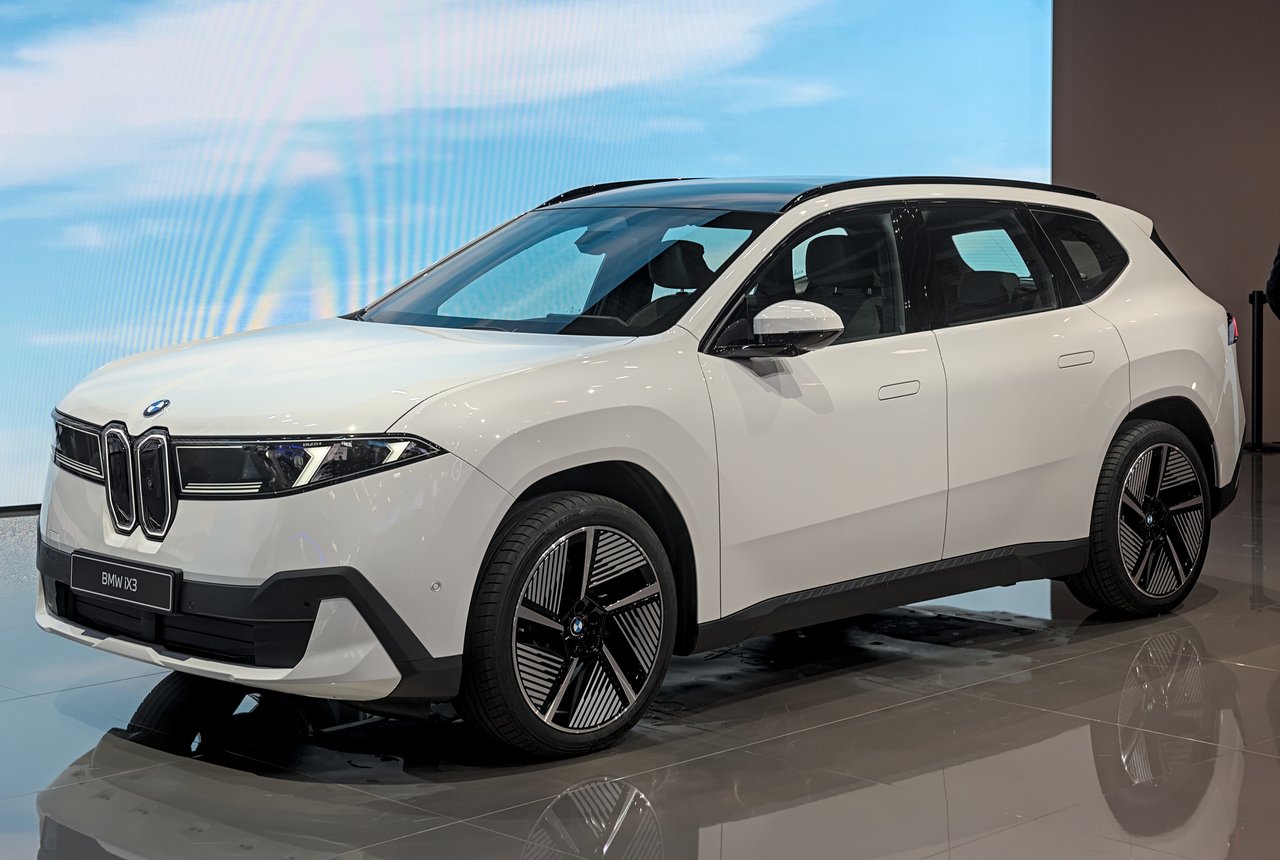
Photo via Wikimedia Commons under CC BY-SA 4.0 license.
BMW iX3 (2026): The Neue Klasse Revolution Starts Here
There are moments in automotive history when a company draws a hard line in the sand — not with a concept car destined for a museum, but with a real, buyable machine that redefines what they stand for. The 2026 BMW iX3 is exactly that. This is not a rebadged combustion platform squeezed into battery-electric service, nor is it an incremental refresh of the outgoing iX3 that never quite set enthusiast hearts racing. This is ground zero for BMW's Neue Klasse: a purpose-built EV architecture conceived from a blank sheet, carrying 800-volt electrical muscle, charging speeds that sound like fiction, and a powertrain philosophy that only a company obsessed with driving dynamics could have engineered. The stakes are enormous. BMW has bet its next decade on this platform, and the iX3 is where that bet lands first.
The Neue Klasse Platform: Architecture as Ambition
Understanding the iX3 means understanding what Neue Klasse actually is — and it is considerably more than marketing vocabulary. BMW's engineers have rebuilt the fundamental geometry of the car around the battery, not the other way around. The prismatic lithium iron phosphate and nickel manganese cobalt cells are integrated structurally into the floor, contributing to torsional rigidity rather than simply occupying space. The result is a chassis that sits lower, wider, and stiffer than anything the old CLAR platform could have produced in EV form.
The headline electrical specification is the 800-volt architecture, which is no longer the exclusive preserve of Porsche and Hyundai's premium offerings. Running at twice the voltage of most competitors means the iX3 can safely push enormous current through its charging cables without generating destructive heat. The real-world payoff: 400 kW DC peak charging capability. BMW claims this translates to 231 miles of WLTP range recovered in just ten minutes of charging. Plug it into an appropriately powerful charger — increasingly available along European motorway corridors — and coffee-stop recharging becomes genuinely practical rather than a hopeful aspiration.
The usable battery capacity stands at 108.7 kWh, which is a substantial number. But BMW's engineers have been as focused on energy density and thermal management efficiency as on raw capacity. The cell-to-pack integration reduces weight penalties, while the sixth-generation eDrive thermal architecture uses predictive navigation-linked preconditioning to ensure the battery arrives at a charging stop already within its optimal temperature window.
Powertrain Deep-Dive: Two Motors, One Purpose
BMW offers the iX3 in two powertrain configurations, and the engineering distinction between them is meaningful rather than merely commercial.
The iX3 40 uses a single rear-mounted motor — an electrically excited synchronous unit — driving the rear axle alone. Rear-wheel drive purists will appreciate the logic immediately. With no front motor complicating the weight distribution or adding mechanical complexity, the iX3 40 delivers up to 395 miles of WLTP range, exploiting the full battery capacity with maximum efficiency. Power output sits at a competitive level for the segment, making it the rational long-distance cruiser of the range.
The iX3 50 xDrive is where BMW's powertrain ambition reaches its full expression. The rear axle retains the electrically excited synchronous motor — a design that allows the field excitation to be precisely varied electronically, enabling the motor to operate at peak efficiency across a much wider RPM band than a conventional permanent magnet unit. At the front, BMW fits an asynchronous induction motor, which contributes meaningfully to all-wheel-drive traction but can be decoupled and made nearly lossless during steady-state cruising, protecting range. Combined system output: 463 hp (345 kW). Maximum WLTP range: 500 miles (805 km) — a figure that genuinely challenges range anxiety as a concept rather than merely managing it. The 0-100 km/h sprint falls in the low four-second bracket, quick enough to embarrass most combustion SUVs at a traffic light, though BMW has wisely focused on real-world usability over drag-strip bragging rights.
Chassis, Suspension and Dynamics
BMW has re-engineered the suspension geometry from first principles for Neue Klasse. The front axle uses a double-wishbone arrangement — a departure from the MacPherson struts that cost-cutting had imposed on many recent BMW models — which allows superior camber control under cornering loads and better NVH isolation simultaneously. At the rear, a multi-link setup manages the considerable torque of the electric motors while maintaining the progressive, adjustable handling balance that BMW's chassis engineers consider non-negotiable.
The standard fitment of adaptive dampers means the iX3 can compress its dual personality effectively: compliant and quiet on the motorway, noticeably alert and body-motion-controlled when a mountain road presents itself. Steering is electrically assisted but BMW has recalibrated the system specifically for the Neue Klasse platform, prioritising weight progression and on-centre accuracy over the light, disconnected feel that blighted some earlier electric BMWs. Early drive impressions suggest the iX3 50 xDrive in particular rewards a committed driver — the xDrive system can distribute torque with enough intelligence to produce genuinely adjustable handling characteristics rather than simply switching to understeer the moment grip reduces.
Braking is handled by a blended regenerative and hydraulic system, with regen strong enough for largely one-pedal operation in urban environments. BMW has tuned the transition between regenerative and friction braking to be imperceptible during normal driving — a detail that sounds minor until you spend a week in an EV that gets it wrong.
Specifications
| Specification | iX3 40 | iX3 50 xDrive |
|---|---|---|
| Battery (usable) | 108.7 kWh | 108.7 kWh |
| Architecture | 800V | 800V |
| Drive | Rear-wheel drive | All-wheel drive (xDrive) |
| Motors | 1x rear synchronous | Rear synchronous + front asynchronous |
| Combined Power | ~286 hp (est.) | 463 hp (345 kW) |
| 0–100 km/h | ~6.5 sec (est.) | ~4.2 sec |
| WLTP Range | Up to 395 miles (636 km) | Up to 500 miles (805 km) |
| Peak DC Charging | 400 kW | 400 kW |
| 10-min charge gain | Up to 231 miles | Up to 231 miles |
| UK Price | From £53,250 | From £58,755 |
| US Price (2027 MY) | N/A | $61,500 + $1,350 destination |
| US Sales Start | — | September 2026 |
| Production Plant | BMW Group Plant Debrecen, Hungary | |
| Lifecycle CO2e vs predecessor | >30% reduction | |
Market Positioning and Key Rivals
The iX3 occupies premium mid-size electric SUV territory — a segment that has become intensely competitive but remains financially lucrative. Its most direct confrontations are with the Mercedes EQC successor, the refreshed Audi Q6 e-tron, and from outside the German establishment, the Volvo EX90 and Genesis GV70 EV. Against these, the iX3 distinguishes itself through the genuine 800-volt charging infrastructure advantage, the exceptional WLTP range figures — particularly the 50 xDrive's 500-mile claim — and the depth of dynamic capability that the Neue Klasse platform enables.
The iX3 40's £53,250 UK entry point positions it competitively against the Audi Q6 e-tron quattro but undercuts the Mercedes equivalent. In the US market, the $61,500 iX3 50 xDrive pitches directly at the Model Y Performance while offering considerably more interior sophistication and brand heritage. BMW's decision to build the iX3 at Plant Debrecen — its newest and most carbon-efficient manufacturing facility — also supports the lifecycle CO2 claim, which increasingly matters to fleet and corporate buyers operating under ESG reporting obligations.
Sustainability and Production
BMW's assertion of more than 30% lower lifecycle CO2e compared to the outgoing iX3 is not simply a product of switching from a combustion-derived platform. Plant Debrecen has been designed from the ground up for carbon-neutral manufacturing, running on renewable energy and integrating circular economy principles into its supply chain. The Neue Klasse battery chemistry choices — balancing LFP and NMC cell types across the range — reflect both cost management and a deliberate effort to reduce cobalt dependency. For a buyer weighing the true environmental credentials of their purchase, the iX3 makes a compelling and substantiated case.
Frequently Asked Questions
Does the 800V system require specialist charging infrastructure, or will standard public chargers work?
The iX3 is fully backward-compatible with existing 400V CCS charging networks through an integrated voltage conversion system. The 400 kW peak charging speed requires a capable ultra-rapid charger — such as those being rolled out across European motorway networks and in US urban corridors — but on a standard 150 kW station the iX3 will still charge faster than most competitors, simply not at its theoretical maximum. For home charging via a three-phase 11 kW AC wallbox, a full charge from near-empty takes approximately 11–12 hours overnight.
Is the 500-mile WLTP range figure achievable in real-world driving?
WLTP figures are genuinely more representative than the old NEDC cycle, but real-world range will vary with speed, temperature, load, and driving style. At sustained motorway speeds in cool European winter conditions, expect a realistic figure closer to 380–420 miles for the 50 xDrive. In mixed urban and suburban driving at moderate speeds, matching or approaching the official figure is plausible. The key point is that even with a 20% discount applied, this car eliminates meaningful range anxiety for the vast majority of journeys.
How does the iX3's driving character compare to a combustion-powered BMW X3?
The Neue Klasse platform's lower centre of gravity — a direct consequence of the floor-integrated battery — gives the iX3 a handling composure the combustion X3 cannot match at equivalent ride heights. The steering and chassis tuning retain BMW's characteristic rear-biased dynamic balance, particularly on the 40 variant. What the iX3 gains in cornering composure it trades, inevitably, in the tactile engine feedback and exhaust note that define the combustion driving experience. Whether that trade represents progress or loss depends entirely on what you value most.
Sources and editorial note
Specifications, performance numbers, pricing, and technical measurements in this feature are based on official manufacturer documentation, engineering releases, and certified automotive benchmarks. Real-world parameters may vary based on market specifications and testing conditions.
- https://www.press.bmwgroup.com/united-kingdom/article/detail/T0452406EN_GB/the-start-of-a-new-era-the-new-bmw-ix3?language=en_GB
- https://www.press.bmwgroup.com/usa/article/detail/T0457571EN_US/bmw-officially-announces-pricing-and-range-for-2027-bmw-ix3-50-xdrive?language=en_US
- https://www.bmwusa.com/vehicles/x-series/ix3/bmw-ix3.html
The featured lead image is sourced from Wikimedia Commons under Creative Commons licensing with proper attribution. Editorial reporting complies with international copyright and fair-use standards.