
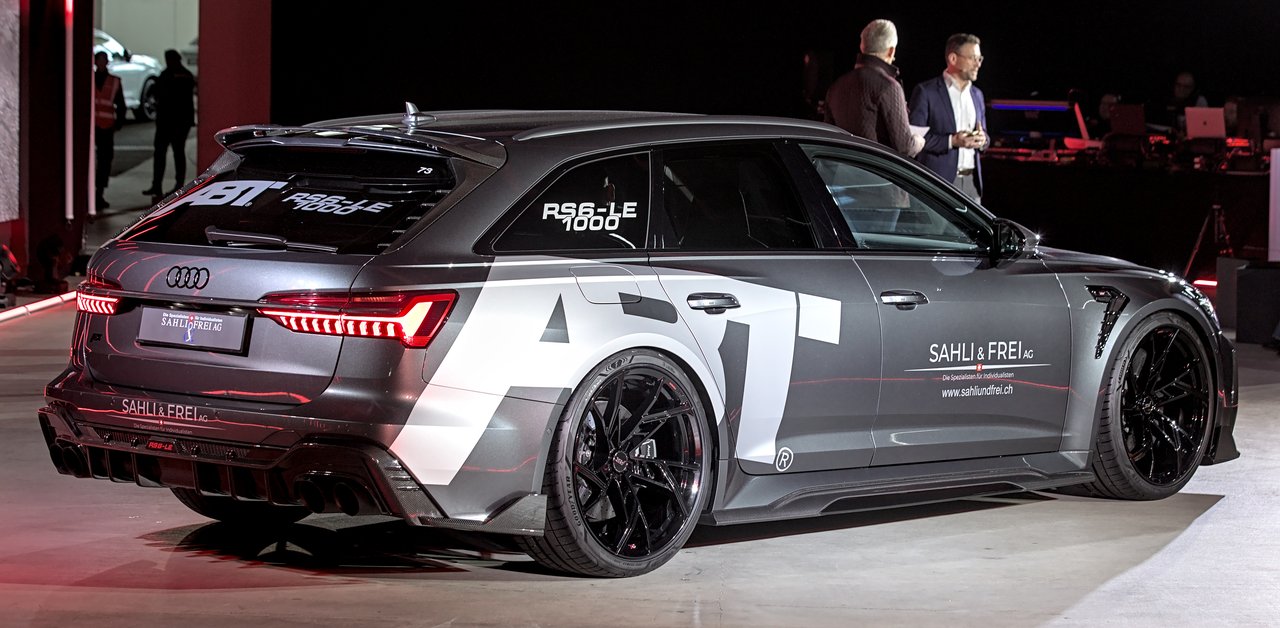
Photo via Wikimedia Commons under CC BY-SA 4.0 license.
The Apex Predator of the Long-Roof Breed
Thirty-five years ago, Audi unleashed the 90 quattro IMSA GTO on North American circuits. With Hans-Joachim Stuck wrestling its massive gear lever and Hurley Haywood carving lines through sports car fields, that 720-horsepower, turbo-five silhouette monster shattered orthodox beliefs about all-wheel-drive racing dynamics. Today, as performance road cars stand on the precipice of wholesale electrification and heavy plug-in hybrid architectures, Audi Sport’s skunkworks team at Neckarsulm has issued an uncompromising parting salute: the 2025 Audi RS6 Avant GT.
Limited strictly to 660 units worldwide, the GT is not merely an RS6 Performance wearing a nostalgic graphic package. It is the direct production manifestation of the wild RS6 GTO concept penned by apprentices in 2020. More importantly, it represents a mechanical and aerodynamic purge of executive-sedan compromises. By stripping away acoustic insulation, deleting standard roof rails, executing radical weight reductions through hand-laid carbon fiber, and installing track-tuned, manually adjustable coilover suspension, Audi has built the most focused, visceral iteration of the fast wagon ever conceived.
Carbon Architecture and Aerodynamic Kinematics
Wagons inherently suffer from a high center of gravity compared to their mid-engine cousins, primarily due to the mass of sheet metal, sound deadening, and glass cantilevered over the rear axle. Audi Sport’s engineers attacked this dynamic drawback using motorsport-grade carbon-fiber-reinforced polymer (CFRP).
For the first time on an RS6, the hood is fashioned entirely from carbon fiber, finished with visible naked-carbon extractors that evacuate high-pressure air from the engine bay. The front fenders are also sculpted entirely from CFRP. Integrated behind the front wheels are functional aerodynamic air extractors—direct design homages to the 1989 IMSA GTO—that bleed off turbulent, high-pressure air swirling within the wheel arches. This cut-out reduces front-axle lift at high speed while lowering drag through the wheelhouses.
Look higher, and the engineering commitment deepens. The RS6 GT features a full carbon-fiber roof, eliminating significant mass from the car's highest polar moment of inertia. Audi took the rare styling and aerodynamic step of completely deleting the utilitarian roof rails, smoothing laminar flow across the glasshouse toward a massive, twin-element, pass-through rear wing. Working in conjunction with an aggressive, wind-tunnel-honed rear diffuser, the GT’s aero balance shifts rearward, generating usable high-speed stability without adding parasitic parasitic drag.
Powertrain Deep-Dive: EA825 V8's Unbridled Finale
Nestled deep in the nose sits the final, non-hybridized iteration of the EA825 4.0-liter twin-turbocharged 90-degree V8. While lesser variants make do with muted calibrations, the GT matches the ferocious output of the RS6 Performance: 621 horsepower (630 PS) at 6,000 rpm and an earth-moving 850 Nm (627 lb-ft) of torque sustained across a wide shelf from 2,300 to 4,500 rpm.
To produce this muscle, twin dual-scroll turbochargers sit squarely inside the "hot V" between cylinder banks, shortening exhaust gas runner paths to millisecond throttle responses. Absolute boost pressure is ramped up to 2.6 bar. Audi retained the lightweight 48-volt mild-hybrid subsystem, not for zero-emissions propulsion, but to operate the high-draw active systems and fire up the internal combustion engine instantly during coasting phases.
Mated to the V8 is a quickened eight-speed tiptronic torque-converter automatic transmission. Shift maps in Dynamic mode have been rewritten with raised line pressures for crisp, hard-edged gear engagement that rattles through the cabin with genuine motorsport urgency. Power reaches all four wheels through a purely mechanical, self-locking center differential set at a default 40:60 front-to-rear torque split. When slip is detected, up to 70 percent of drive can route forward, or up to 85 percent directly to the rear axle.
Crucially, Audi eliminated 8 kilograms (17.6 pounds) of sound-deadening material between the passenger cell, engine bulkhead, and rear luggage compartment. The result is visceral: induction whoosh, twin-turbo spool, and the unadulterated growl of the RS titanium sport exhaust fill the cabin under full throttle.
Chassis Kinematics: Ditching Air for Coilovers
The standard RS6 Avant leans heavily on dual-chamber adaptive air suspension or hydraulically cross-linked Dynamic Ride Control (DRC) dampers to balance highway comfort with flat cornering. The RS6 GT discards both in favor of something purer: a bespoke, manually adjustable coilover suspension system with twin-tube dampers and progressive-rate steel coil springs.
This chassis setup drops the static ride height by 10 millimeters compared to an RS6 Performance. More critically, the spring rates are drastically altered: spring stiffness is dialed up by 30 percent at the front and a massive 80 percent at the rear axle. By substantially stiffening the rear roll resistance, Audi's chassis engineers have neutralized the stubborn entry understeer that has historically defined high-output, front-heavy quattro machinery.
The three-way adjustable dampers allow owners to independently dial in rebound and low/high-speed compression damping using a dedicated toolkit included in the trunk. The roll-center height is optimized, while stiffer stabilizer bars reduce body roll angles under maximal lateral loading.
Further refining dynamic agility, the electronically controlled quattro sport differential on the rear axle receives an exclusive calibration. In Dynamic mode, the software acts proactively rather than reactively, overdrive-clamping the outside rear wheel the split-second the driver initiates turn-in. This induces a clear, controllable yaw-rate gain that tucks the nose violently toward the apex, turning what was once a heavy long-roof cruiser into an agile, throttle-steerable weapon.
Technical Specifications
| Specification | Technical Data |
|---|---|
| Engine | 4.0-liter (3,996 cc) 90° Twin-Turbocharged TFSI V8 |
| Valvetrain | DOHC, 32 valves, variable valve timing and lift |
| Maximum Power | 621 hp (630 PS / 463 kW) @ 6,000 rpm |
| Peak Torque | 850 Nm (627 lb-ft) @ 2,300–4,500 rpm |
| Transmission | 8-speed tiptronic automatic with paddle shift |
| Drivetrain | Permanent quattro AWD with mechanical center diff & sport rear diff |
| 0–100 km/h (0–62 mph) | 3.3 seconds |
| 0–200 km/h (0–124 mph) | 11.5 seconds |
| Top Speed | 305 km/h (190 mph) electronically limited |
| Curb Weight (DIN) | 2,075 kg (4,575 lbs) |
| Suspension | Manually adjustable coilovers (-10mm), triple-adjustable damping |
| Brakes (Front / Rear) | Ceramic discs: 440 mm front (10-piston calipers) / 370 mm rear |
| Tires / Wheels | 285/30 R22 Continental SportContact 7 on 22-inch forged alloys |
| Base Price (Germany / US) | €219,355 / ~$220,000 USD (est.) |
Dynamics on the Blacktop: Killing the Understeer Ghost
Throw the RS6 GT into a tight, off-camber third-gear sweeper, and the mechanical metamorphosis is instantly apparent. Through the Continental SportContact 7 rubber, front-end bite is shockingly positive. Where standard RS wagons lean onto their outer front tire and rely on stability control to trim wide trajectories, the GT stays dead-flat, the front axle keyed into the pavement.
The steering rack, though electromechanically assisted, communicates clear tire slip angles because the compliance bushings have been hardened and the manual coilovers do not mask chassis frequency responses. Mid-corner bumps are absorbed with singular, instantaneous damping cycles. There is no second harmonic float; the chassis settles instantly.
Unwind the wheel, pin the throttle past the apex, and the rear differential proves its worth. Torque surges to the rear axle, kicking the tail into a precise, slight slip angle that points the nose down the straightaway. It is not an unwieldy drift machine, but an exceptionally sharp, rear-biased trajectory weapon capable of humiliating mid-engine supercars on damp, technical roads.
Global Allocations, Production, and Rivals
Of the 660 units entering production, 85 examples are earmarked for the United States, with 7 heading to Canada and the rest distributed across Europe, the Middle East, and Asia. Unlike the standard RS6, which rolls down the high-volume Neckarsulm line, final assembly of each GT takes place at Böllinger Höfe—the low-volume facility where the Audi R8 supercar and e-tron GT are hand-finished. Each car requires an entire day of specialized assembly by a dedicated team of seven master technicians, who fit the carbon panels and calibrate the manual coilovers by hand.
Buyers can choose the iconic heritage livery inspired by the 1989 IMSA GTO—featuring Arkona White paint paired with black, gray, and red graphics over heritage-style white 22-inch 6-spoke wheels—or a subtle, monochromatic scheme with exposed carbon elements.
In terms of competitive landscape, the RS6 GT occupies rare ground. The BMW M5 Touring (G99) has transitioned to a heavy plug-in hybrid architecture tipping the scales near 2.5 tons. Mercedes-AMG has retired the cross-plane twin-turbo V8 E 63 S Wagon. The Porsche Panamera Turbo S E-Hybrid Sport Turismo has exited production entirely. The RS6 Avant GT stands virtually alone as the final pure, non-hybrid V8 super estate of the old guard.
Enthusiast FAQ
Why did Audi select manual coilovers instead of adaptive air suspension or DRC?
Adaptive air systems and Dynamic Ride Control are inherently compromised by the requirement to offer plush cruising compliance. By engineering bespoke manual coilovers, Audi gained fixed, ultra-rigid spring rates (+80 percent stiffer out back) and dedicated damping curves. This completely eradicated vertical body float, increased suspension reaction speed, shaved unsprung mass, and allowed drivers to dial in corner-weighting and damping characteristics for specific racing circuits.
Can the RS6 Avant GT fully disengage the front axle for a rear-wheel-drive drift mode?
No. Audi Sport purposefully rejected a gimmicky front-axle disconnect system like BMW’s M xDrive or Mercedes-AMG’s 4MATIC+ Drift Mode. The GT remains true to traditional quattro mechanical philosophy, retaining the self-locking crown-gear center differential. Rear bias is achieved dynamically through the reprogrammed quattro sport differential, which aggressively overdrives the outside rear wheel to allow deliberate, controllable oversteer while maintaining massive all-wheel traction.
Are the aerodynamic modifications functional or primarily cosmetic?
Every exterior modification on the GT serves an aerodynamic function. The carbon-fiber front fender vents actively purge trapped turbulent air from the wheel wells, dramatically cutting front-end aerodynamic lift. The roof-rail delete smooths airflow across the car's upper surface, and the dual-element pass-through rear wing combines with the underfloor diffuser to produce measured rear downforce at triple-digit speeds.
The Verdict: An Engineering Masterpiece Sent to Pasture
The Audi RS6 Avant GT is not a calculated marketing exercise; it is an unapologetic, mechanically authentic masterwork created by engineers who knew the clock was running out. By stripping weight from the highest coordinates of the car, rejecting adaptive electronic suspension nannies in favor of mechanical coilovers, and unleashing the EA825 twin-turbo V8 without hybrid ballast, Audi has built the definitive fast wagon of the internal combustion era.
As regulations enforce heavy electrification, the RS6 GT remains an intoxicating snapshot of mechanical engineering at its absolute pinnacle: brutal, communicative, blindingly fast, and devastatingly capable.
Sources and editorial note
Specifications, performance numbers, pricing, and technical measurements in this feature are based on official manufacturer documentation, engineering releases, and certified automotive benchmarks. Real-world parameters may vary based on market specifications and testing conditions.
The featured lead image is sourced from Wikimedia Commons under Creative Commons licensing with proper attribution. Editorial reporting complies with international copyright and fair-use standards.