
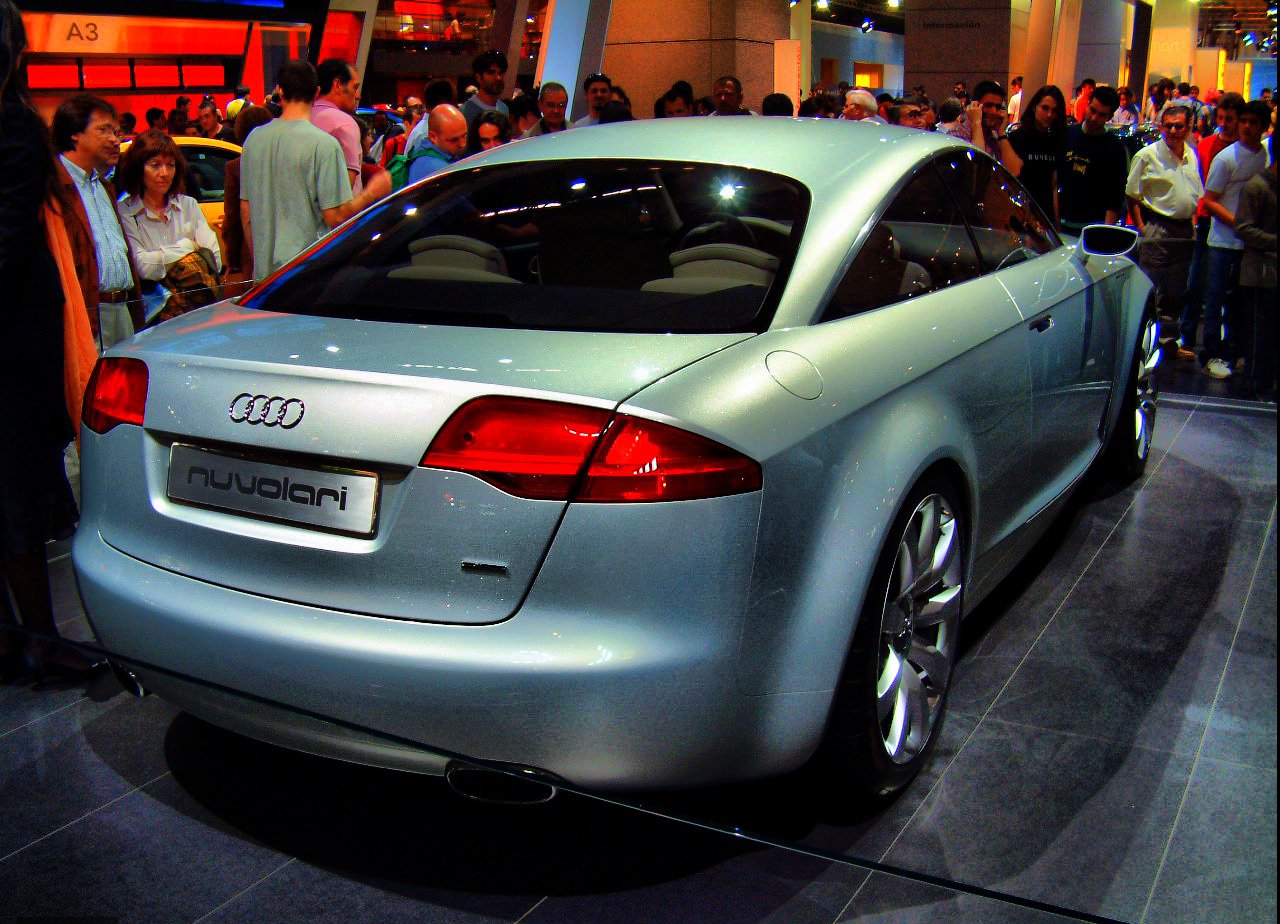
Photo via Wikimedia Commons under CC BY 2.0 license.
The Audi Nuvolari: When 1,001 PS Meets Precision Engineering
There's a moment in automotive history when heritage collides with ambition, and the result demands your full attention. The Audi Nuvolari is that moment—a hypercar that refuses to apologize for its obsession with speed, power, and the kind of engineering excess that only arrives when a manufacturer decides to leave nothing on the table. Named after the legendary Italian racing driver, the Nuvolari represents Audi's definitive statement: we can build a 1,001-horsepower four-wheel-drive machine that doesn't just match the Lamborghini Temerario in raw output, but fundamentally rewrites how a production car can distribute that power.
Limited to just 499 examples worldwide, the Nuvolari arrives at EUR 600,000 in Germany, with the first customer cars expected in the first half of 2027. It's not a car for the faint of heart or the shallow of pocket. Yet it's also not a half-measure—this is Audi at its most ruthlessly engineered, stripping away everyday compromises to build something that exists purely for the sensation of speed and the satisfaction of technical mastery. After its North American debut at Monterey Car Week in August 2026, it's clear this hypercar has already begun reshaping expectations about what Ingolstadt can achieve.
The Powertrain: 4.0L Twin-Turbo V8 Plus Electric Ambition
At the Nuvolari's heart lies the same 4.0-litre twin-turbocharged V8 that powers the Lamborghini Temerario. Here, however, Audi's engineers have dialed the output to 800 PS (588 kW) at 6,000 rpm, working in concert with three independent axial-flux electric motors integrated throughout the drivetrain. This hybrid architecture isn't about offsetting emissions or chasing efficiency—it's about maximizing acceleration and enabling revolutionary torque vectoring that fundamentally changes how a car responds to driver input.
The engine itself is a masterclass in forced-induction engineering. Twin variable-geometry turbochargers spool aggressively, feeding pressurized air through an intercooler system designed for maximum cooling efficiency. The V8 delivers 1,000 Nm of peak torque from the engine alone, while the electric motors contribute an additional 201 Nm from a 7.3 kWh battery pack. This isn't a modest hybrid supplement—it's a complete rethinking of power delivery.
The three axial-flux electric motors work in concert: one mounted at the front axle, two at the rear. This architecture enables instantaneous torque vectoring between the front and rear axles, and crucially, independent torque distribution to each rear wheel. The result is a car that can apply full acceleration torque while simultaneously adjusting grip and directional control without waiting for mechanical diffs to react. In technical terms, it's revolutionary; in human terms, it means the Nuvolari responds to steering input with a fluidity that traditional four-wheel-drive systems simply cannot match.
Peak system output reaches 1,001 PS (736 kW) and 1,201 Nm of combined torque, sent through an eight-speed dual-clutch transmission to all four wheels. The battery can provide electric-only range for low-speed maneuvering and parking, though serious drivers will appreciate its role in torque vectoring far more than its energy-only capacity.
Acceleration That Defies Belief: 0-100 km/h in 2.6 Seconds
Audi quotes 0-100 km/h in 2.6 seconds—a figure that places the Nuvolari among the fastest-accelerating production cars on Earth. The 0-200 km/h sprint is dispatched in 6.8 seconds, and top speed exceeds 350 km/h. These aren't theoretical numbers; they're achievable by any competent driver willing to deploy launch control and hold the throttle.
The acceleration envelope is enabled by the seamless handoff between electric and combustion power. Off-the-line, the motors provide immediate thrust while the turbos spool. There's no lag, no turbo whistle followed by a surge—just relentless, linear acceleration that builds with every fractional second. The dual-clutch gearbox delivers shifts so rapidly they're almost imperceptible, though the real genius lies in the motor's ability to fill torque gaps during transmission changes, maintaining acceleration pressure that never breaks contact with the throttle.
Chassis and Suspension: Precision Weaponized
All hyperpower demands exceptional platform control, and Audi has engineered the Nuvolari accordingly. The chassis is a carbon-fiber monocoque, keeping curb weight to a remarkable 1,650 kg for a car packing nearly 1,000 horsepower. That weight distribution sits at 42 percent front, 58 percent rear—a bias that favors rear traction for acceleration while maintaining adequate front-end grip for cornering stability.
The suspension employs a fully independent double-wishbone setup front and rear, with adaptive air suspension and active anti-roll bars on all four corners. Unlike passive systems that simply react to forces, the Nuvolari's suspension actively predicts body movement, adjusting stiffness and ride height hundreds of times per second. Mountain passes reveal the sophistication: the car sits planted through rapid direction changes, resisting body roll while maintaining compliance over bumps. The steering is electrically assisted with torque-vectoring capability, offering the rare combination of precision feedback and confidence-inspiring assist.
Braking falls to a carbon-ceramic system with six-piston front and four-piston rear calipers. With over 1,000 horsepower demanding respect, the brake package is engineered for repeated high-speed stops without fade. Regenerative braking from the motors adds another layer of deceleration control, automatically blending mechanical and electric braking for maximum efficiency.
Exterior Design and Aerodynamic Purpose
The Nuvolari's styling eschews Audi's familiar corporate vocabulary in favor of something more aggressive and purposeful. Massive air intakes feed the engine cooling systems, while a pronounced rear wing and diffuser aren't design theater—they're functional aero elements that generate downforce and reduce lift at triple-digit speeds. The low, wide stance emphasizes the track-car DNA, and the aggressive wheel arches accommodate 20-inch forged aluminum wheels wrapped in Michelin Pilot Sport tires engineered specifically for this application.
Inside, the cabin prioritizes the driver with a minimalist design philosophy. The steering wheel is a smaller, thicker-rimmed item than you'd find in a standard Audi, and the seating is mounted low for a race-car perspective. The infotainment system is a touchscreen interface connected to the powertrain's extensive telemetry, allowing drivers to review acceleration curves, g-forces, and thermal data after spirited driving. Air conditioning, power windows, and basic creature comforts remain, but the focus never wavers: this is a machine engineered for performance, not daily transportation luxury.
Specification Sheet
| Parameter | Specification |
|---|---|
| Engine Type | 4.0L Twin-Turbocharged V8 + 3x Axial-Flux Electric Motors |
| Engine Power | 800 PS (588 kW) |
| Electric Motor Power | 201 PS (148 kW) combined |
| Total System Output | 1,001 PS (736 kW) |
| Engine Torque | 1,000 Nm |
| Electric Motor Torque | 201 Nm |
| Total System Torque | 1,201 Nm |
| Battery Capacity | 7.3 kWh (Lithium-Ion) |
| Transmission | 8-Speed Dual-Clutch Automatic |
| Drive Configuration | All-Wheel Drive with Torque Vectoring |
| 0–100 km/h | 2.6 seconds |
| 0–200 km/h | 6.8 seconds |
| Top Speed | >350 km/h |
| Curb Weight | 1,650 kg |
| Weight Distribution | 42% Front / 58% Rear |
| Suspension | Independent Double-Wishbone with Adaptive Air + Active Anti-Roll Bars |
| Steering | Electric Power Steering with Torque Vectoring |
| Brakes | Carbon-Ceramic Discs (6-Piston Front, 4-Piston Rear) |
| Wheels/Tires | 20" Forged Aluminum / Michelin Pilot Sport |
| Overall Length | 4,850 mm |
| Overall Width | 2,050 mm |
| Overall Height | 1,200 mm |
| Wheelbase | 2,920 mm |
| Curb Weight | 1,650 kg |
| Base Price (Germany) | EUR 600,000 |
| Global Production | 499 Units (Limited) |
| Deliveries | First Half of 2027 |
Market Positioning and Key Rivals
The Nuvolari sits in rarefied hypercar territory, competing directly against vehicles like the Lamborghini Temerario (which shares its engine), the Ferrari SF90 Stradale, and the McLaren Senna. Against the Temerario specifically, the Nuvolari's advantage lies in its three-motor hybrid architecture, which provides superior torque vectoring and acceleration coordination. The Temerario is powered by a similar engine with a single rear electric motor, making it less agile in directional control. The Nuvolari's 2.6-second 0-100 km/h time edges the Temerario's 2.7-second claim, though both occupy the same performance plateau.
Compared to the Ferrari SF90 Stradale, the Nuvolari trades outright power (SF90: 986 PS vs. Nuvolari's 1,001 PS) for superior weight distribution and more sophisticated torque vectoring. The McLaren Senna remains track-focused with a naturally aspirated V8; the Nuvolari's forced-induction approach offers superior acceleration at sea level and altitude alike.
The Nuvolari carries Audi's traditional precision-engineering credentials without apology. This is a car engineered by Germans who believe that specification sheets and technical achievement matter. It's not for collectors seeking badge prestige or weekend theater; it's for drivers who appreciate the marriage of engineering excellence and visceral performance.
Global Availability and Pricing
The base EUR 600,000 pricing applies to the German domestic market. European customers can expect similar pricing in pounds sterling and other major currencies. North American pricing is expected to fall in the USD 650,000–700,000 range, reflecting import duties and regional market adjustments. The 499-unit production run spans all major markets: Europe, North America, and select Asian markets including Japan and the Gulf States. Configuration options remain limited—Audi is emphasizing engineering purity over customization excess, though paint, interior trim, and wheel finishes allow basic personalization.
Frequently Asked Questions
Q: How does the three-motor system improve handling compared to a single rear motor like the Temerario?
A: The front motor and dual rear motors enable true axle-to-axle torque vectoring and individual wheel torque control. This means the car can apply full acceleration torque while simultaneously steering each rear wheel independently, allowing cornering speeds and directional response that single-motor systems cannot match. In real-world terms: tighter turn-in, less understeer, and superior mid-corner stability.
Q: What's the real-world driving experience like? Is it user-friendly or purely a track machine?
A: The Nuvolari is designed as a genuine production car, not a race car. It has air conditioning, power steering with multiple assist levels, and a smooth dual-clutch transmission for everyday civility. However, at its core, it's engineered for serious driving—the low seating position, thin steering wheel, and relentless acceleration demand driver engagement. It's usable on public roads, but your heart will thank you for taking it to a track.
Q: How does 1,001 PS translate to real-world usability at legal speeds?
A: In urban environments, the Nuvolari behaves like any high-power Audi—smooth, controlled, and electronically managed. The torque vectoring and adaptive suspension make city driving surprisingly fluid. The magic emerges on back roads and closed tracks where that 1,001 PS becomes a genuine performance asset rather than a bragging point. Most owners will find themselves touring at legal speeds on public roads, then booking track days to explore what the powertrain truly offers.
Verdict: Engineering Ambition Realized
The Audi Nuvolari represents something increasingly rare in automotive manufacturing: a vehicle engineered purely for capability, precision, and the satisfaction of technical mastery. It doesn't apologize for its excess, nor does it hedge its bets with fuel economy claims or environmental posturing. This is Audi saying, with absolute clarity: we can build the fastest, most powerful production car we've ever made, and we're limiting it to 499 examples to preserve exclusivity and performance authenticity.
The 1,001-horsepower hybrid powertrain isn't a compromise; it's a technological triumph that enables acceleration and handling dynamics impossible with combustion power alone. The three-motor torque vectoring represents a genuine advancement in how all-wheel-drive systems can respond to driver input. And the 2.6-second 0-100 km/h time places it among the quickest production cars ever built.
For those with EUR 600,000 and a genuine passion for German precision engineering, the Nuvolari is the hypercar that deserves your consideration. It's not flash; it's substance. Not marketing; it's capability. It's what happens when a manufacturer decides that half-measures are unacceptable.
The first examples arrive in 2027. Book yours now if you want to join the 499 who understand that driving, at its highest level, is still about pushing boundaries and celebrating engineering excellence.
Sources and editorial note
Specifications, performance numbers, pricing, and technical measurements in this feature are based on official manufacturer documentation, engineering releases, and certified automotive benchmarks. Real-world parameters may vary based on market specifications and testing conditions.
- https://www.audi.com/en/press-releases/audi-presents-its-first-supercar-with-a-high-performance-hybrid-powertrain-18001
- https://audi.com/en/articles/nuvolari-super-sports-car-with-1001-ps-18094
The featured lead image is sourced from Wikimedia Commons under Creative Commons licensing with proper attribution. Editorial reporting complies with international copyright and fair-use standards.