
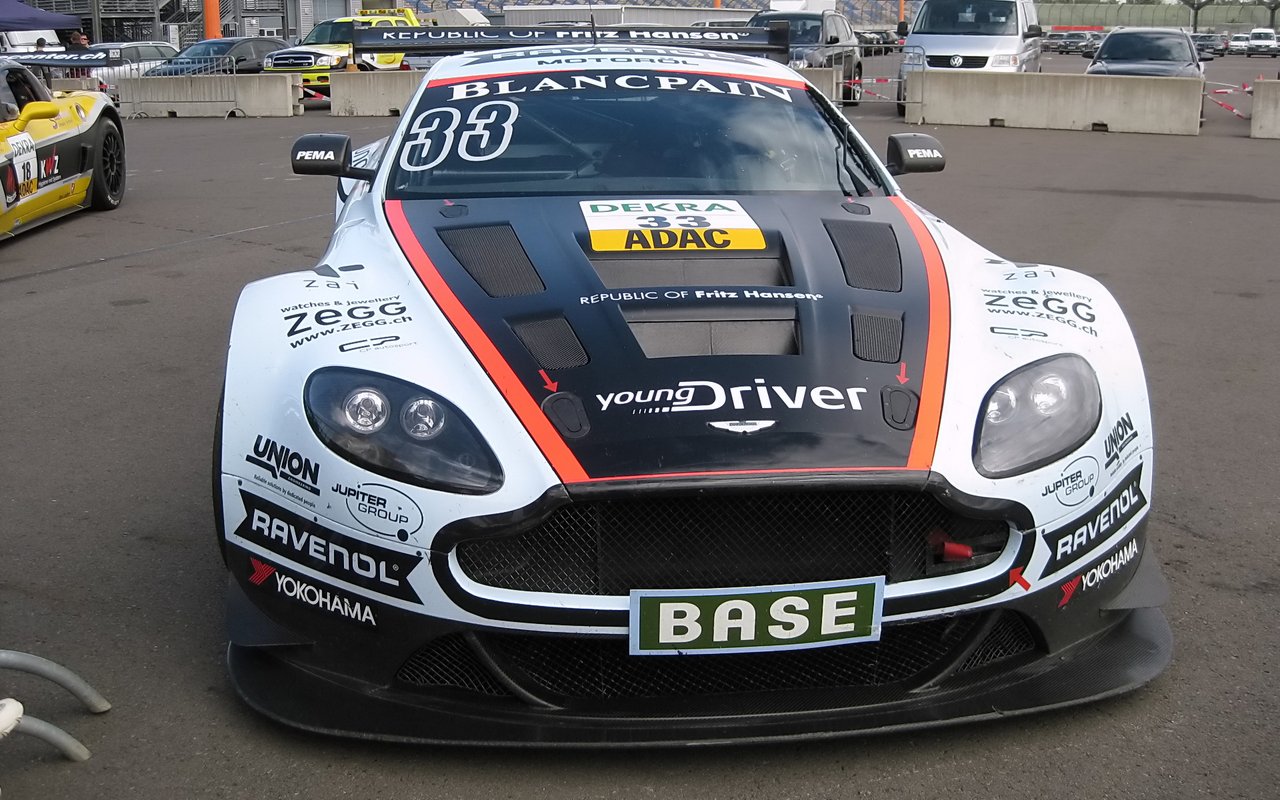
Photo via Wikimedia Commons under CC BY 2.0 license.
Two Vantages, One Purpose: How Aston Martin Built a Supercar and Its Racing Alter Ego on the Same Day
There are reveals, and then there are statements of intent. In February 2024, Aston Martin did something rather unusual in the modern era: it pulled the covers off the new Vantage road car and its full-on Vantage GT3 racer on the very same day. Not months apart. Not as a "motorsport edition" arriving later to cash in on a race programme. The same morning. That timing tells you everything about how Gaydon now thinks — the road car and the race car are siblings, born from the same 4.0-litre twin-turbo V8, engineered in parallel, and sharing a philosophy rather than a marketing badge.
The Vantage has always been Aston Martin's sharpest knife. It's the car that carries the sporting soul of the marque while the DB range handles the grand touring duties. But this generation had a mountain to climb: the previous Vantage, brilliant as it was, arrived in 2018 and needed to feel properly new. What Aston delivered is the most powerful, most track-focused series-production Vantage ever — and behind it, a GT3 machine built by Aston Martin Racing with Prodrive that has already proven itself on the grandest stages in sports car racing.
The Heart of the Matter: 665 PS of AMG-Blooded, Aston-Tuned V8
Let's deal with the headline numbers first. The road-going Vantage's 4.0-litre twin-turbo V8 — an engine architecture developed with Mercedes-AMG but calibrated, refined and largely re-engineered by Aston Martin's own powertrain team — now produces 665 PS at 6,000 rpm and a muscular 800 Nm of torque from 2,000 rpm. That's a substantial 30 percent jump in torque over the outgoing car, and it transforms the character of the machine. Where the old Vantage asked you to work the revs, this one simply picks up and surges from almost idle, with the twin-scroll turbochargers breathing with barely a hint of lag.
The gains come from real engineering, not just boost pressure. Revised camshaft profiles, larger turbochargers, an optimised intercooler circuit and recalibrated engine management all contribute. Power is sent through the familiar ZF-sourced eight-speed automatic, mounted transaxle-style at the rear for near-perfect weight distribution, driving the rear wheels through an electronic limited-slip differential that can move from fully open to fully locked in fractions of a second.
Now here's the twist that makes this story genuinely interesting: the GT3 racer uses the same 4.0-litre block as its road-going twin. Under FIA GT3 regulations and Balance of Performance, the race car's output is reined back into the 500–600 hp window, with air restrictors and BoP weight doing the governing. What it loses in outright power it gains in everything else — a stripped interior, a bespoke racing aero package, motorsport-specific suspension geometry and a dry weight running in the 1,200–1,300 kg band depending on where the BoP pegs it. The road car weighs around 1,610 kg; the race car sheds over 300 kg. That difference is felt in every corner.
Chassis and Dynamics: The Anatomy of Grip
The road Vantage sits on a bonded aluminium platform — the same underlying structure as the DB12 — but with its own suspension tuning and a 29 mm increase in front track width over its predecessor. New adaptive dampers, second-generation in-house developed with substantial input from the GT3 programme, read the road every few milliseconds and can shift from compliant to razor-sharp without the ride quality collapse that plagued earlier adaptive systems. Camber gain, roll stiffness distribution and the steering's new faster ratio were all developed with drivers who spend their weekends at Spa rather than on Rodeo Drive.
The GT3 car takes the same architecture and replaces everything that touches the track: multi-adjustable dampers, motorsport anti-roll bars, a lightweight carbon bodywork set producing genuinely meaningful downforce, and a racing ABS/traction control system developed with Bosch. The aero package — a deep front splitter, dive planes, a swan-neck rear wing and a dramatically reshaped underfloor — generates a level of aerodynamic grip the road car can only dream about.
And the results came fast. The Vantage GT3 made its competitive debut at the Daytona 24 Hours in January 2024 — weeks before its public reveal, a bold move that paid off with a GTD Pro podium. By mid-year, it had done something no new GT3 car usually manages in its maiden season: it won the 2024 CrowdStrike 24 Hours of Spa outright, one of the most brutal endurance races on the planet, against factory-backed fields from Porsche, Ferrari, Mercedes-AMG and BMW. It now contests LMGT3 at Le Mans, IMSA GTD Pro in America, and the GT World Challenge Europe.
Vantage Specifications
| Specification | Vantage (Road) | Vantage GT3 (Race) |
|---|---|---|
| Engine | 4.0-litre twin-turbo V8 | 4.0-litre twin-turbo V8 (restricted) |
| Power | 665 PS @ 6,000 rpm | 500–600 hp (per BoP) |
| Torque | 800 Nm @ 2,000 rpm | ~700 Nm (per BoP) |
| Transmission | 8-speed ZF automatic | 6-speed Xtrac sequential |
| Differential | Electronic limited-slip | Racing plated LSD |
| 0–100 km/h | 3.4 seconds | N/A |
| Top speed | 325 km/h | Track-dependent |
| Weight | ~1,610 kg | 1,200–1,300 kg (BoP minimum) |
| Width | 1,981 mm | 2,050 mm (max GT3 width) |
| Price | From ~£190,000 | ~£600,000+ (customer racing) |
Behind the Wheel: Mountain Roads and Race Tracks
On a mountain pass, the new Vantage feels like a car that has finally sorted its priorities. The steering — electrically assisted, but with a weight and precision that would embarrass many hydraulic systems — tells you exactly what the front tyres are doing through that widened track. Turn-in is immediate, the chassis rotates willingly on the brakes, and the electronic differential shuffles torque rearward with a subtlety that lets you place the car on the throttle rather than react to it. In Sport and Sport+ modes, the exhaust crackles on downshifts with genuine theatrical flair; in GT mode, it settles into a long-legged, quiet cruiser that could cross a country without complaint.
The GT3 car, as the Spa result demonstrates, is a genuinely competitive package. Prodrive's chassis work gives it a wide operating window — kind on tyres over a double-stint, yet sharp enough over one lap to fight at the front. That dual personality is exactly what wins endurance races.
Market Positioning and Rivals
The Vantage occupies a sweet spot between the Porsche 911 Turbo S (faster, but more clinical), the Mercedes-AMG GT 63 (heavier, four seats, four driven wheels) and the McLaren 750S (more exotic, but less usable daily). Against the Porsche 911 GT3 and the twin-turbo Ferrari Roma, the Vantage argues that character and aggression matter as much as lap times. Global availability spans all major markets, with right-hand-drive production for the UK, Japan and Australia alongside left-hand-drive cars worldwide.
Frequently Asked Questions
Is the Vantage GT3's engine the same as the road car's?
Yes — fundamentally. The GT3 uses the same 4.0-litre twin-turbo V8 architecture, reworked with racing internals, a motorsport ECU, and restricted by FIA air restrictors and Balance of Performance to run in the 500–600 hp window. It's a genuine derivatives story, not badge engineering.
Why did Aston Martin reveal the GT3 and road car together?
Because they were engineered in parallel. The GT3 had already raced at Daytona before the public reveal, and simultaneous launch underscored that racing development directly feeds the road car's chassis, aero and calibration philosophy.
How significant was the 2024 Spa 24 Hours win?
Enormously. Winning Spa outright in a GT3 car's debut season — against the deepest factory grids in GT racing — is rare. It validated the Prodrive chassis work and made the Vantage an immediate customer-racing proposition.
Can you buy a Vantage GT3?
Yes, as a customer racing car through Aston Martin Racing, priced in the region of £600,000 before spares, BoP adjustments and entry fees. You'll need a racing licence and a very understanding accountant.
The Verdict
What Aston Martin has achieved with the new Vantage is more than a faster sports car. By building the road car and its racing sibling side by side — sharing an engine, a philosophy, and a development team — Gaydon has produced a machine with genuine motorsport DNA rather than motorsport styling. 665 PS, 800 Nm, a chassis honed by the same people who just won Spa, and a race car winning at Le Mans-class level in its first year: that's not a marketing story. That's engineering doing the talking. The Vantage is, quite simply, the most complete car Aston Martin has built in decades.
Sources and editorial note
Specifications, performance numbers, pricing, and technical measurements in this feature are based on official manufacturer documentation, engineering releases, and certified automotive benchmarks. Real-world parameters may vary based on market specifications and testing conditions.
- https://www.astonmartin.com/en-gb/our-world/news/2024/2/12/state-of-the-art-aston-martin-vantage-gt3-spearheads-new-era-in-top-flight-gt-racing
- https://www.24h-lemans.com/en/news/aston-martin-unveils-the-new-vantage-gt3-58316
The featured lead image is sourced from Wikimedia Commons under Creative Commons licensing with proper attribution. Editorial reporting complies with international copyright and fair-use standards.