
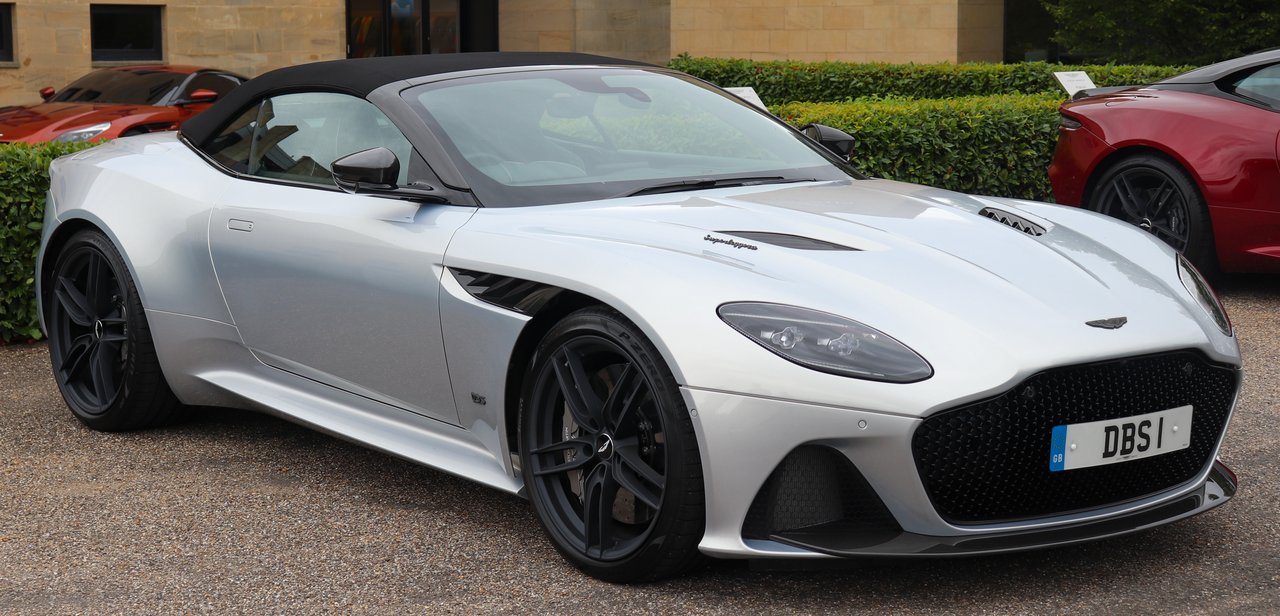
Photo via Wikimedia Commons under CC BY-SA 4.0 license.
Twelve Cylinders, Zero Batteries: The 2026 Aston Martin Vanquish Reclaims the Grand Touring Throne
Gaydon has drawn a definitive line in the sand. At a moment when rival manufacturers are cluttering their engine bays with electric drive units, heavy battery packs, and complex multi-clutch hybrid architectures, the 2026 Aston Martin Vanquish arrives as an unapologetic, front-engine super-GT powered purely by internal combustion. Reviving a fabled nameplate that first debuted under Ian Callum’s pen in 2001, this third-generation flagship preserves the traditional front-midships V12 blueprint while pushing mechanical engineering and chassis kinematics into modern hyper-GT territory.
The stakes could not be higher. Following the focused DB12 and the aggressive Vantage, the Vanquish assumes the mantle of Aston Martin’s ultimate series-production flagship. It does not chase lightweight sports car agility; instead, it refines continent-crushing high-speed capability, devastating cross-country pace, and mechanical theater into a singular grand tourer capable of 214 mph.
Mechanical Anatomy: The 824-HP 5.2-Liter Twin-Turbo V12
Under the reverse-hinged clamshell bonnet sits a heavily re-engineered 5.2-liter 60-degree all-alloy twin-turbo V12. While the displacement matches the unit found in the outgoing DBS 770 Ultimate, chief engineer Roberto Fedeli’s powertrain team redesigned the engine block from the ground up to handle colossal thermal and mechanical loads.
The structural changes run deep. The engine block features reinforced cylinder walls, thicker web sections, and a re-engineered crankcase designed to endure peak cylinder pressures that far exceed those of its predecessor. High-strength forged connecting rods mate to redesigned pistons with optimized crowns, altering the combustion chamber geometry to maximize flame propagation. Overhead, the four-cam cylinder heads incorporate revised intake and exhaust porting, repositioned spark plugs, and high-flow fuel injectors delivering a 10% increase in flow rate to ensure precise atomization under heavy boost.
Forced induction duties are handled by twin reduced-inertia turbochargers. By reducing rotational inertia by 15%, the turbines spool significantly faster across the rev range. Crucially, Aston Martin integrated a proprietary calibration termed Boost Reserve. During part-throttle cruising, when the driver is not demanding full output, the engine management system closes the wastegates and modulates the throttle plate to accumulate pressurized air within the intake plenum. When full load is suddenly requested, that pressurized volume is released instantly into the cylinders, effectively mitigating turbo lag and offering immediate throttle response reminiscent of high-displacement naturally aspirated powerplants.
The result of this thermodynamic overhaul is staggering: 824 hp (835 PS) at 6,500 rpm and 1,000 Nm (738 lb-ft) of torque spanning from 2,500 to 5,000 rpm. Without a single volt of hybrid assistance, the Vanquish sends its monumental reserves strictly to the rear wheels, achieving a terminal velocity of 214 mph (345 km/h).
Chassis Architecture and Suspension Kinematics
Harnessing 1,000 Nm requires an unyielding foundation. The Vanquish is built upon a bespoke bonded extruded aluminum monocoque featuring an 80 mm wheelbase extension ahead of the A-pillar compared to the DB12. This stretch balances the front-to-rear mass distribution and accommodates the long-stroke V12 behind the front axle line, yielding a near-ideal 51:49 front-to-rear balance.
Structural bracing played a pivotal role in chassis development. Aston Martin incorporated a stiffer engine tie-bar across the front strut towers, a beefier under-engine crossmember, and a redesigned rear bulkhead undertray. These structural enhancements deliver a 75% increase in lateral chassis stiffness over the DBS 770 Ultimate. This rigid platform allows the suspension mounting points to remain entirely stable under high cornering loads, preserving suspension geometry without unwanted deflection.
Wheel control is governed by forged aluminum double wishbones up front and an independent multi-link assembly at the rear, managed by cutting-edge Bilstein DTX (Dynamics Technology eXtreme) adaptive dampers. Compared to prior-generation adaptive dampers, the DTX units feature bespoke internal valving that yields a 500% increase in damping force variation bandwidth. This wide operational window allows chassis calibrations to transition seamlessly from compliant road absorption in GT mode to ultra-stiff, track-focused roll control in Sport and Sport+ modes.
Deceleration is handled by standard Carbon Ceramic Brakes (CCB). Massive 410 mm ventilated carbon-ceramic rotors up front are clamped by six-piston monobloc calipers, while 360 mm discs reside at the rear. Beyond resisting thermal fade up to 800 degrees Celsius, the ceramic braking setup sheds 27 kg of unsprung mass compared to traditional cast-iron equivalents, sharply improving steering response and wheel articulation over uneven asphalt.
Drivetrain and Aerodynamic Mastery: The Kamm Tail
Power is routed from the front-mid V12 via a rigid, lightweight carbon-fiber propeller shaft housed inside an extruded aluminum torque tube, spinning directly into a rear-mounted ZF 8-speed automatic transaxle. The rear transaxle layout integrates an electronic limited-slip differential (E-diff). Capable of transitioning from fully open to 100% lock in just 135 milliseconds, the E-diff interfaces with a sophisticated six-axis Inertial Measurement Unit (IMU). This system predicts vehicle yaw and slip angles, pre-loading the clutches to stabilize corner exits under full throttle.
Aerodynamic efficiency is achieved without compromising the clean, sweeping profile of a classic British grand tourer. The exterior architecture abandons active deployable wings in favor of precise surface management. The defining aesthetic and functional element is the bold Kamm tail—a tribute to Wunibald Kamm’s aerodynamic principles. The rear end is cleanly chopped off and dominated by a distinct "floating shield" panel flanked by seven vertical LED light blades on either side.
This floating shield creates a crisp air-separation edge that detaches airflow cleanly from the rear bodywork, reducing drag-inducing low-pressure turbulence behind the car. Working in conjunction with a massive carbon-fiber rear diffuser and underbody venturis, the Kamm tail generates stabilizing high-speed downforce without generating parasitic drag, ensuring total chassis composure at speeds surpassing 200 mph.
Technical Specifications
| Specification Parameter | Aston Martin Vanquish (2025–2026) |
|---|---|
| Engine Type | 5.2-liter (5,204 cc) 60° Twin-Turbocharged V12, 48-Valve DOHC |
| Internal Code | AE31 (Significantly Redesigned Block & Heads) |
| Peak Power Output | 824 hp (835 PS / 614 kW) @ 6,500 rpm |
| Peak Torque | 1,000 Nm (738 lb-ft) @ 2,500–5,000 rpm |
| Transmission | Rear-mounted ZF 8-speed automatic transaxle with integrated E-diff |
| Drive Configuration | Front-mid engine, rear-wheel drive (carbon torque tube) |
| Acceleration (0–100 km/h / 0–62 mph) | 3.3 seconds (0–60 mph in 3.2 seconds) |
| Top Speed | 214 mph (345 km/h) |
| Dry Weight / Curb Weight (DIN) | 1,775 kg (3,913 lbs) dry / ~1,910 kg (4,210 lbs) DIN curb |
| Wheelbase / Length / Width / Height | 2,885 mm / 4,850 mm / 2,044 mm (excl. mirrors) / 1,290 mm |
| Braking Hardware | Carbon Ceramic: 410 mm front (6-piston), 360 mm rear (4-piston) |
| Tires | Bespoke Pirelli P Zero: 275/35ZR21 (Front), 325/30ZR21 (Rear) |
| Base Price (MSRP) | Approximately $420,000 USD / £330,000 GBP |
Road, Mountain Pass, and High-Speed Dynamics
Point the long, sculptural nose of the Vanquish onto an unrestricted German Autobahn or a sweeping alpine pass, and its mechanical character reveals itself instantly. Unlike the peaky, stratospheric-revving naturally aspirated delivery of Maranello’s latest machinery, the Vanquish relies on relentless, hydraulic-grade low-end torque. Burying the throttle in third gear produces a sustained tidal push; the mid-range shove from 2,500 rpm upwards pins occupants back as the digital speed readout skips numbers in double-digit increments.
The steering is quick, geared at a fixed 13.0:1 ratio rather than an artificial variable-rack arrangement, delivering intuitive off-center weighting and genuine road surface texture through the rim. Through fast, third-gear sweepers, the 75% increase in front-end lateral stiffness is immediately perceptible. The front axle bites hard on turn-in with virtually none of the heavy-nosed reluctance historically associated with big V12 grand tourers. The bespoke Pirelli P Zero tires—featuring noise-canceling foam inserts for refined high-speed cruising—offer extraordinary lateral grip.
When transitioning through chassis-unsettling mid-corner compressions, the Bilstein DTX dampers demonstrate their superiority. In Sport mode, vertical wheel travel is reined in with a single rebound stroke, maintaining tire contact patches flat against the tarmac. Body lean is checked cleanly without inducing high-frequency cabin harshness. Feed in throttle past the apex, and the E-diff locks progressively, transforming 1,000 Nm of twist into straight-line propulsion rather than smoking rubber, accompanied by the sonorous baritone roar of the un-muffled V12 exhaust system.
Market Context, Rivals, and Global Availability
The 2026 Vanquish sits atop Aston Martin’s front-engine hierarchy, positioned directly against the newly minted Ferrari 12Cilindri and the Bentley Continental GT Speed. The philosophical contrast between these machines is stark:
- Ferrari 12Cilindri: Adheres to pure atmospheric induction, revving to 9,500 rpm and producing 819 hp, but trades away low-end muscle with only 678 Nm of torque. It is sharper and lighter, but less suited to effortless high-speed grand touring.
- Bentley Continental GT Speed: Has abandoned the W12 engine entirely in favor of a plug-in hybrid twin-turbo V8 producing 771 hp and 1,000 Nm. While rapid and refined, the hybrid Bentley carries a significant weight penalty, cresting 2,450 kg on the scales.
By retaining a pure twin-turbo V12 while keeping dry weight at a manageable 1,775 kg, the Vanquish hits a sweet spot of physical engineering purity. Aston Martin has confirmed that global production of the Vanquish will be strictly limited to fewer than 1,000 units per year across worldwide markets. Initial customer deliveries are scheduled to commence in late 2024 and roll through 2025, with base pricing starting around $420,000 in North America and £330,000 in the United Kingdom before bespoke Q by Aston Martin personalization.
Frequently Asked Questions
Why did Aston Martin decline to add hybrid assistance to the new Vanquish?
Hybrid powertrains introduce substantial mass via electric motors, inverters, and high-voltage traction batteries—often adding between 200 kg and 350 kg to a chassis. Aston Martin’s vehicle dynamics team determined that a re-engineered, high-boost twin-turbo V12 generating 1,000 Nm provided more than enough low-end torque, preserving an authentic grand touring power-to-weight ratio and purer vehicle dynamics without the penalties of hybrid packaging.
How does the "Boost Reserve" system eliminate turbo lag in real-world driving?
Traditional turbo lag occurs when exhaust energy drops under partial throttle, causing turbine speeds to fall. The Vanquish’s Boost Reserve function monitors throttle position and pre-spools the turbochargers during steady-state cruising by maintaining closed wastegates and partially throttling the intake air. This creates an engineered pressure reservoir behind the throttle valve. The moment the driver demands sudden acceleration, the throttle opens and instant boost floods the combustion chambers, providing immediate transient response.
What mechanical hardware differentiates the Vanquish from the DB12?
While sharing a corporate bonded aluminum architectural philosophy, the Vanquish features an 80 mm longer wheelbase ahead of the front firewall, a bespoke carbon-fiber torque tube, a 75% stiffer front-end structural brace assembly, standard carbon-ceramic brakes, and unique Bilstein DTX adaptive damper software tuning. Most notably, the DB12 uses a 4.0-liter Mercedes-AMG sourced twin-turbo V8, whereas the Vanquish features Gaydon’s proprietary 5.2-liter twin-turbo V12 producing 824 hp.
The Maseko Verdict
The 2026 Aston Martin Vanquish represents an uncompromising masterstroke of automotive mechanical engineering. In an era where vehicle character is frequently diluted by electric motors and synthetic sound actuators, this front-engine British grand tourer relies on immaculate structural rigidity, sophisticated damper physics, and 824 horsepower of pure twelve-cylinder combustion fury. It stands as a glorious, defiant triumph of internal combustion engineering that firmly asserts Aston Martin’s dominance at the pinnacle of luxury super-GTs.
Sources and editorial note
Specifications, performance numbers, pricing, and technical measurements in this feature are based on official manufacturer documentation, engineering releases, and certified automotive benchmarks. Real-world parameters may vary based on market specifications and testing conditions.
The featured lead image is sourced from Wikimedia Commons under Creative Commons licensing with proper attribution. Editorial reporting complies with international copyright and fair-use standards.