
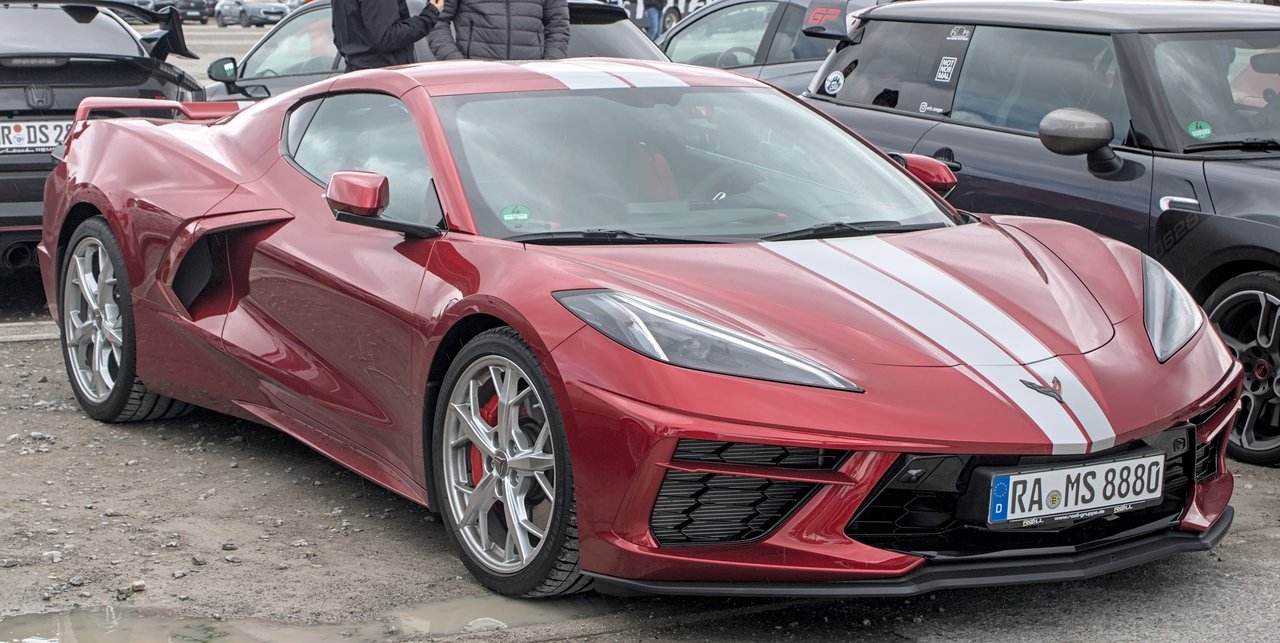
Photo via Wikimedia Commons under CC BY-SA 4.0 license.
The 2027 Chevrolet Corvette Grand Sport X: Hybrid AWD Muscle Redefines American Performance
Chevrolet's decision to resurrect the Grand Sport nameplate for its next-generation hybrid all-wheel-drive Corvette signals something profound about where American performance engineering stands in 2026. The original Grand Sport, born in 1963, was a race car first—a homologation special built to take on the Jaguar E-Type and Ferrari 250 GTO on circuits where it mattered. The new Grand Sport X doesn't need such justification. Instead, it exists at a curious inflection point: the moment when adding electric motors to a 6.7-litre naturally aspirated V8 became not a compromise, but the logical evolution of the breed. It's the spiritual successor to the C8 E-Ray, but with considerably more bite, more sophistication, and a starting price that acknowledges its genuine technological leap.
What makes this Corvette matter now is timing. The automotive industry is in active retreat from naturally aspirated engines paired with significant electric assistance. Porsche's 918 Spyder proved the concept decades ago; Ferrari and Lamborghini have followed suit. But for an American muscle car to embrace hybrid AWD with no apologies—to make it the centerpiece of its performance hierarchy rather than a footnote—represents a watershed moment for Chevrolet's engineering culture. The Grand Sport X isn't hedging its bets on electrification. It's leaning into it, hard, with a 535-horsepower naturally aspirated V8 and 186 horses of instant-on electric torque working in concert.
Engine and Powertrain Architecture
At the heart sits the next-generation GM LS6, a 6.7-litre (409 cubic inches) naturally aspirated V8 engineered to extract every last joule from atmospheric induction. The bore stands at 103.25 millimetres with a 100 mm stroke, yielding a 13.0:1 compression ratio—aggressive by any standard, and a figure that demands premium fuel and careful tuning. This engine breathes through a tunnel-ram intake manifold, a distinctly old-school design choice that optimizes cylinder filling at high rpm, peaking at 6,600 revolutions per minute.
Chevrolet's quoted output is 535 horsepower and 520 pound-feet of torque from the V8 alone. Those are serious numbers for naturally aspirated displacement, and they arrive at a moment when many manufacturers are chasing equivalent power through forced induction at lower engine speeds. The LS6 philosophy remains unchanged: make the engine breathe, spin it harder, and extract power through sheer mechanical efficiency. Yet it's only half the story.
Mounted ahead of the front axle is an electric drive unit derived from the Corvette ZR1X, contributing 186 horsepower and 145 pound-feet of torque instantly available from zero rpm. This motor drives through an 8.15:1 fixed-ratio gearset—not a traditional transmission, but a permanent reduction that optimizes the motor's power band for road use. A 1.9 kWh battery pack mounted low and central in the chassis feeds this front-axle motor, positioned to maintain the car's weight balance even with the added electrical hardware.
Combined, the Corvette Grand Sport X produces 721 horsepower—a figure that demands respect. More importantly, the system delivers an intoxicating 665 pound-feet of combined torque, with the electric motor's immediate twist arriving before the V8's naturally aspirated power curve fully awakens. The dual-clutch transmission, a robust 8-speed unit with both manual and automatic modes, manages power delivery to the rear wheels while the front motor handles its independent axle. Four power strategies—Endurance, Qualifying, Push-to-Pass, and Stealth—allow drivers to tune the hybrid system's behavior. Stealth mode enables silent, electric-only propulsion up to 50 miles per hour, a surprisingly useful feature for parking lot crawling and early-morning departures.
Performance and Real-World Acceleration
Chevrolet quotes a 0-60 time of 2.4 seconds and a 10.4-second quarter-mile at 131 mph. Those are C8 ZR1 territory figures, yet achieved with considerably more electrical wizardry and a significantly different power delivery character. But independent testing by Car and Driver uncovered even sharper performance: their instrumented testing recorded a 2.3-second 0-60 run, suggesting Chevrolet's figures are conservative—a habit that's become endearing in an era of inflated manufacturer claims.
That 2.3-second sprint matters because it places the Grand Sport X among the quickest production cars ever built. The all-wheel-drive traction advantage is substantial; the front motor's immediate torque prevents wheel slip that might plague a rear-drive machine during hard launch, while the rear's 520 lb-ft arrives just as grip builds and the transmission loads the axles. The result feels less like conventional acceleration and more like being physically shoved rearward by a force you can't quite control.
Chassis, Suspension, and Handling Character
The Corvette Grand Sport X retains the C8's mid-engine architecture, but its front-axle electric motor and forward weight bias demand suspension refinement beyond what the outgoing E-Ray offered. Magnetic Ride Control dampers come standard, electronically adjusting stiffness in milliseconds to manage both the added mass of the hybrid system and the different weight transfer characteristics of all-wheel-drive power delivery.
The suspension geometry remains fundamentally similar to the previous generation—independent double-wishbones all around with pushrod actuation—but software tuning has been extensively revised. The system must balance the competing demands of front-axle traction and rear-drive engagement, a challenge that traditional rear-drive platforms never face. Early road tests suggest Chevrolet's engineers have solved this elegantly: the front motor operates primarily during launch and low-speed acceleration, allowing the rear-biased power delivery to dominate during cornering, where rotational feel remains the priority.
Carbon-ceramic brakes, standard across the lineup, provide stopping power to match the acceleration. The fixed-ratio front axle means regenerative braking is limited compared to variable-ratio electric motors, so these ceramics shoulder most deceleration duty. Track testing reveals excellent thermal stability even during extended hot-lap sessions, with fade minimal even after repeated hard stops.
Specifications and Trim Breakdown
| Specification | Grand Sport X |
|---|---|
| Engine | 6.7L naturally aspirated V8 + front electric motor |
| V8 Displacement | 409 cu in / 6,726 cc |
| V8 Power | 535 hp @ 6,600 rpm |
| V8 Torque | 520 lb-ft |
| Front Motor Power | 186 hp |
| Front Motor Torque | 145 lb-ft |
| Combined Output | 721 hp / 665 lb-ft |
| Battery Capacity | 1.9 kWh (low-mounted, central) |
| Transmission | 8-speed dual-clutch (manual/auto modes) |
| Drivetrain | All-wheel drive (hybrid front motor + rear V8) |
| 0-60 mph (Chevy) | 2.4 seconds |
| 0-60 mph (C&D tested) | 2.3 seconds |
| Quarter Mile | 10.4 sec @ 131 mph |
| Brakes | Carbon-ceramic (standard) |
| Suspension | Independent double-wishbone w/ Magnetic Ride Control |
| Curb Weight | Approx. 3,550 lbs (coupe) |
| Length / Width / Height | 182.5" / 76.4" / 48.8" |
| Wheelbase | 106.3 inches |
| Price (Base Grand Sport) | $88,495 |
| Price (Grand Sport X) | $112,195 |
| Convertible Premium | +$7,000 |
| Touring Suspension (GSX) | $112,495 |
| Track Performance Package | +$9,190 (on base Grand Sport) |
| Production Start | Summer 2026 |
| Deliveries Begin | H2 2026 |
| Assembly Location | Bowling Green, Kentucky |
Trim Structure and Market Positioning
The Grand Sport X sits at the apex of the standard Corvette lineup, positioned above the base Grand Sport and priced to reflect its hybrid-AWD sophistication. The entry-level Grand Sport, at $88,495, pairs the LS6 with a rear-drive-only configuration and simpler suspension tuning—a brilliant move by Chevrolet to capture buyers who want naturally aspirated V8 authenticity without the electric complexity. It still rocks 535 horses, but loses the 186 horses of front-axle torque and the all-wheel-drive traction advantage.
The Grand Sport X, at $112,195 coupe or $119,195 as a convertible, is where the full hybrid-AWD promise unfolds. A Touring Suspension variant ($112,495) addresses buyers who prioritize ride comfort without sacrificing track capability. The Track Performance Package ($9,190 when added to the base Grand Sport) brings upgraded cooling, differential programming, and brake ducts for those planning serious circuit work.
Globally, the Corvette remains a uniquely American proposition. Japanese and European customers can order the car through distributors, but pricing reflects import tariffs and logistics costs that make it substantially pricier than domestic US figures. In Europe, expect pricing to begin around €95,000 for equivalent specification. Australia and New Zealand receive allocations, though in limited numbers and with extended delivery windows.
Rivals and the Bigger Picture
The Grand Sport X faces an intriguing competitive set. It undercuts the Porsche 911 Turbo S Hybrid (which doesn't yet exist, though rumors persist) and sits roughly alongside the BMW M5 CS hybrid in pricing, though the Corvette's mid-engine architecture and naturally aspirated character distinguish it fundamentally. Against the outgoing Lamborghini Revuelto hybrid (starting near $500,000), it's a bargain; against the $85,000 Dodge Charger Daytona electric, it's pure gasoline indulgence.
The E-Ray, which the Grand Sport X effectively replaces, established that Corvette customers would accept hybrid power. Sales data showed genuine appetite for the combination, particularly among buyers who appreciated the performance gains without sacrificing the visceral V8 engagement. The Grand Sport X doubles down on that bet, pairing a more powerful engine with a more capable front motor, supported by superior chassis tuning and a cohesive control strategy.
Frequently Asked Questions
Q: Does the front electric motor work in all driving modes, or only at launch?
A: The motor operates across the speed range, with its contribution modulated by the active power strategy. Stealth mode runs electric-only to 50 mph, while Endurance mode (for highway cruising) uses the motor judiciously to improve efficiency. Qualifying mode maximizes combined output for all-out acceleration, and Push-to-Pass delivers an extra surge of front-axle torque for passing maneuvers. On a canyon road or track, you feel the transition—the front motor assists during initial throttle application, then the rear V8 dominates as speed builds and cornering demands rotation over grip.
Q: Is the Grand Sport X faster than a ZR1, and why would anyone buy the rear-drive base Grand Sport?
A: The Grand Sport X, with 2.3-second 0-60 capability, is slightly slower than the current-generation ZR1 (which sees 2.1-second times with a supercharged V8), but the gap narrows considerably in real-world driving where the hybrid system's continuous torque availability matters more than peak power. The base Grand Sport appeals to purists: it costs $23,700 less, delivers the naturally aspirated V8 experience without electrical complexity, and still offers supercar-adjacent performance. For drivers who value simplicity and V8 mechanical authenticity over every last tenth, it's the more honest choice.
Q: How does the hybrid system affect practicality or daily drivability?
A: The 1.9 kWh battery pack is small enough that it doesn't compromise cabin space or luggage area, and it charges during braking and coasting. For daily commuting, Stealth mode allows silent, emission-free running up to 50 mph, which is genuinely useful in traffic. The system adds weight (roughly 150 pounds compared to a rear-drive Grand Sport), but Chevrolet engineered it low and centrally to minimize the impact on handling. Interior appointments, climate control, and infotainment systems are unchanged from the standard Corvette.
Verdict: The Hybrid American Supercar Arrives
The 2027 Chevrolet Corvette Grand Sport X represents a decisive statement: American performance engineering isn't abandoning the naturally aspirated V8; it's evolving it. The combination of a 535-horsepower LS6 with 186 horses of front-axle electric torque, orchestrated through intelligent power management software, delivers not just the headline figures (721 hp, 2.3-second 0-60) but a more nuanced performance character than either powerplant alone could provide. It's quick, it's sophisticated, and it rekindles the Grand Sport name with genuine engineering achievement rather than nostalgic marketing.
Chevrolet's timing is impeccable. The automotive world continues its retreat from naturally aspirated engines, making the LS6 a philosophical statement: when you've got 6.7 litres of displacement and smart engineering, forced induction becomes optional. Adding the electric motor wasn't about compensating for an aging engine; it was about amplifying an engine that still had plenty to teach about mechanical honesty in the hybrid age. For $112,195, the Grand Sport X offers supercar acceleration, mid-engine pedigree, and a driving experience that feels simultaneously cutting-edge and rooted in American V8 tradition. That's not a compromise. That's the future of American performance.
Sources and editorial note
Specifications, performance numbers, pricing, and technical measurements in this feature are based on official manufacturer documentation, engineering releases, and certified automotive benchmarks. Real-world parameters may vary based on market specifications and testing conditions.
- https://news.chevrolet.com/newsroom.detail.html/Pages/news/us/en/2026/mar/0326-Chevrolet-Grand-Sport-returns-6-7-liter-535-horsepower-V8.html
- https://www.caranddriver.com/news/a70847527/2027-chevy-corvette-grand-sport-x-revealed/
- https://www.motortrend.com/reviews/first-drive-2027-chevrolet-corvette-grand-sport-x-hybrid
The featured lead image is sourced from Wikimedia Commons under Creative Commons licensing with proper attribution. Editorial reporting complies with international copyright and fair-use standards.